
AeroGenie — Seu copiloto inteligente.

Tendências
Categories
Airbus and Boeing Order Totals for 2025 Compared
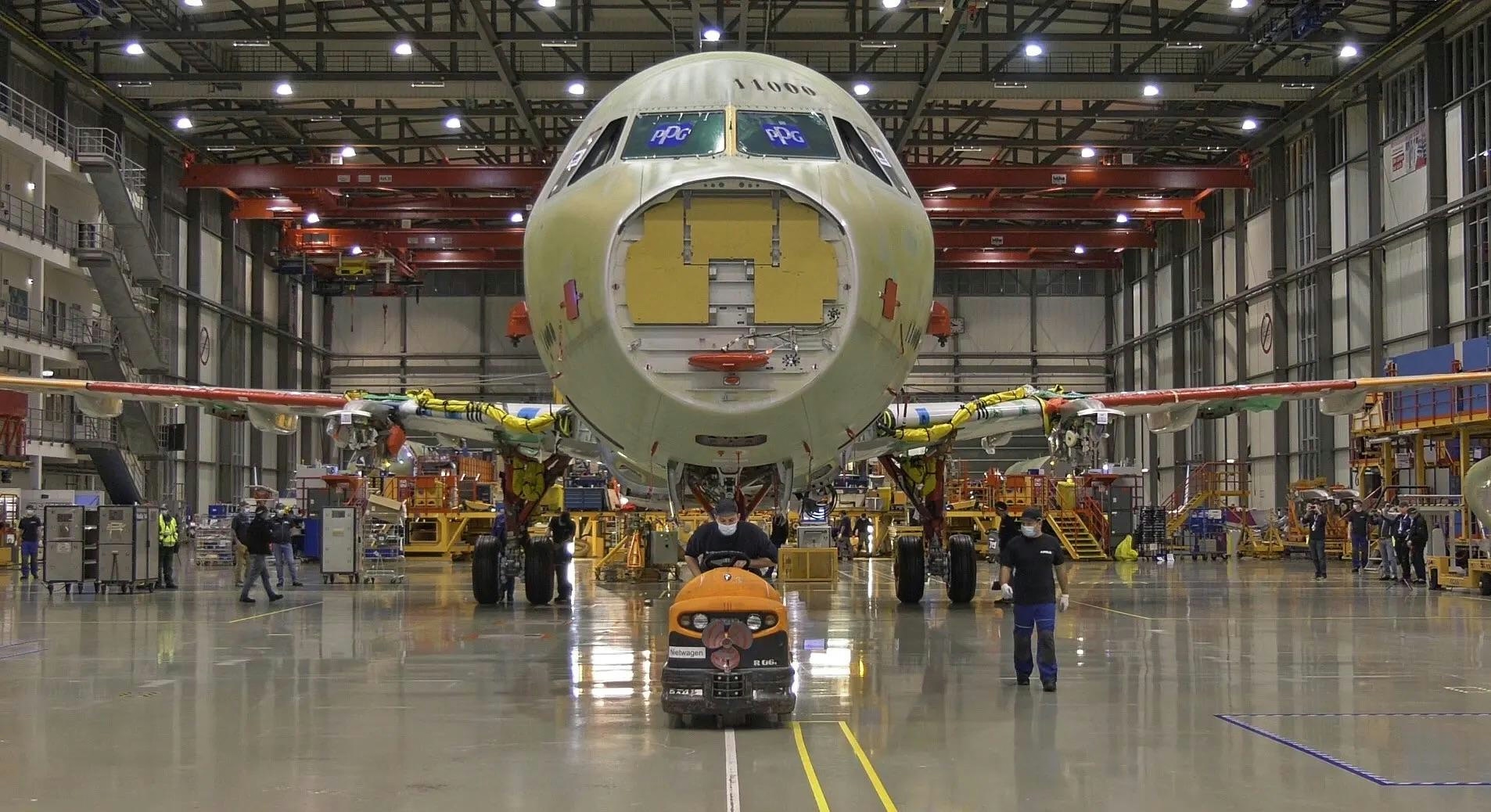
Airbus and Boeing Order Totals for 2025 Compared
The longstanding rivalry between Boeing and Airbus continues to be one of the most significant in the global aerospace industry. Since its establishment in 1970, Airbus has steadily narrowed the gap with its American counterpart, frequently surpassing Boeing in market share and financial performance. Both companies now offer highly competitive product portfolios, particularly in the single-aisle and widebody aircraft segments.
Narrowbody Market: A220 and A320neo Versus 737 MAX
In the narrowbody sector, Airbus competes with its A220 series (A220-100 and A220-300) and the A320neo family (A319neo, A320neo, A321neo), while Boeing counters with the 737 MAX series (MAX 7, 8, 9, and 10). The A220, originally developed by Bombardier as the C Series before its acquisition by Airbus in 2018, has encountered challenges in 2025. Production cost concerns and persistent reliability issues with its Pratt & Whitney GTF engines have led to several groundings and retirements, which have overshadowed new sales.
Despite these difficulties, Airbus secured a notable order in June when LOT Polish Airlines placed its first-ever order with the manufacturer, acquiring 20 A220-100s and 20 A220-300s, with options for an additional 44 aircraft. This 40-aircraft deal was the only A220 order recorded in 2025 and represented a significant victory for Airbus, as LOT’s A220s will replace older Embraer E-Jets. Nevertheless, the Embraer E2 family outpaced the A220 in new orders during the year.
Boeing does not offer a direct competitor to the A220, with its smallest 737 MAX 7 more closely aligned with the A319neo. Consequently, Airbus leads the small narrowbody category with 40 new orders, while Boeing recorded none.
Large Narrowbodies: A320neo Family and 737 MAX
The A320neo family remains a strong performer for Airbus, securing 504 new orders in 2025, including 402 for the A321neo from 11 disclosed customers. This sustained demand has helped Airbus maintain a competitive position in the large narrowbody market.
However, November 2025 witnessed a shift in momentum. Boeing secured 149 firm orders, surpassing Airbus’s 75 for the month and signaling a robust market position as the year draws to a close. This surge was driven by strong demand for the 787 Dreamliner and the strategic timing of orders, influenced in part by ongoing trade negotiations. Boeing’s stock reflected this positive trend, rising 1.2% for the week ending December 12, buoyed by its integration with Spirit AeroSystems and increased FAA scrutiny over the 737 MAX 10.
Widebody Market and Year-End Outlook
In the widebody segment, Airbus offers the A330neo and A350 XWB families, while Boeing’s lineup includes the 777X, 777F, and 787 Dreamliner. Both manufacturers have experienced steady demand, with Boeing’s 787 standing out as a particular highlight in 2025.
Despite Airbus’s strong performance throughout the year, Airbus CEO Guillaume Faury acknowledged that Boeing may ultimately lead the annual order race for 2025, owing to the late-year surge in orders and favorable market dynamics.

Jeju Island Introduces Air Taxis to Enhance Tourism and Reduce Emissions

Hillary Scholten Advances Bipartisan Aviation Supply Chain Digitization Act in House Committee

Delta’s Pilot Scheduling Software Disrupts Airline Operations

FTAI Aviation Shares Rise Amid Market Gains

Air China Orders 60 Airbus A320neo Jets in Year-End Deal
Lockheed Martin’s X-62A VISTA Advances AI in Fighter Jet Flight

MTU Aero Engines and the Future of Aviation
Jetaire Group Obtains Global Approvals for INVICTA Flammability Reduction Technology on Airbus and Boeing Aircraft

MTU Aero Engines: From Steady Performer to Volatile Stock