AeroGenie — ваш интеллектуальный второй пилот.

В тренде
Categories
Airbus CEO Acknowledges Boeing Surpassing Orders for First Time in Six Years
Airbus CEO Acknowledges Boeing Surpassing Orders for the First Time in Six Years
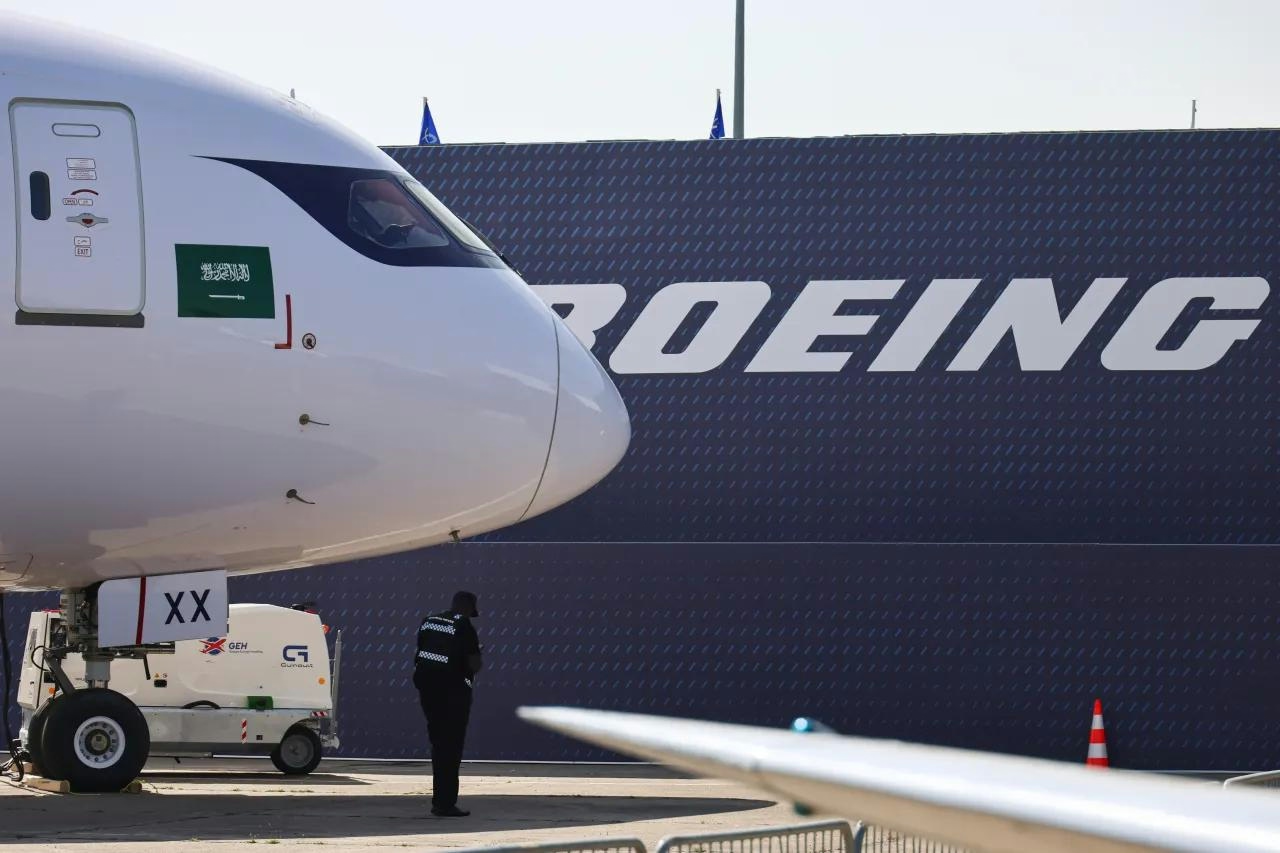
Boeing has overtaken Airbus in aircraft orders for the first time in six years, a development confirmed by Airbus CEO Guillaume Faury amid a challenging period for the European manufacturer. This surge in Boeing’s orders coincides with a global trend of countries seeking to reduce trade deficits with the United States, where high-value airplane purchases have become a strategic tool in trade negotiations.
Trade Dynamics and Order Shifts
In an interview with France Inter radio, Faury acknowledged that Airbus had maintained a lead in orders over the past five years, but this year marks a notable reversal. He attributed Boeing’s recent success in part to U.S. trade policies, stating that “they have been helped by the American President as part of tariff negotiations with several countries, where plane orders became part of the resolution of trade disputes.” This suggests that Boeing’s order book has benefited from broader geopolitical and economic factors beyond pure market demand.
According to Reuters, Boeing’s total orders surpassed 1,000 as of November, more than doubling Airbus’s 11-month total of 427. Boeing’s November alone saw 74 orders for its 777X wide-body aircraft and 30 for its 787 model. This momentum contrasts with Airbus’s ongoing industrial challenges, including a significant software recall and quality issues involving metal panels on its A320 jets. These problems have resulted in the largest recall in Airbus’s history and have contributed to a notable decline in its share price.
Airbus’s Response and Market Position
Despite these setbacks, Airbus secured a substantial $24 billion contract for 150 jets from flydubai, demonstrating sustained demand for its aircraft. The company is currently evaluating the full impact of its quality issues on year-end deliveries and faces considerable pressure to meet its annual production target. To achieve its 2025 goal of delivering 790 aircraft, Airbus must complete 133 jet deliveries in December.
In terms of actual deliveries, Airbus continues to outperform Boeing. In November, Airbus delivered 72 jets, while Boeing’s deliveries declined by 17% to 44 planes. However, industry sentiment appears to be shifting. Willie Walsh, Director General of the International Air Transport Association (IATA), told Reuters that airlines currently express greater confidence in Boeing’s ability to meet delivery commitments compared to Airbus.
Boeing’s Challenges and Outlook
Boeing itself has encountered difficulties. The company’s stock price fell by 6% in November, marking a third consecutive monthly decline, following a third-quarter loss partly linked to delays in the 777X program. Boeing recorded a $4.9 billion pre-tax charge due to these delays and now anticipates delivering the 777X in 2027. Despite these setbacks, Boeing plans to increase deliveries of its best-selling 737 Max and widebody aircraft in the coming year.
While Airbus maintains a lead in overall backlog and deliveries, the recent shift in order momentum underscores the competitive and volatile nature of the global aerospace industry. Both manufacturers continue to navigate supply chain disruptions and evolving market dynamics as they vie for dominance in a rapidly changing environment.
SMBC Aviation Capital Signs Agreement for 737 MAX 9 with United
AerFin Acquires CFM56-5B PIP Engines for Teardown

xCelle Asia Expands APAC Nacelle Support Network
Boeing Shares Fall 0.8% Amid DHS 737 Contract and Airbus Competition

ExecuJet Malaysia Gains EASA and FAA Certifications to Enhance MRO Services
Italy’s ITA Airways Adopts Iris Technology to Enhance Flight Efficiency and Sustainability
Airbus Shares Face Volatility Amid Market Uncertainty

Parachutists Review Software Following Jumper Snag Incident on Plane
NASA Demonstrates Simulation Platform for Urban Air Mobility