
Trasforma le intuizioni dell’IA in azioni concrete

Tendenze
Categories
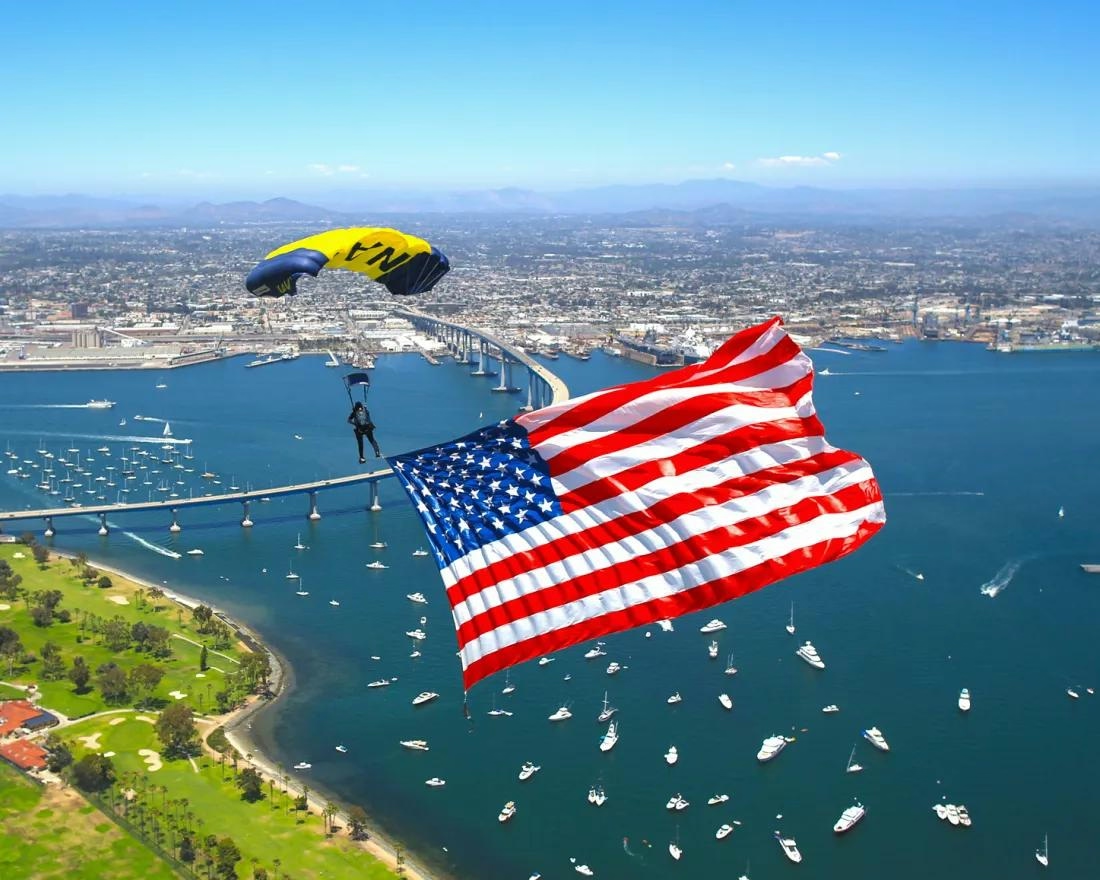
A Parachutist Is Descending Ahead
A Parachutist Is Descending Ahead
On June 15, 2023, a German-registered Cessna TU206G Stationair crashed during landing at Denmark’s Aversi private airfield. The aircraft, bearing the registration D-EPRR, had undergone extensive modifications over its operational life. Originally equipped with a piston engine, it was first converted to a turboprop configuration using a Rolls Royce 250 turboshaft by Soloy Aviation Solutions. Subsequently, Turbine Conversion Ltd upgraded the aircraft further, fitting it with a five-blade MT-Propeller and a Pratt & Whitney PT6 engine. These modifications introduced new operational complexities, particularly due to the PT6 engine’s slower power response compared to traditional piston engines—a critical consideration for pilots transitioning to turbine-powered aircraft.
Flight Details and Training Scenario
The flight involved two crew members: a highly experienced flight examiner with 22,500 flight hours, including 390 on this aircraft type, and a commercial pilot with 950 hours, primarily on piston aircraft, who was also an accomplished parachutist. The mission was a Visual Flight Rules (VFR) skill test for the Cessna Single Engine Turbine class rating. After a navigation leg from Holbæk (EKHB) to Aversi and subsequent refueling, the examiner briefed the pilot on the next phase of the test. This included a simulated engine failure and an aborted landing on the grass strip, followed by a planned flight to Kalundborg.
During the circuit at 1,000 feet, the examiner simulated an engine failure by reducing power and feathering the propeller, challenging the pilot to execute a forced landing. As the aircraft approached short final, the examiner, impressed by the pilot’s handling, introduced an additional challenge: a low-altitude go-around scenario. At approximately 30 feet above the ground, the examiner called out in Danish, “Der er en faldskærmsspringer foran dig på banen, du skal gå rundt” (“There is a parachutist in front of you on the runway, you must go around”). Although the runway was clear, this simulated emergency was designed to test the pilot’s ability to respond promptly and effectively to an unexpected hazard—a common technique in advanced skill assessments.
Broader Implications of Adaptability
This incident highlights the critical importance of realistic training and adaptability in aviation, particularly when pilots must manage new technologies and unexpected situations. The challenges faced in this context resonate beyond aviation, reflecting similar dynamics in other high-stakes industries. For instance, biopharmaceutical companies such as Biogen encounter significant risks when acquiring firms like RayThera, including the integration of new business models and the uncertainty of meeting regulatory milestones. Likewise, independent hotels must evolve from reactive to proactive pricing strategies to remain competitive amid rapidly shifting market conditions and competitor actions.
In both aviation and these sectors, the capacity to respond swiftly and effectively to unforeseen events—whether a simulated parachutist on a runway or sudden market shifts—can be decisive in determining success or failure. The Aversi incident thus underscores the value of rigorous, scenario-based training and the broader necessity for operational flexibility in complex environments.

Etihad and Swissport Extend Global Partnership

Sepehran Airlines B737 Returns to Mashhad After Tyre and Engine Issues

Etihad Deploys Widebody Fleet to Meet Strong Demand

Korean Air Finalizes $36.2 Billion Deal with Boeing

Australia’s RFDS Queensland Section Orders Six King Air 260Cs

Korean Air Finalizes Order for 103 Boeing Jets and Engines

Embraer E195-E2 Features Distinctive Engine Placement Among Regional Jets

What Passengers Can Expect on Boeing’s New 777X Jet

How Ethiopian Airlines Became Africa’s Leading Carrier Amid Gulf Competition

Joby Aviation Extends Autonomous Flight Capabilities with Cross-Country Tour
