
Trasforma le intuizioni dell’IA in azioni concrete

Tendenze
Categories
Advances in Air Traffic Control Technology
Advances in Air Traffic Control Technology
In the realm of air traffic control (ATC), the imperative to balance safety with technological innovation has become increasingly urgent amid rising air traffic volumes and persistent workforce shortages. Industry leaders and technology pioneers are actively navigating this evolving landscape to enhance operational efficiency and maintain rigorous safety standards.
The Emergence of Digital Towers
Searidge Technologies, a notable innovator in the sector, marks its 20th anniversary this year. Founded in 2006 by Moodie Cheikh and Alex Sauriol, the company emerged from a recognition of the need to alleviate ground congestion at airports through technological advancement. Despite limited initial experience in the aviation industry, the founders assembled an advisory group comprising former NAV CANADA personnel, leveraging their proximity to the organization’s Ottawa headquarters. Their objective was to harness cutting-edge technology to improve airfield operations.
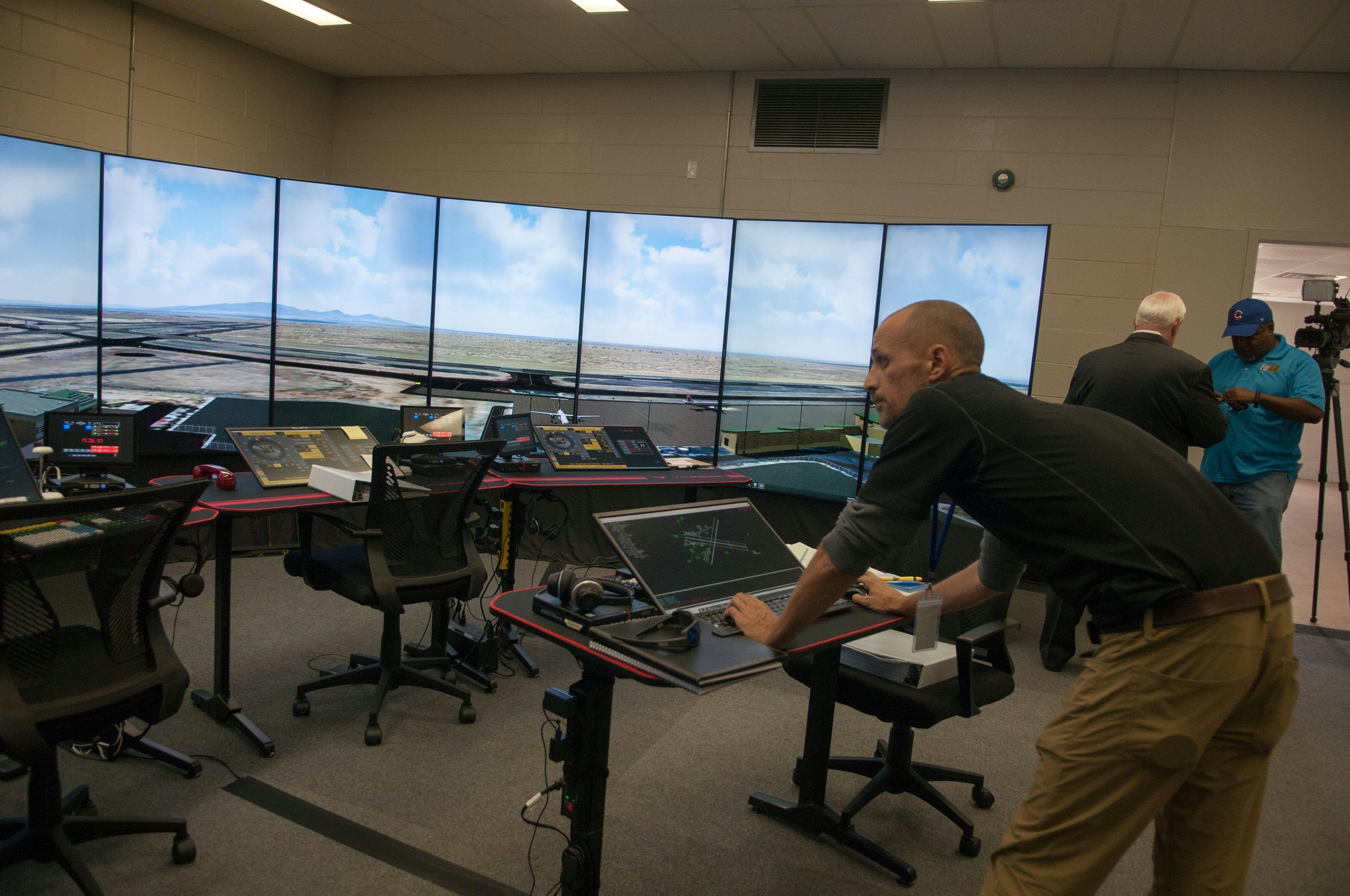
This vision culminated in the creation of the digital tower, a transformative alternative to traditional analogue towers where controllers depend on direct visual observation and radio communication. Digital towers employ high-definition cameras, sensors, and robust data networks to provide comprehensive remote monitoring of airfields, effectively eliminating blind spots. These systems can function as emergency backups or fully replace conventional towers. Today, Searidge offers five distinct digital tower models tailored to diverse operational requirements.
The development process faced significant challenges, particularly given the limitations of video technology at the time. Cheikh recalls that radar and multilateration technologies were only beginning to gain traction, yet the founders recognized the potential of integrating sensor technology with video to revolutionize air traffic management. Although the concept of fully digital airfields was not initially envisaged, the company’s innovations have since paved the way for such advancements.
Currently, Searidge’s digital towers are operational at major airports including Hamad International and Vigo-Peinador, with the most sophisticated system deployed at Hong Kong International Airport. These digital solutions enable airports to consolidate multiple facilities into centralized hubs, thereby reducing construction costs and streamlining operations. This capability is particularly valuable in the context of global shortages of qualified air traffic controllers. Cheikh highlights the strategic advantage of optimizing human resources through such technology.
Industry Challenges and Modernization Efforts
The broader ATC industry continues to grapple with significant challenges. The U.S. Federal Aviation Administration (FAA), for instance, faces high attrition rates and capacity limitations in controller training programs, issues that have attracted regulatory scrutiny. In response, the FAA has initiated comprehensive modernization efforts, awarding contracts to firms such as Collins Aerospace, Indra, and Peraton to upgrade aging radar infrastructure and integrate advanced ATC systems. Similarly, partnerships like that between Thales and Aireon in the Asia-Pacific region aim to improve air traffic flow and safety.
Despite these technological strides, structural and regulatory barriers remain in certain markets. Brazil exemplifies such challenges, where aviation growth is hindered by regulatory constraints, as noted by the CEO of Azul Airlines. Concurrently, the demand for skilled air traffic controllers persists, prompting the establishment of new training programs at institutions like Aims Community College. Safety innovations, including devices such as the ATR stick-shaker, continue to be critical in preventing accidents and enhancing operational safety.
As global air traffic expands and operational complexities intensify, the integration of advanced technologies alongside collaborative industry initiatives will be vital to sustaining both safety and efficiency in air traffic control.

Etihad Airways Suspends Airbus A380 Flights on Key Route

Aditya Birla Group Seeks Approval for Aircraft Leasing in GIFT City

Qatar Airways Highlights Innovation and Connectivity at Arabian Travel Market 2026

Hong Kong's Five-Year Plan Includes Andrew Fan's Aircraft Parts Processing Hub Proposal

ACIA Aero Leasing Delivers ATR72-600 to Air Nostrum

RTX Appoints Jill Albertelli as Head of Pratt & Whitney

TAT Technologies Joins Beyond Aero Hydrogen Aircraft Program

AURAK Study Highlights Barriers to Air Taxi Adoption in Emerging Economies

Xiamen Air Selects Altitude for 787 Maintenance at Heathrow

Etihad and Swissport Extend Global Partnership
