
Trasforma le intuizioni dell’IA in azioni concrete

Tendenze
Categories
AI Advances Transform Passenger Experience in Aviation
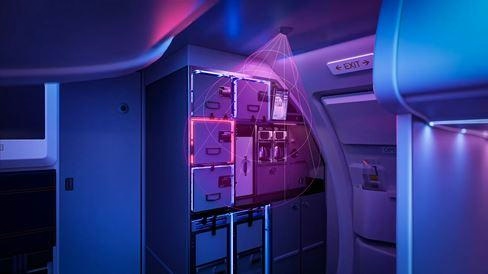
AI Advances Transform Passenger Experience in Aviation
Revolutionizing In-Flight Service with Artificial Intelligence
A recent demonstration of galley.ai, a virtual assistant developed by Collins Aerospace, showcased how artificial intelligence is beginning to transform the passenger experience aboard commercial aircraft. When a flight attendant inquired about the location of cookies on the plane, the response came instantly from galley.ai, identifying the exact storage bin. This innovation, designed to optimize one of the busiest areas on an aircraft, was presented to the Crystal Cabin Award judges and highlights the growing role of AI in streamlining in-flight operations.
The immediate benefits of galley.ai are significant. Passengers receive snacks more promptly, while flight crews experience reduced physical strain from handling heavy storage bins. Additionally, the system replaces traditional paper logs with a real-time digital inventory, enhancing accuracy and efficiency. D’Orlando, head of engineering for Collins’ applied technology and labs, described the technology as “another set of eyes” assisting crew members throughout the flight. This advancement earned Collins’ Interiors business the 2025 Crystal Cabin Award and is underpinned by two decades of AI research at the RTX Technology Research Center in East Hartford, Connecticut.
Broader Implications and Industry Challenges
Beyond the galley, airlines are increasingly integrating AI-driven solutions across the entire passenger journey, aiming to deliver personalized services and improve operational efficiency. However, the adoption of AI in aviation is not without controversy. For instance, Delta Air Lines’ proposal to use AI for airfare pricing has sparked debate over the potential for personalized pricing models that may be perceived as predatory. Critics warn that such practices could compromise fairness and transparency, leading to calls for regulatory frameworks to safeguard equitable treatment for all travelers.
The competitive dynamics within the aviation industry are also evolving as AI adoption accelerates. Airlines implementing advanced AI technologies may compel competitors to follow suit or push for industry-wide standards to prevent monopolistic behavior. At the same time, there is a risk that investments in AI could outpace actual market demand, potentially causing disruptions if the technology fails to meet expectations.
Despite these challenges, the momentum behind AI in aviation remains strong. Innovations like galley.ai exemplify the potential for smarter, safer, and more efficient air travel. As the industry continues to embrace these technologies, it must carefully navigate issues of fairness, transparency, and long-term value to ensure that AI delivers tangible benefits to both passengers and airlines.

Etihad Airways Suspends Airbus A380 Flights on Key Route

Aditya Birla Group Seeks Approval for Aircraft Leasing in GIFT City

Qatar Airways Highlights Innovation and Connectivity at Arabian Travel Market 2026

Hong Kong's Five-Year Plan Includes Andrew Fan's Aircraft Parts Processing Hub Proposal

ACIA Aero Leasing Delivers ATR72-600 to Air Nostrum

RTX Appoints Jill Albertelli as Head of Pratt & Whitney

TAT Technologies Joins Beyond Aero Hydrogen Aircraft Program

AURAK Study Highlights Barriers to Air Taxi Adoption in Emerging Economies

Xiamen Air Selects Altitude for 787 Maintenance at Heathrow

Etihad and Swissport Extend Global Partnership
