
Trasforma le intuizioni dell’IA in azioni concrete

Tendenze
Categories
AI Becomes Crucial as Aerospace Systems Exceed Human Oversight
AI Becomes Crucial as Aerospace Systems Exceed Human Oversight
The Data Deluge in Aerospace
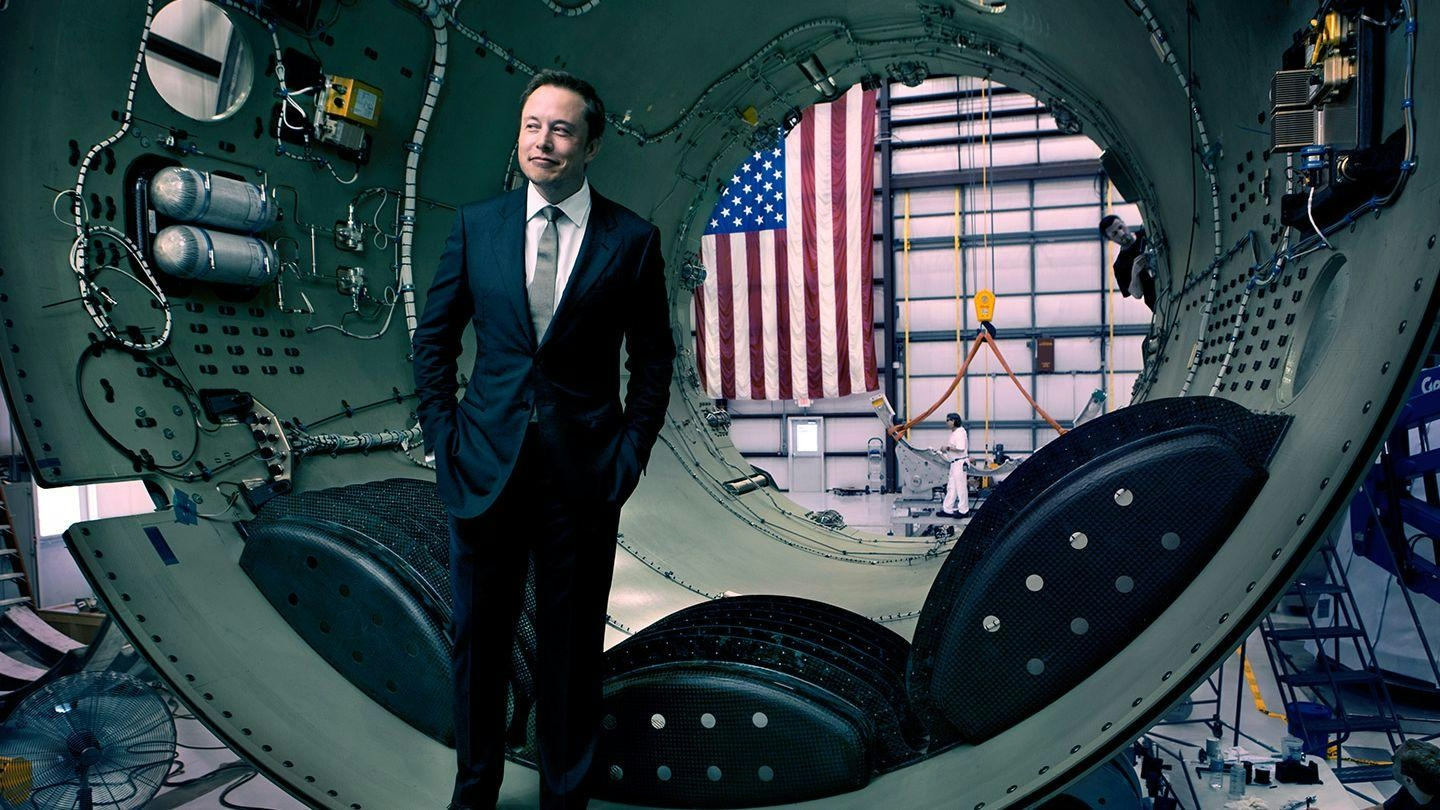
Modern aerospace systems are generating data at volumes that far exceed human capacity for real-time monitoring, prompting a significant shift toward artificial intelligence (AI) that goes well beyond traditional fault detection. Michael Foale, a veteran astronaut with over 370 days in space across six missions—including time aboard the Mir space station and as commander of the International Space Station (ISS)—emphasizes that this transformation is not a distant future scenario but an immediate challenge.
Foale highlights the dramatic increase in sensor data, noting that while the space shuttle was equipped with roughly a thousand sensors, the ISS now operates with hundreds of thousands, potentially millions, of measurements simultaneously. “No human can watch them all,” he states, underscoring the impracticality of manual oversight in the face of such complexity.
This surge in data is not confined to space exploration. Commercial aviation is experiencing a parallel trend, with aircraft systems and components generating vast streams of operational data. Airlines are under increasing pressure to detect faults earlier, reduce maintenance costs, and minimize service disruptions. For instance, easyJet’s maintenance, repair, and overhaul (MRO) expenditure rose to £451 million in 2025, up from £390 million the previous year. The core challenge has shifted from data collection to effective data interpretation.
The Limits of Human Monitoring and the Role of AI
Traditionally, engineers have manually reviewed system readings on the ground to identify anomalies. Foale points out that for the past five decades, system monitoring has relied heavily on human analysis. However, the complexity of current aerospace systems has surpassed this model’s feasibility. “Aerospace is crossing a complexity threshold,” he explains.
While AI is already in use within the aerospace sector, its application remains largely reactive. Presently, AI systems tend to identify failures only after they occur rather than predicting them in advance. Foale describes these as “stupid systems” that merely spot faults post-failure. Onboard predictive failure analysis is notably absent on the ISS, with most predictive analytics still conducted on the ground using powerful computing resources to process data transmitted from orbit.
Nonetheless, advancements are emerging. Airbus, for example, is developing neural network-based systems that analyze extensive spacecraft data sets. These systems employ autoencoder models to learn normal operational patterns across thousands of parameters. When deviations occur, the AI flags potential issues for further investigation by engineers. This approach represents a significant step toward predictive fault analysis, as Foale explains.
Challenges and Cultural Shifts in AI Adoption
Scaling AI integration in aerospace faces considerable obstacles beyond technical development. Dismantling established processes and cultivating a culture receptive to technological innovation are critical. Jie Zheng of TUI Group emphasizes the importance of organizational openness to change in this context.
Market responses to AI adoption remain mixed, with skepticism fueled by concerns over AI’s disruptive potential and its capacity to circumvent cybersecurity measures. Representative Dave Min highlights fears related to shifting risk profiles, ranging from minor chatbot errors to more severe threats such as cyberattacks, economic instability, and the concentration of power in the hands of a few.
Industries adjacent to aerospace are exploring strategies to optimize human roles alongside AI, aiming to preserve oversight and accountability. As the aerospace sector advances through this transition, fostering a culture of safe and responsible AI deployment will be essential to leveraging its advantages while managing emerging risks.
BBN Airlines Becomes IATA Member
FAA Orders Breeze Airways and Delta to Inspect Airbus A220 Fuel Hoses

Philippine Aviation Navigates Expansion and Costs Amid Fuel Price Volatility
On April 26, 1971, an SR-71 Blackbird Flew Over 15,000 Miles in 10.5 Hours, Limited by Liquid Nitrogen Supply
Boeing 747 Airframe Valued Less Than One Landing Gear Component
The Rear-Fan Engine Behind the Crash of the World's Fastest Airliner
Morphing Aircraft Skin Improves Safety and Fuel Efficiency

BRICS Nations Commit to Enhanced Cooperation on Sustainable Transport and Green Aviation
CFM Turbine Upgrade Doubles LEAP Engine Service Life in Harsh Conditions
CFM Upgrade Doubles LEAP Engine Lifespan in Harsh Climates
