Immagine

Trasforma le intuizioni dell’IA in azioni concrete

Unisciti oggi alla lista d’attesa di AeroGenie!

Tendenze

Categories

Air India Express Flight Returns After Engine Oil Pressure Drops
September 7, 2026By ePlane AI
Air India Express Flight Returns After Engine Oil Pressure Drops
0
0
Air India Express
Boeing 737
Engine Oil Pressure

Air India Express Flight Returns to Kochi Following Engine Oil Pressure Drop

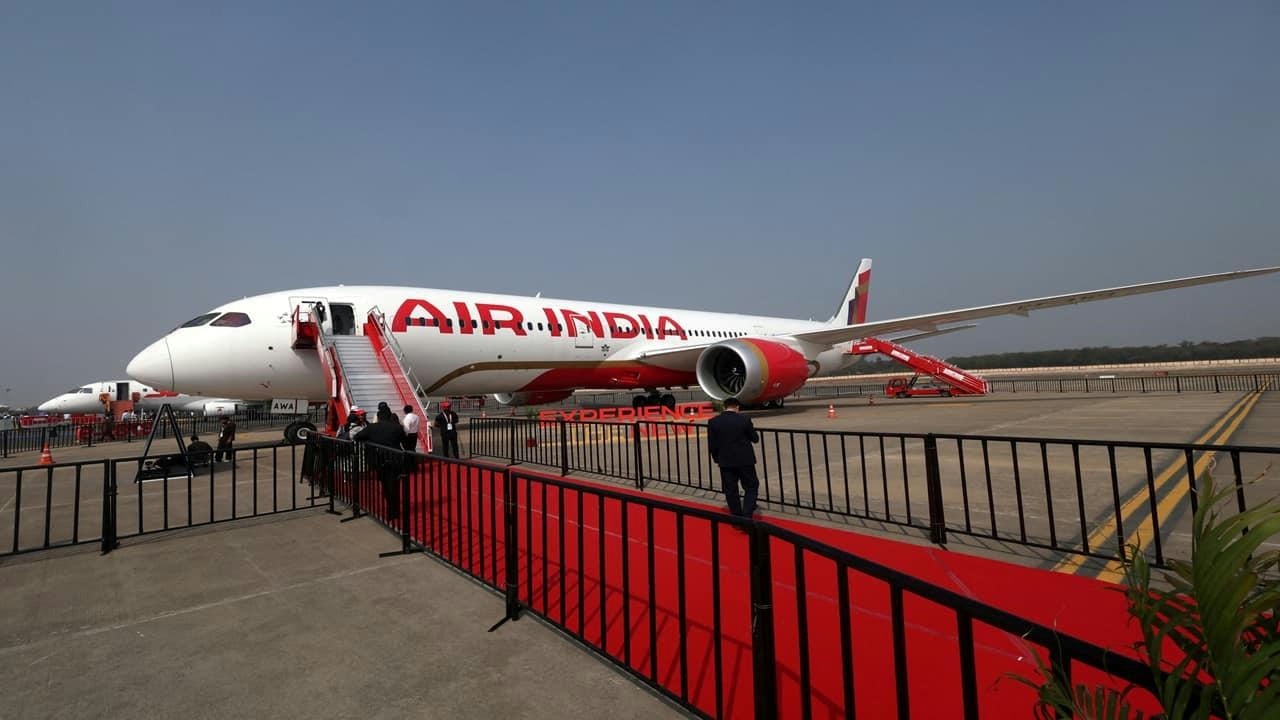
An Air India Express flight from Kochi to Abu Dhabi was compelled to return to its point of origin on Thursday after the flight crew detected a rapid decline in oil quantity and pressure in one of the aircraft’s engines. The Boeing 737, operating as flight IX 415, safely landed at Cochin International Airport without any reported injuries among passengers or crew.

Incident Details and Crew Response

Approximately 50 minutes into the flight, while cruising at 36,000 feet, the pilot and co-pilot observed a significant drop in oil quantity in Engine 1. As the oil pressure entered a critical range, the crew initiated a FORDEC assessment—a structured decision-making process used in aviation emergencies. Despite these measures, the oil quantity continued to decrease, prompting the decision to abort the journey to Abu Dhabi and return to Kochi. With oil pressure reaching dangerously low levels, the crew prudently shut down the affected engine as a precautionary measure before executing a safe landing.

Regulatory and Industry Implications

The incident has intensified scrutiny of Air India Express’s safety protocols and maintenance practices. Aviation regulators have launched an investigation focusing on the cause of the engine oil pressure drop, with particular attention to the airline’s hydraulic systems and maintenance procedures. This inquiry follows a recent similar event involving an Airbus A320neo, raising broader concerns about the airline’s operational reliability.

Industry experts suggest that Air India Express may face several challenges in the aftermath, including increased regulatory oversight that could result in the temporary grounding of certain aircraft. The airline’s reputation may also suffer, potentially affecting passenger confidence. Additionally, competitors may leverage the situation to emphasize their own safety records and advocate for stricter safety standards across the industry.

The airline has reaffirmed that passenger safety remains its highest priority and is cooperating fully with the ongoing investigation. Regulators are expected to conduct a thorough review of maintenance records and operational procedures to determine if further corrective actions are warranted.

The safe return of flight IX 415 highlights the critical importance of rigorous crew training and strict adherence to emergency protocols, even as Air India Express faces heightened regulatory scrutiny and industry pressure to uphold the highest safety standards.

More news
Keeta Drone Resumes Deliveries in Dubai

Keeta Drone Resumes Deliveries in Dubai

Keeta Drone Resumes Deliveries in Dubai Amid Regulatory Updates Keeta Drone has recommenced its delivery operations in Dubai after a temporary suspension prompted by new regulatory requirements. The company initially launched its services in the city in 2024, following the acquisition of a commercial drone delivery certificate from the Dubai Civil Aviation Authority (DCAA). However, operations were paused when the DCAA introduced a revised regulatory framework that mandated additional clearances for drone flights. Under the updated guidelines, Keeta Drone was required to map its delivery routes and secure official approval to ensure compliance with airspace restrictions. These measures are designed to prevent drones from entering restricted zones, emergency corridors, and other areas with significant low-altitude traffic. The resumption of services reflects adherence to enhanced safety protocols and formal agreements aimed at integrating commercial drone activity into public spaces such as residential neighborhoods, parks, and shopping centers. The operational hiatus also provided Keeta with an opportunity to restructure its Dubai operations to improve efficiency and regulatory compliance. The company’s delivery service will initially relaunch from Silicon Central Mall, with plans to expand as it obtains further clearances. Navigating a Competitive and Evolving Market Keeta Drone’s return to the Dubai market occurs amid intensifying global competition in the drone delivery sector. Established players including Amazon, Alphabet’s Wing, Walmart, and Uber Eats have already made significant advances. Amazon, for instance, has announced plans to extend its Prime Air drone delivery service to nearly 500 U.S. cities by 2026. Meanwhile, Alphabet’s Wing and Walmart have collectively completed millions of drone deliveries, and Uber Eats, in partnership with Zipline, aims to achieve one million daily drone deliveries by 2029. This competitive environment poses challenges for Keeta Drone as these major companies continue to invest heavily in advanced drone technologies and expand their delivery networks. Industry analysts expect mounting pressure on Keeta to enhance both delivery efficiency and service quality in order to sustain its position in this rapidly evolving market. Competitors are likely to respond with further technological innovation and broader network expansion to safeguard their market shares. Keeta Drone’s capacity to effectively navigate regulatory demands while adapting to a highly competitive landscape will be critical as drone delivery increasingly becomes an integral component of urban logistics in Dubai and beyond.
Boeing Resumes F-15EX Deliveries After 105-Day Strike in St. Louis

Boeing Resumes F-15EX Deliveries After 105-Day Strike in St. Louis

Boeing Resumes F-15EX Deliveries Following Historic 105-Day Strike Boeing has recommenced deliveries of its F-15EX Eagle II fighter jets after a 105-day strike by machinists brought production to a halt at its St. Louis-area facilities. The labor stoppage, which began on August 4, 2025, involved approximately 3,200 members of the International Association of Machinists and Aerospace Workers District 837. Workers rejected Boeing’s contract proposal, leading to a shutdown of fighter and munitions production across sites in St. Louis and St. Charles, Missouri, as well as Mascoutah, Illinois. This strike marked the longest in the history of Boeing’s St. Louis operations. After five unsuccessful contract proposals, the union ratified a new five-year agreement on November 13. The contract included a general wage increase and a ratification bonus, although demands for a 401(k) match were dropped. Production resumed shortly thereafter, with Boeing officially declaring the strike over. The disruption had a direct impact on the F-15EX and F/A-18 Super Hornet Block III production lines, both of which contribute several billion dollars in revenue. The strike, however, delayed scheduled deliveries of the F-15EX to the U.S. Air Force, pushing timelines off course. Rapid Recovery and Production Outlook Despite the lengthy work stoppage, Boeing’s F-15EX production line returned to full-rate output within three weeks of the strike’s conclusion. The 142nd Wing at Portland Air National Guard Base received its eighth F-15EX, tail number 21-0015, just nine days after the strike ended. Notably, two aircraft—EX14 and EX15—were delivered during the strike, likely due to their advanced stage of assembly prior to the work stoppage. The delivery of EX16 less than three weeks after operations resumed was credited to close coordination among Boeing, the Air Force Life Cycle Management Center, and the Defense Contract Management Agency. Boeing has highlighted this swift recovery as evidence of effective collaboration across production, logistics, and testing teams, as well as with the Oregon Air National Guard. The 142nd Wing became the first operational F-15EX unit in June 2024, and Boeing plans to accelerate production in St. Louis to fulfill the current order of 18 jets. The company aims to achieve a production rate of two aircraft per month by 2026, with manufacturing scheduled to continue through Fiscal Year 2031. Ongoing Labor and Geopolitical Challenges While the St. Louis strike has concluded, Boeing faces continued labor challenges. In Seattle, union members recently rejected a contract and authorized a potential strike, raising concerns about the company’s ability to sustain production momentum. Market analysts are closely monitoring Boeing’s capacity to meet delivery schedules, particularly in light of a recent $131.23 billion contract awarded by the U.S. Air Force for F-15 production and modernization. This contract is expected to significantly influence the competitive landscape of military aircraft manufacturing. Geopolitical factors also add complexity to Boeing’s outlook. Poland’s name has emerged in discussions related to the U.S. F-15EX deal, despite official denials from Warsaw. This development introduces potential future competition in international fighter procurement markets. As Boeing works to recover from the St. Louis strike and ramp up production, the company must navigate a challenging environment shaped by labor relations, market demands, and geopolitical considerations that will define the next phase of the F-15EX program.
Israir Begins Ticket Sales for Tel Aviv-New York Route Launching September 15

Israir Begins Ticket Sales for Tel Aviv-New York Route Launching September 15

Israir Launches Ticket Sales for Tel Aviv-New York Route Starting September 15 Israir has announced the commencement of ticket sales for its new Tel Aviv–New York route, with the inaugural flight from Tel Aviv scheduled for September 15. This marks the airline’s first regular service to the United States, operated using two newly acquired Airbus A330 wide-body aircraft. The return flight from New York to Israel is planned for September 17, as Israir gradually integrates its wide-body fleet into active service. Rapid Preparation and Investment The airline’s entry into the transatlantic market follows an intensive preparation period of approximately three and a half months. During this time, Israir finalized the acquisition and outfitting of the two Airbus A330 aircraft, completing payment for both on May 27. The total investment amounted to around $85 million, covering not only the purchase but also service-related modifications and the establishment of a spare-parts inventory. To support the new route, Israir secured over 60 agreements addressing various operational requirements and obtained all necessary regulatory approvals from Israel’s Civil Aviation Authority, the U.S. Department of Transportation, and the Federal Aviation Administration. Intensified Competition on a Key International Route Israir’s entry into the Tel Aviv–New York market introduces heightened competition on one of Israel’s most significant international air routes. The airline will contend with established local carriers such as El Al and Arkia, alongside major U.S. airlines. Notably, United Airlines is preparing to resume flights to Israel after a suspension caused by regional conflicts, further intensifying competition. The return of U.S. carriers is anticipated to reshape the market dynamics, potentially leading to adjustments in fare structures and prompting airlines to enhance pricing strategies and onboard services to retain market share. As Israir embarks on its first transatlantic operations, its expansion underscores an ambitious growth strategy amid an increasingly dynamic Israel–U.S. aviation landscape. Industry observers will closely monitor the impact of Israir’s market entry on fares, service quality, and the broader competitive environment along this vital route.
China's Sino Jet Acquires Aruba-Registered Gulfstream G700

China's Sino Jet Acquires Aruba-Registered Gulfstream G700

China’s Sino Jet Expands Fleet with Aruba-Registered Gulfstream G700 Sino Jet, a prominent business aviation group based in Beijing, has augmented its fleet with the addition of a new Gulfstream G700, registered in Aruba under the tail number P4-HUA (msn 87125). The aircraft left Gulfstream Aerospace’s Savannah International production facility on August 30, 2026, making a technical stop at Anchorage Ted Stevens before arriving at Shanghai Hongqiao Airport. Details regarding which specific Sino Jet division will operate the G700 have not yet been disclosed. Strategic Fleet Modernization and Market Positioning This latest acquisition reflects Sino Jet’s ongoing strategy to expand its presence in the large-cabin jet segment. Notably, the G700 registration was previously assigned to an ACJ319-100N operated by Sino Jet Beijing from mid-2022 until late 2024. The company initiated G700 operations earlier in 2026, signaling a broader effort to modernize and upscale its fleet. Sino Jet’s group, which encompasses Sino Jet Beijing, Sino Jet (Cayman), and Hong Kong-based Sino Jet Management, currently manages nearly 50 aircraft, with approximately 95 percent classified as large-cabin jets. In a 2025 interview with ch-aviation, Sino Jet’s vice chair Jenny Lau emphasized the rising demand for large-cabin aircraft among owners, highlighting a trend toward replacing older models such as the G650 with newer, more advanced jets like the G700. This shift aligns with the company’s focus on maintaining a competitive edge in the evolving business aviation market. Regulatory and Market Implications The registration of the G700 in Aruba introduces potential regulatory complexities, as operating the aircraft internationally will necessitate adherence to diverse aviation standards across multiple jurisdictions. Market responses to Sino Jet’s acquisition have been mixed. Some investors interpret the move as a calculated effort to reinforce the company’s charter fleet and strengthen its position within the business aviation sector. This development may also intensify competition, prompting rival operators to accelerate their own fleet expansions to remain competitive. The Gulfstream G700’s proven performance in extreme environments, combined with its advanced technological capabilities, could further enhance Sino Jet’s competitive standing, contingent on shifting market demands and client preferences. As the business aviation landscape in China and the wider region continues to evolve, Sino Jet’s acquisition of the G700 underscores its commitment to sustaining a leading role in the sector.
Airbus Leads in Orders and Backlog as Airbus and Boeing Recover Jet Deliveries

Airbus Leads in Orders and Backlog as Airbus and Boeing Recover Jet Deliveries

Airbus Leads in Orders and Backlog as Jet Deliveries Rebound Airbus and Boeing are demonstrating significant recovery in jet deliveries, approaching output levels last seen before the pandemic. Deliveries have risen by 12% year-over-year, reflecting renewed momentum within the commercial aviation industry. Airbus’s Dominance in Orders and Backlog Airbus currently holds a commanding lead in the 2026 order race, having secured 1,024 net orders compared to Boeing’s 438. This advantage translates into a $23.1 billion higher net order value for the European manufacturer. Airbus has not only exceeded its 2018 delivery benchmark but also maintains a record-high backlog. As of July 2026, the total industry backlog surpassed 17,000 aircraft, driven primarily by strong demand for single-aisle jets, which continue to form the core of global airline fleets. Boeing’s Recovery and Market Position Boeing has rebounded to 88% of its pre-crisis delivery volume and is actively working to close the gap with Airbus. The U.S. manufacturer has sustained a visible presence at key industry events, including the Farnborough International Airshow, underscoring its commitment to aggressively compete for new orders. Despite trailing Airbus in orders and backlog, Boeing’s efforts signal a determined push to regain market share. Emerging Competition and Market Dynamics While Airbus currently leads, sustaining this advantage presents challenges amid a recovering market marked by intensifying competition. Both Airbus and Boeing are increasing production rates to meet growing airline demand. Additionally, new entrants are beginning to influence the landscape. China’s COMAC C919 recently completed its first international flight, a milestone for the Chinese aerospace sector. However, the C919 remains dependent on foreign components and lacks certification from major U.S. and European aviation authorities, limiting its immediate impact on the global market. Investor sentiment has been positive, buoyed by the strong backlog and growth in deliveries. Analysts anticipate that these trends will support future revenue, profitability, and free cash flow for both Airbus and Boeing as production normalizes. As the commercial aviation sector continues its recovery, competition between the two manufacturers is expected to intensify, with each striving to capitalize on rising demand and secure their positions in a rapidly evolving market.
Contrail Avoidance Trial Launched in Asia-Pacific

Contrail Avoidance Trial Launched in Asia-Pacific

Contrail Avoidance Trial Launched in Asia-Pacific Addressing Aviation’s Hidden Climate Impact Contrails, the thin white streaks trailing behind aircraft, form when planes traverse cold, humid air. While many contrails dissipate rapidly, some persist and spread, trapping heat in the atmosphere and significantly contributing to aviation’s climate footprint. Estimates suggest that contrails are responsible for approximately one-third of the total warming effect attributed to aviation. In response to this environmental challenge, efforts to mitigate contrail-induced warming have evolved from theoretical AI models to practical, real-world trials. Following initial tests conducted in the United States and across the North Atlantic, a new initiative has been launched in the Asia-Pacific region, the fastest-growing aviation market globally. This project marks Google’s first collaboration with a commercial airline in Asia, partnering with Cathay Pacific to test contrail avoidance strategies on ultra-long-haul flights. Early Results and Operational Approach The initial phase of the trial involved over 80 Cathay Pacific flights, with findings indicating an estimated 40% reduction in the warming impact of contrails by following AI-recommended avoidance routes. Notably, the Hong Kong–Singapore corridor, known for frequent contrail formation, accounted for more than half of the total emissions reductions observed during the trial. Building on these promising results, the program is expanding to encompass a broader segment of Cathay Pacific’s global network. The objective is to evaluate the operational feasibility of contrail avoidance while contributing to the scientific understanding of its climate benefits. The methodology underpinning the trial is relatively straightforward. Aircraft make minor altitude adjustments to circumvent atmospheric zones where persistent, warming contrails are likely to form, akin to how pilots currently navigate around turbulence. These adjustments are planned prior to departure and are designed to have no adverse effect on passenger comfort or flight safety. The system integrates AI-driven predictions, satellite imagery, and advanced meteorological data to identify contrail-forming regions. This information is then transmitted directly to pilots via in-flight Wi-Fi and Cathay Pacific’s proprietary Electronic Flight Folder, providing real-time guidance without disrupting standard cockpit operations. Challenges and Broader Context Despite the encouraging progress, scaling contrail avoidance initiatives presents challenges. Fluctuating fuel prices, for instance, can affect the continuity of such programs. American Airlines, for example, paused its contrail-avoidance efforts amid rising fuel costs. Airlines must therefore balance operational adjustments and budget considerations when adopting these measures. Industry responses vary, with some carriers leveraging contrail avoidance to enhance their sustainability profiles, while others may delay or modify their initiatives in response to economic pressures. The Asia-Pacific trial builds upon similar projects such as Operation Blue Skies in the North Atlantic, which also employs AI-guided flight rerouting to reduce contrail formation. Independent verification of results by institutions including Imperial College London and the University of Cambridge ensures scientific rigor and credibility. As the partnership with Cathay Pacific advances into a larger second phase and collaborates with Contrails.org, a nonprofit dedicated to contrail mitigation, these trials are expected to yield valuable insights. Collectively, these efforts are shaping the future of sustainable aviation by exploring practical and scalable solutions to reduce the climate impact of contrails worldwide.
Boeing Ended 747SP Production Just Before Reaching Break-Even

Boeing Ended 747SP Production Just Before Reaching Break-Even

Boeing Ended 747SP Production Just Before Reaching Break-Even Boeing came within a single aircraft of making the Boeing 747SP program profitable, only to halt production just shy of its break-even point. The 747SP—a shortened, lighter variant of the iconic jumbo jet—was developed in response to airlines seeking nonstop service on exceptionally long, relatively thin routes. However, by the time the final 747SP was delivered, the economics of operating four-engine jets on such routes had shifted significantly. The Ambitious Origins of the 747SP Originally designated the 747SB for “short body,” the 747SP was Boeing’s solution to airline demands for a long-range, four-engine widebody capable of flying nonstop routes that were too lengthy for existing twin-aisle jets and too thin to fill a standard 747. Pan Am aimed to connect the Pacific and Middle East without stops, while Qantas sought nonstop “kangaroo routes” to Europe. Rather than designing an entirely new aircraft to compete with the McDonnell Douglas DC-10 and Lockheed L-1011 TriStar, Boeing chose to modify the existing 747. The company shortened the fuselage by over 48 feet, lightened the structure, and added a taller vertical stabilizer, reducing the empty weight by approximately 45,000 pounds compared to the 747-200. These changes enabled the 747SP to fly higher, faster, and farther, circumventing the twin-engine range restrictions that would later be formalized as ETOPS. Boeing projected a market for 214 aircraft and set a break-even point at 45 units, based on internal estimates. This target reflected expectations of steady demand for ultra-long-haul routes—a niche the 747SP was specifically designed to serve. Falling Short by One Between 1976 and 1982, Boeing built and delivered 44 747SPs. The final aircraft, registered YI-ALM, was delivered to Iraqi Airways on August 30, 1982. Despite coming within a single sale of breaking even, the order book had dried up, and no 45th customer materialized. The 747SP production line was subsequently closed, marking a rare instance in which a Boeing program ended just before reaching its financial target. This decision coincided with a transformation in the economics of long-haul flying. Rising fuel prices and the emergence of more efficient twin-engine widebodies began to redefine airline preferences for long-range aircraft. The 747SP’s operating costs, once justified by its unique capabilities, became increasingly difficult to defend as technological advancements progressed. New Pressures and a Changing Market Boeing’s experience with the 747SP underscores the challenges of adapting to shifting market dynamics—a reality that remains pertinent today. The company now faces growing competition from new entrants such as China’s COMAC, whose C919 recently completed its first international commercial flight. Although the C919 still relies on foreign components and lacks certification from major Western regulators, its progress signals a potential challenge to the longstanding Boeing-Airbus duopoly. Simultaneously, Boeing contends with internal pressures, including the risk of strikes by its engineers’ union and broader shifts in U.S. manufacturing, such as the momentum toward reshoring. These factors could affect Boeing’s supply chain and production strategies, highlighting the complexity of maintaining competitiveness in a rapidly evolving global aviation market. The story of the 747SP serves as a reminder that even the most innovative aircraft can be overtaken by changing technology, economics, and global competition—forces that continue to shape Boeing’s future.
Comparing the A321XLR and Tu-214: Strengths and Suitable Uses

Comparing the A321XLR and Tu-214: Strengths and Suitable Uses

Comparing the A321XLR and Tu-214: Strengths and Suitable Uses The Airbus A321XLR and Russia’s Tu-214 are frequently compared due to their positioning between traditional narrowbody jets and larger long-haul aircraft. However, a detailed examination of their specifications and operational deployment reveals significant differences that influence their suitability for various airline needs. Range and Operational Realities The Tu-214 is generally reported to have a range of approximately 6,500 kilometers, whereas the A321XLR boasts a published range of 8,700 kilometers. These headline figures, however, do not fully capture the operational realities faced by airlines. Actual range is influenced by multiple factors including passenger load, baggage, cargo, and fuel requirements. The A321XLR was specifically designed to open long-distance routes that do not justify the use of widebody aircraft. Airbus markets it as a “route opener,” capable of connecting both primary and secondary cities, particularly in markets where operating larger jets would be economically impractical. Its modern engines, advanced fuel system, and a maximum takeoff weight (MTOW) of 101.5 tonnes extend the capabilities of the single-aisle aircraft into the long-haul domain. Capacity: More Than Just Seats While Airbus lists the A321XLR’s maximum seating capacity at 244 passengers, this figure corresponds to a high-density, single-class layout that is rarely employed on long-haul flights. Most airlines prefer two-class configurations, typically accommodating between 206 and 220 passengers. This distinction is critical because long-range flights require additional space for catering, water, crew equipment, reserve fuel, and sometimes cargo, all of which reduce the available payload for passengers. Real-world airline configurations demonstrate this variability. For instance, Wizz Air’s A321XLRs are outfitted with 239 seats in a high-density arrangement, whereas Air Canada’s version features only 182 seats, including 14 full-flat business-class seats. Consequently, the effective passenger capacity of the A321XLR ranges widely, from around 206 to 220 seats in a standard two-class layout, up to 239 in high-density configurations, or fewer in premium-focused setups. Range Versus Payload: The Real-World Tradeoff The A321XLR’s official specifications include a maximum range of 8,700 kilometers and an MTOW of 101.5 tonnes, supported by a permanent rear center fuel tank holding 12,900 liters, with an optional forward tank available. However, maximum range, payload, and fuel capacity are interdependent variables. Increasing fuel load reduces the weight available for passengers and cargo. Industry analyses indicate that high-density seating configurations (230–240 seats) cannot achieve the aircraft’s full theoretical range when operating near maximum payload, underscoring the tradeoff between range and capacity. Market Impact and Competitive Edge The A321XLR has empowered airlines to inaugurate new long-haul routes that were previously unfeasible with narrowbody aircraft. United Airlines and American Airlines, for example, have introduced nine new international routes utilizing the XLR. United plans to deploy the aircraft on five additional international routes in 2027, including destinations such as Ibiza, Valencia, Marseille, Toulouse, and Luxembourg City. The A321XLR’s integration within the A320 family also facilitates streamlined pilot and crew training, enhancing its appeal to airlines already operating Airbus narrowbodies. In contrast, the Tu-214, a Russian twinjet, has not played a significant role in recent international market developments. Its shorter range and limited adoption suggest it is less competitive in the long-haul segment compared to the A321XLR. Conclusion Although both the A321XLR and Tu-214 occupy the intermediate space between narrowbody and widebody aircraft, the A321XLR’s extended range, operational flexibility, and seamless integration into existing fleets have established it as the preferred option for airlines seeking to open new long-haul routes. The Tu-214 remains less prominent and less competitive within this evolving market segment.
Ufa Designers Develop Afterburner Increasing Turbofan Engine Thrust by 30%

Ufa Designers Develop Afterburner Increasing Turbofan Engine Thrust by 30%

Ufa Designers Develop Afterburner Increasing Turbofan Engine Thrust by 30% Innovative Detonation Thrust Amplifier Enhances Engine Performance Engineers at the Ufa-based ODK-UMPO plant have introduced a groundbreaking detonation thrust amplifier designed to enhance the performance of existing turbofan engines by up to 30%. This novel system, intended for integration with current turbofan (TRDD) platforms, provides a temporary thrust increase ranging from 15 to 30 percent when activated. The technology holds the potential to significantly impact both civil and military aviation propulsion by offering a powerful yet adaptable boost to engine output. The amplifier functions as an annular detonation chamber composed of a diffuser, a cylindrical section, and an outlet confuser. Fuel is supplied through an annular manifold equipped with nozzles angled at 70 degrees relative to the airflow. Upon activation, an initiator generates a continuous spin detonation wave, accelerating the airflow within the amplifier to speeds between Mach 1.0 and 1.3. This process sharply elevates the temperature and pressure of the gases, producing additional thrust that supplements the main engine’s output. Designed to be installed on the outer contour of a two-spool turbofan engine, the device is intended for use only when a short-term thrust increase is necessary, potentially serving as an alternative to conventional afterburner systems. Strategic Context and Industry Implications The development of this detonation thrust amplifier comes amid growing interest in propulsion innovation, as both airlines and defense contractors seek more efficient and powerful engine solutions. The recent selection of the GEK800 turbofan by the U.S. Air Force for the JASSM cruise missile highlights the strategic importance of advanced engine technologies. Ufa’s new amplifier may attract considerable attention from commercial and military sectors alike, offering performance enhancements without the need to develop entirely new engine platforms. Despite its promise, the path to widespread adoption presents several challenges. The afterburner must comply with rigorous regulatory standards and demonstrate seamless integration with existing aircraft systems. Furthermore, ODK-UMPO faces intense competition from established global manufacturers such as Safran Aircraft Engines, GE Aerospace, Pratt & Whitney, Rolls-Royce, MTU Aero Engines, IHI Corporation, Kawasaki Heavy Industries, and GKN Aerospace. The introduction of this technology could prompt these industry leaders to accelerate their own research and development efforts, potentially igniting a new wave of innovation within the turbofan engine market. As the aviation sector continues to prioritize efficiency and enhanced performance, the Ufa-designed detonation thrust amplifier represents a notable advancement. Its ultimate success will depend on regulatory approval, market acceptance, and its ability to outperform or effectively complement existing propulsion technologies in a highly competitive environment.
Russia Develops Domestic Production of ASH-62IR Engine Parts for An-2 Aircraft

Russia Develops Domestic Production of ASH-62IR Engine Parts for An-2 Aircraft

Russia Advances Domestic Production of ASH-62IR Engine Components for An-2 Aircraft Russian manufacturers have initiated the domestic production of critical components for the ASH-62IR piston engine, which powers the renowned An-2 biplane. This development was confirmed by Pavel Nenastyev, director of the DOSAAF Aircraft Repair Plant (DARZ) in Balashikha. The move follows the imposition of Western sanctions that have disrupted the supply chain, particularly the sourcing of parts from Poland, where the engine continues to be produced in series. Nenastyev emphasized the importance of import substitution efforts, stating that his plant is actively mastering the production of these parts to ensure the An-2 fleet remains airworthy. The transition to domestic manufacturing is regarded as essential for sustaining the operational readiness of these aircraft, especially given the restricted access to foreign components. Sustaining the An-2 Fleet Amid Sanctions Over the past three years, the Siberian Aeronautical Research Institute (SibNIA) has successfully restored 16 previously inoperable An-2 aircraft, underscoring the persistent demand for dependable maintenance and spare parts. Although the design rights to the An-2 are currently held by Airbus Military, Russia continues to invest in the upkeep and modernization of its fleet. The shift to domestic production, however, presents significant challenges. A primary concern for manufacturers and operators alike is ensuring that Russian-made parts meet or exceed the quality and reliability standards of their imported predecessors. The initiative’s success will hinge on stringent quality control measures and the ability to replicate or improve upon the performance of previously sourced components. Market responses to this development have been predominantly positive, reflecting growing confidence in Russia’s capacity to achieve self-sufficiency in aircraft maintenance and production. This confidence may stimulate increased demand for domestically produced parts as operators seek reliable, locally sourced alternatives. Meanwhile, competitors are closely observing the situation, evaluating the quality and cost-effectiveness of the new Russian components, and potentially adjusting their own procurement strategies in response to evolving market conditions. Enhancing Performance with New Engine Developments In addition to the ASH-62IR, Russia’s United Engine Corporation (ODK) has developed the VK-1600V engine, which delivers 1,600 horsepower—significantly surpassing the original engine’s 1,000 horsepower. This new powerplant is anticipated to enhance the An-2’s performance and operational capabilities further. As Russia continues to address the challenges posed by import substitution, the successful domestic production of ASH-62IR engine parts represents a critical milestone in maintaining and modernizing its aviation assets amid ongoing international restrictions.
line









