Immagine

AeroGenie — Il tuo copilota intelligente.

Chiedi qualsiasi cosa. Analizza tutto. Agisci immediatamente.

Tendenze

Categories

Air Taxi Built in Guntur Passes Key Structural Tests
January 30, 2026By ePlane AI
Air Taxi Built in Guntur Passes Key Structural Tests
0
0
Magnumwings
eVTOL
Structural Testing

Air Taxi Developed in Guntur Passes Critical Structural Tests

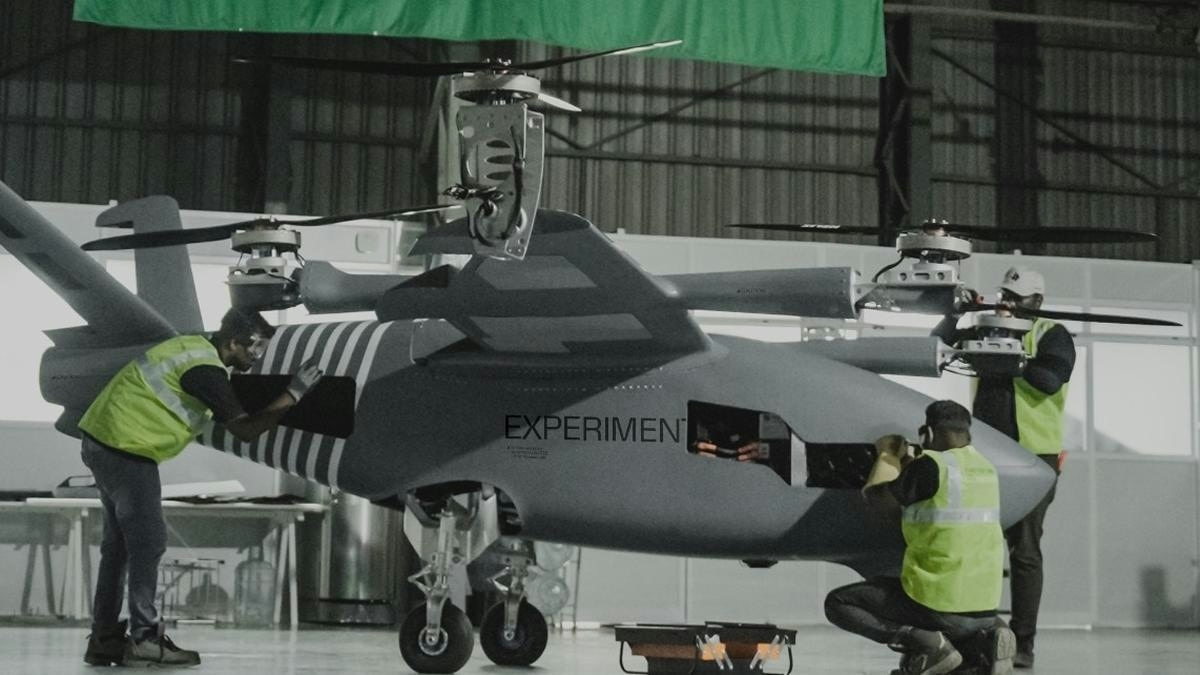
Guntur, Andhra Pradesh — Magnumwings, an Indian aerospace company based in Guntur, has achieved a significant milestone with its air taxi prototype successfully completing rigorous structural frame testing. This accomplishment marks a notable advancement in India’s pursuit of innovation within the electric vertical take-off and landing (eVTOL) sector, a rapidly evolving field in advanced air mobility.

Rigorous Testing Under Real-World Conditions

The air taxi was specifically engineered to meet the diverse and challenging conditions found across India, with a focus on safety, durability, and operational reliability. The recent series of tests subjected the aircraft to intense roll-and-pitch maneuvers designed to simulate real-world stresses, including substantial motion and vibration. These trials evaluated the airframe’s ability to absorb loads, manage vibrations, and maintain structural integrity while quickly regaining stability after each movement.

Test footage released by Magnumwings demonstrated the air taxi’s resilience under aggressive conditions, confirming the robustness of its design. Abhiram Chava, Managing Director of Magnumwings, emphasized that the tests were aimed at assessing the “structural response and controllability under stress,” highlighting the aircraft’s capacity to withstand heavy structural loads without compromising performance.

In addition to dynamic stress tests, the company conducted a controlled hard-landing exercise to evaluate the strength of the landing gear and the airframe’s capacity to endure impact forces. This test simulated scenarios such as emergency descents and operations on uneven or remote terrain, reflecting the varied and often harsh environments in which the air taxi is expected to operate. Magnumwings underscored that the design incorporates considerations for India’s diverse terrain, dust exposure, and weather conditions, prioritizing ruggedness over idealized operating environments.

Positioning Amidst Global eVTOL Competition

This development occurs amid intensifying global competition in the eVTOL industry, where companies are racing to secure regulatory approvals and commercialize air taxi services. International players like Archer Aviation and Joby Aviation are closely observing advancements such as those made by Magnumwings. The competitive stakes in this sector have been highlighted recently by a high-profile trade-secrets lawsuit filed by Joby Aviation against Archer Aviation, alleging the misappropriation of confidential information by a former employee. This legal dispute underscores the critical importance of intellectual property protection as firms strive for technological leadership.

Concurrently, regulatory bodies and infrastructure investments are shaping the trajectory of air mobility worldwide. The U.S. Federal Aviation Administration (FAA) has committed $4 billion to support the development of eVTOL air-taxi networks, a move expected to influence global market dynamics and accelerate innovation.

Following the successful completion of these structural tests, Magnumwings intends to proceed with further evaluations and expanded flight trials in the coming months, aiming to establish itself as a prominent participant in the emerging air taxi market.

For additional details, visit magnumwings.com.

More news
Amazon Prime Air Airbus A330 Makes Emergency Landing in Cincinnati After Bird Strike Causes Engine Fire

Amazon Prime Air Airbus A330 Makes Emergency Landing in Cincinnati After Bird Strike Causes Engine Fire

Amazon Prime Air Airbus A330 Makes Emergency Landing in Cincinnati After Bird Strike Causes Engine Fire Incident Overview and Flight Details On Wednesday, January 28, 2026, an Amazon Prime Air Airbus A330-300 freighter was compelled to execute an emergency landing shortly after takeoff from Cincinnati/Northern Kentucky International Airport (CVG). Flight AS-2616, operated by an Amazon air carrier partner and destined for Houston’s George Bush Intercontinental Airport (IAH), departed CVG at 3:05 p.m. local time. The aircraft, registered as N5827K, ascended normally until reaching approximately 3,000 feet when the crew reported a significant bird strike involving the No. 1 (left) engine. The ingestion of the bird caused the engine to lose power and subsequently catch fire, filling the cockpit with smoke. Air traffic control (ATC) communications captured the urgency of the situation as the pilots calmly declared an emergency, requesting immediate return to the airport. Within eight minutes of departure, the aircraft completed a rapid left turn and safely landed back at CVG at 3:13 p.m., where it was met by a substantial response from Crash Fire Rescue (CFR) units. Emergency Response and Crew Safety Measures Upon landing, the flight crew halted the aircraft on the runway, expressing concern over the structural integrity of the damaged engine and the potential for fire or toxic fumes to spread. Rather than initiate a slide evacuation, the pilots requested extraction via ladder, specifying the right side door to avoid the fire on the left. CFR teams confirmed that although flames were visible during the aircraft’s approach, onboard fire suppression systems and the engine shutdown had effectively contained the fire by the time the plane came to a stop. The aircraft was subsequently towed to Amazon’s Global Air Hub at CVG for a thorough inspection. No injuries were reported among the crew or ground personnel. An FAA spokesperson confirmed the safe outcome, and Amazon issued a statement emphasizing that the aircraft returned as a precaution and is currently undergoing inspection. Industry Implications and Safety Considerations This incident highlights the persistent risks bird strikes pose to cargo operations at major airports. It underscores the critical importance of rigorous engine testing and certification to withstand such events, a challenge recently addressed through successful PD-8 engine trials at the Saturn facility. As the air cargo industry continues to evolve, this event may prompt heightened scrutiny of both conventional aircraft and emerging technologies, including Amazon Prime Air’s drone delivery systems. Safety concerns arising from such incidents could delay the deployment of drone fleets, while competitors may accelerate their own technological advancements to maintain market competitiveness. Meanwhile, traditional airlines such as Delta are reaffirming their commitment to widebody aircraft, as evidenced by recent orders for Airbus A330s and A350s, signaling a continued reliance on established air freight solutions amid ongoing safety challenges.
Archer Aviation vs. EHang: Who Has the Edge in Future Air Mobility?

Archer Aviation vs. EHang: Who Has the Edge in Future Air Mobility?

Archer Aviation vs. EHang: Who Has the Edge in Future Air Mobility? The burgeoning electric vertical takeoff and landing (eVTOL) industry is rapidly evolving, driven by increasing demand for cleaner and more efficient urban transportation. At the forefront of this transformation are two prominent companies: Archer Aviation, based in the United States, and China’s EHang Holdings. Each pursues distinct strategies aimed at revolutionizing city travel by alleviating congestion and reducing commute times. Archer Aviation’s Strategic Advances and Challenges Archer Aviation is progressing steadily toward Federal Aviation Administration (FAA) approval for its Midnight aircraft, with ambitions to launch commercial air taxi services across the United States. The company has secured a prominent role as the official air taxi provider for the 2028 Los Angeles Olympics, underscoring its position as a key player in the future air mobility sector. Archer’s vision centers on offering short, competitively priced flights designed to transform urban commuting. Its Hawthorne Airport facility in Los Angeles serves as both an operational hub and a testing ground for artificial intelligence-driven aviation technologies. In January 2026, Archer announced plans to integrate next-generation AI capabilities through the NVIDIA IGX Thor platform. This initiative aims to enhance aircraft safety, improve airspace integration, and develop autonomy-ready systems. On the international front, Archer has expanded its footprint through a strategic partnership with the Government of Serbia, which has designated Archer as its preferred eVTOL partner. Serbia may acquire up to 25 Midnight aircraft, subject to regulatory approval, marking a significant step in Archer’s efforts to penetrate the European urban air mobility market. Despite these promising developments, Archer faces notable obstacles. Community concerns in Los Angeles have emerged regarding noise pollution, low-flying aircraft, and a perceived lack of public engagement. These issues highlight the challenges of securing public acceptance, which could influence the pace and scope of urban air taxi service deployment. EHang’s Autonomous Approach and Global Expansion In contrast, EHang is concentrating on fully autonomous, pilotless eVTOL aircraft and has achieved a regulatory milestone by becoming the first company to receive type certification for an autonomous eVTOL from China’s aviation authority. This early regulatory endorsement positions EHang to accelerate commercial operations within China and internationally. EHang is also pursuing global expansion. In January 2026, it signed a Memorandum of Understanding with Spain’s Real Automóvil Club de España to explore collaborative initiatives in advanced air mobility and next-generation mobility services. The company’s EH216 series pilotless eVTOL recently completed a successful 22-kilometer point-to-point flight across China’s Qiongzhou Strait, slashing travel time from up to 90 minutes by ferry to just 18 minutes by air. Furthermore, Saudi Arabia has opened regulatory pathways for EHang’s eVTOL aircraft as part of its Vision 2030 initiative, facilitating early operations in major cities through strategic partnerships and evolving regulatory frameworks. Navigating Regulatory and Public Acceptance Challenges Both Archer and EHang have attracted strong investor interest and made significant technological strides. However, they continue to confront complex regulatory landscapes and the critical challenge of achieving broad public acceptance. As the global eVTOL market expands, the competition between these two innovators remains in its early stages. The ultimate success of either company will depend on their ability to effectively address regulatory, operational, and community concerns in the rapidly evolving urban air mobility sector.
Aircraft on Static Display at Singapore Airshow 2026

Aircraft on Static Display at Singapore Airshow 2026

Aircraft on Static Display at Singapore Airshow 2026 The Singapore Airshow (SAS) remains Asia’s foremost aviation and defence exhibition, attracting leading figures from the global aerospace industry, military delegations, and government representatives. The 2026 edition, scheduled from February 3 to 8 at the Changi Exhibition Center near Singapore Changi Airport, is set to deliver an extensive program of flying and static displays, exhibitions, and networking events. This biennial event underscores Singapore’s position as a pivotal hub in aerospace and defence, supported by strong government backing and world-class manufacturing and maintenance, repair, and overhaul (MRO) facilities. Attendees will have the opportunity to witness high-speed aerobatic demonstrations featuring precision stunts, alongside close-up views of the latest commercial, military, and general aviation aircraft. The event is expected to draw over 50,000 trade visitors, including more than 100 commercial and cargo operators, as well as numerous original equipment manufacturers (OEMs). Public access is limited to the final two days, February 7 and 8. Static Aircraft Display Highlights The static display, located adjacent to the main exhibition hall and hospitality chalets, will present a diverse array of aircraft spanning commercial, military, and business aviation sectors. Commercial Aviation Airbus will showcase both ends of its product spectrum with the A350-1000, its largest production aircraft, and the smaller A220-300. The presence of China’s COMAC C909 and C919 models highlights the manufacturer’s growing ambitions in the Asia-Pacific market. As of December 2025, COMAC has delivered 175 C909 regional jets and 32 C919 aircraft, primarily to Chinese carriers. Both the Airbus A350-1000 and COMAC C919 are also slated for flying demonstrations during the show. Reflecting the evolving competitive landscape, Boeing will present the BBJ ‘Freedom Plane’ on static display as part of its efforts to regain market share in the narrowbody segment, where Airbus currently dominates single-aisle sales. Embraer’s E190-E2 will also be featured, emphasizing the intensifying rivalry among manufacturers. Additionally, long-haul business jets from Gulfstream, Dassault, and Bombardier will be on display, targeting the expanding Asia-Pacific business aviation market and underscoring the sector’s strategic significance. Military Aviation The military static display will feature a broad spectrum of manned and unmanned aircraft. Manned platforms include the Embraer KC-390 tactical airlifter, the GAF A400M, and a range of combat and support aircraft from the Republic of Singapore Air Force (RSAF) such as the F-35A, F-15SG, F-16C, and A330 MRTT. The United States Air Force (USAF) will contribute with the F-35A, P-8A Poseidon maritime patrol aircraft, and KC-46 tanker. Unmanned aerial systems will also be prominently featured, with Airbus presenting the SIRTAP, Flexrotor, and ALIACA models. The RSAF will display Elbit Hermes 900 and ORBITER 4 drones, while the USAF will showcase the combat-proven MQ-9 Reaper, demonstrating the latest advancements in autonomous and remotely piloted technologies. Helicopters The helicopter segment will include Airbus models such as the H160 O&G and H145M, alongside RSAF rotary-wing assets, highlighting capabilities across both civilian and military applications. Industry Challenges and Outlook As the global aerospace community convenes in Singapore, manufacturers face significant challenges. Airbus and Boeing are under pressure to increase production rates while making critical decisions regarding future aircraft development. Boeing, in particular, is striving to reclaim its position in the narrowbody market, where Airbus currently leads. The competitive dynamics on display at SAS 2026 will provide valuable insights into the future trajectory of the global aviation industry. For industry professionals, enthusiasts, and the general public, the Singapore Airshow 2026 offers a unique platform to observe the latest technological innovations and strategic maneuvers shaping the aerospace sector.
Aircraft Leasing Industry Navigates Uncertain Environment

Aircraft Leasing Industry Navigates Uncertain Environment

Aircraft Leasing Industry Navigates Uncertain Environment Despite escalating geopolitical tensions and volatile market conditions, the global aircraft leasing industry continues to demonstrate resilience amid a complex array of risks and operational challenges. Leading lessors, who collectively own approximately half of the world’s commercial aircraft fleet, emphasize their capacity to adapt and manage uncertainty in an increasingly unpredictable environment. Managing Risks Amid Market Volatility Aircraft leasing companies have largely maintained tariff-free status for most of their assets, enabling them to move aircraft across borders with relative ease. This flexibility, combined with extensive experience in navigating past crises, underpins the sector’s current stability. At the recent Airline Economics conference in Dublin, industry executives highlighted their proven ability to manage geopolitical risks despite emerging uncertainties. Tom Baker, CEO of Aviation Capital Group, described the sector as “shockingly stable” despite global volatility. He attributed this resilience in part to a persistent shortage of available aircraft, which continues to support rental rates and asset values. Peter Barrett, CEO of SMBC Aviation, acknowledged an increase in risk levels but emphasized the industry’s capacity to absorb these challenges. He noted that while risks may be evolving, the sector’s track record in managing geopolitical uncertainty remains strong. Challenges in Supply Chains and Manufacturer Dynamics The industry is concurrently grappling with ongoing supply chain disruptions and production delays at major aircraft manufacturers. Airbus maintains its dominance in single-aisle jet sales, while Boeing faces difficulties in regaining market share within the narrowbody segment. Airlines worldwide are experiencing extended waiting periods for new aircraft deliveries, a situation particularly pronounced in regions such as Latin America and the Caribbean, where market uncertainty persists. Avolon, one of the largest lessors, reported that Pratt & Whitney’s efforts to address its powdered metal issue are expected to gradually reduce the number of grounded aircraft. Nonetheless, the company cautioned that these groundings are likely to continue until at least 2028, thereby prolonging supply constraints. AerCap CEO Aengus Kelly urged the industry to avoid overreacting to recent uncertainties, emphasizing the long-term nature of aviation financing cycles. Firoz Tarapore, CEO of Dubai Aerospace Enterprise, echoed this sentiment, suggesting that it will take time to determine whether current reactions will have lasting effects. Industry Consolidation and Future Outlook A notable divide has emerged between lessors with substantial aircraft order books and those without, intensifying competitive pressures on smaller firms. This dynamic was underscored by SMBC Aviation’s recent acquisition of U.S. rival Air Lease Corp. Meanwhile, industry veteran Steven Udvar-Hazy is reportedly contemplating a new venture, though he has declined to provide details. Andy Cronin, CEO of Avolon, highlighted rising barriers to entry in the sector, driven by the necessity for strong balance sheets, extensive order books, and robust credit ratings. He observed that entering the market today is considerably more challenging without the backing of a sovereign wealth fund or a large financial institution. As the aircraft leasing industry contends with persistent supply constraints, geopolitical uncertainty, and shifting manufacturer dynamics, leading lessors remain cautiously optimistic about their ability to manage risks and sustain stability in a rapidly evolving landscape.
Bird Group Marks 50 Years of Innovation in Aviation, Technology, and Hospitality

Bird Group Marks 50 Years of Innovation in Aviation, Technology, and Hospitality

Bird Group Marks 50 Years of Innovation in Aviation, Technology, and Hospitality A Legacy of Diversification and Growth Since its establishment in 1971, Bird Group has evolved into one of India’s most diversified and influential industry conglomerates, with operations extending across the Indian subcontinent, Europe, and the Middle East. As the company commemorates its 50th anniversary, it reflects on five decades of leadership and innovation spanning aviation, technology, and hospitality sectors. This milestone comes amid a global aviation landscape marked by intensifying competition and strategic challenges. Bird Group has cemented its position as India’s foremost airline management company, collaborating with both established international carriers and emerging low-cost airlines. Employing over 12,000 professionals and operating through 45 offices across the region, the group offers comprehensive airline representation, logistics, and strategic growth services. Its subsidiaries manage India’s largest private ground handling network, servicing 21 airports and overseeing more than 4,400 domestic and international flights each month. Mukesh Sharma, Vice President of Bird Group, emphasized the company’s commitment to excellence, stating, “We are India’s leading airline management company, providing unparalleled, world-class aviation services with the most comprehensive portfolio in the country. By defining the future through transformative technology, evolving solutions, and immaculate service, we match our ambition with rigour, expertise, innovation, and diversification.” Core Business Verticals: Aviation, Technology, and Hospitality Bird Group’s operations are structured around several key verticals that collectively reinforce its market leadership. In travel services, Bird Travels acts as the exclusive representative for over 34 international airlines, including VietJet, Finnair, EgyptAir, Nepal Airlines, and Jazeera Airways, serving as GSA/GSSA partners. The company’s offerings encompass market research, entry strategy formulation, revenue optimisation, sales and marketing, distribution, NDC/API connectivity, regulatory approvals, government liaison, contact centre operations, and ticketing support. In the Middle East, Bird Aero Services FZCO represents VietJet Air and Thai VietJet Air, while Bird Travels recently secured the role of UAE representative for Global Representación Turística (GRT). In the general aviation sector, Bird Delhi General Aviation holds certification under the International Standard for Business Aircraft Handlers (IS-BAH) and provides Fixed Base Operator (FBO) services, regulatory and concierge support, as well as Maintenance, Repair, and Overhaul (MRO) facilities at Indira Gandhi International Airport in New Delhi. Notably, the company developed India’s first dedicated General Aviation Terminal at IGI Airport, featuring a new apron, 57 aircraft parking bays, and state-of-the-art passenger and logistics infrastructure. The group’s hospitality division operates under the Roseate Hotels & Resorts brand, managing luxury properties across India and the United Kingdom. These include The Roseate New Delhi, Roseate House New Delhi, The Roseate Ganges in Rishikesh, and several establishments in London, Reading, Bath, and Edinburgh, with additional properties currently under development. In technology, Bird Group’s joint venture with Lufthansa Commercial Holding, Reservation Data Maintenance (RDM), is an ISO 9001:2015-certified provider of IT-enabled services and solutions. RDM is recognised as a centre of excellence serving the global travel and aviation industry. Navigating a Shifting Industry Landscape As Bird Group celebrates its golden jubilee, the aviation sector continues to undergo significant transformation. Airbus Helicopters has recently made notable advances in the medium rotorcraft segment, challenging the long-standing dominance of Leonardo. Boeing’s latest financial results indicate a positive recovery trajectory, although ongoing challenges may influence future industry dynamics. Concurrently, competitors are recalibrating their strategies, exemplified by EG Group’s planned $9 billion initial public offering in the United States, which could reshape market positioning and investment flows. Within this evolving environment, Bird Group’s sustained focus on innovation and diversification remains central to its strategic approach, enabling the company to adapt and maintain leadership in a rapidly changing global market.
Trump Threatens 50% Tariff on Canadian Aircraft

Trump Threatens 50% Tariff on Canadian Aircraft

Trump Threatens 50% Tariff on Canadian Aircraft, Escalating Trade Tensions U.S. President Donald Trump has announced a potential 50% tariff on all Canadian aircraft sold in the United States, marking a significant escalation in trade tensions between the two nations. In a post on his social media platform Truth Social on Thursday evening, Trump declared that the tariff would be imposed if Canada does not fully certify Gulfstream jet models 500, 600, 700, and 800. He did not specify a timeline for when the tariff might take effect. Certification and Decertification Dispute In addition to the tariff threat, Trump stated that the U.S. would decertify Bombardier Global Express jets and all other Canadian-made aircraft until Gulfstream, described as a "Great American Company," receives full certification—a process he suggested should have been completed years ago. However, the administration has yet to clarify the legal or procedural mechanisms by which it would carry out the decertification of Canadian aircraft. The Federal Aviation Administration (FAA), responsible for aircraft certification in the United States, clarified that any such measures would apply only to new aircraft certifications and would not affect planes already in operation. This distinction is critical, given that thousands of Canadian-built private and civilian jets currently operate daily within U.S. airspace. Industry Response and Broader Implications Bombardier, a leading Canadian aircraft manufacturer, responded promptly, affirming that its aircraft, facilities, and technicians meet all FAA certification standards. The company highlighted that its customers operate a fleet exceeding 5,200 aircraft and expressed hope for a swift resolution to avoid significant disruptions to air traffic and the flying public. The White House has not issued any formal executive order regarding tariffs or decertification, leaving the legal authority and practical steps for such actions uncertain. The prospect of these measures has raised concerns about potential repercussions for U.S. airlines, passengers, and the wider aviation industry. This latest threat from President Trump follows a series of escalating trade actions targeting Canada. Just last week, he warned of a possible 100% tariff on Canadian goods should Ottawa finalize a preliminary trade agreement with China. At present, the administration’s intentions remain unclear, with no official policy changes announced. Industry stakeholders and government officials on both sides of the border continue to monitor the situation closely.
Aviation Executives Express Optimism Amid Active Dealmaking

Aviation Executives Express Optimism Amid Active Dealmaking

Aviation Executives Express Optimism Amid Active Dealmaking Landmark Merger Signals Confidence in Aviation Leasing This week’s announcement of SMBC Capital Aviation’s executive team for its landmark merger with Air Lease marks a significant milestone in the aviation leasing sector. Valued at $7.4 billion, and rising to $28.2 billion when debt is included, the acquisition ranks among the largest recent transactions in the industry. SMBC, supported by its Japanese parent company Sumitomo alongside investment partners Apollo and Brookfield Asset Management, is spearheading the consortium acquiring the New York-listed lessor. This deal reflects a strong vote of confidence in the sector’s growth prospects despite ongoing challenges. Industry Outlook Amid Persistent Challenges The merger announcement coincided with the Growth Frontiers conference in Dublin, where aviation executives and dealmakers gathered to assess the current market environment. While optimism was palpable, participants acknowledged several persistent obstacles. Economic uncertainty in regions such as Latin America and the Caribbean continues to complicate forecasting efforts, and extended delivery timelines for new aircraft remain a significant operational hurdle. These factors contribute to a cautious yet hopeful industry outlook. Financial projections offer a positive backdrop to this cautious optimism. The International Air Transport Association (IATA) forecasts a net profit of approximately $14 billion for European airlines in 2024, corresponding to a net margin of 4.9%. Nonetheless, manufacturers are adopting measured strategies in response to market unpredictability. Embraer, for instance, is prioritizing increased sales of its existing E2 jet family rather than initiating new airliner programs, signaling a focus on consolidating current product lines. Manufacturing and Market Dynamics Major aircraft manufacturers Airbus and Boeing face the dual challenge of scaling up production rates while making critical decisions about future aircraft models. Supply chain constraints and shifting customer demands continue to influence their strategic planning. Meanwhile, the business aviation segment demonstrates resilience, with companies such as Gulfstream and Textron Aviation reporting robust sales and revenue growth. This strength in niche markets contrasts with broader industry uncertainties. The aviation aftermarket is also preparing for evolving trends, with stakeholders anticipating new challenges and investment opportunities as they look toward 2026. Despite the complexities, the prevailing sentiment among industry leaders remains largely positive. The surge in dealmaking activity, exemplified by the SMBC-Air Lease merger, underscores a collective belief in the sector’s long-term growth potential, even as executives navigate a landscape marked by both opportunity and uncertainty.
The Future of Airline Distribution

The Future of Airline Distribution

The Future of Airline Distribution The airline distribution sector is experiencing a profound transformation driven by the accelerated adoption of New Distribution Capability (NDC) and the progression toward advanced offer and order management systems. Jeremy Jameson, Vice President of the Americas at Mystifly, identifies significant advancements in servicing and post-ticketing functionalities, which are enhancing operational efficiencies for travel agencies utilizing direct connections. He observes that the integration of data is facilitating the evolution of offer and order management, signaling a convergence of technologies that are increasingly ready for widespread deployment. While the pace of change varies among airlines and agencies, the underlying technological framework is proving effective and scalable. Global Adoption and Industry Challenges Jesus Monzo Faubel, Senior Director of Flights (West) at Pkfare, highlights the uneven global adoption of NDC. He notes that airlines primarily in Europe and the United States are leading the charge, not only by deploying the technology but also by implementing differentiated content and distribution strategies that accelerate adoption. Conversely, travel sellers continue to face challenges, particularly with post-ticketing processes and the need for substantial technology investments. Faubel emphasizes the pivotal role of intermediaries in bridging these gaps, facilitating easier access to content and smoother integration for agencies. Despite these technological strides, the airline distribution landscape confronts significant challenges. Competition is intensifying, especially from ultra-low-cost carriers such as Spirit Airlines, which are under financial strain and may be compelled to consider mergers or liquidation. Airlines also face delays in aircraft deliveries, constraining their capacity to meet growing demand. Geopolitical instability and economic uncertainties, notably in Latin America and the Caribbean, further complicate operational and profitability prospects. Korean Air and other carriers have cited increased competition and geopolitical volatility as major obstacles. Market dynamics are shifting as well, with heightened competition for premium services contrasting with struggles among lower-cost carriers amid reduced travel spending by lower-income consumers. This evolving environment is prompting airlines to reassess their distribution and retailing strategies, placing greater emphasis on customer centricity and data-driven personalization. Embracing Customer Centricity and Artificial Intelligence Jameson stresses the critical importance of robust customer data platforms in this new landscape. He explains that true customer centricity involves developing data architectures capable of tracking customer shopping and booking behaviors both on the airline’s own channels and within its broader ecosystem. Both Jameson and Faubel highlight the growing influence of artificial intelligence in enhancing retailing capabilities and personalizing the customer experience. As airlines and travel agencies navigate these technological advancements and market pressures, their capacity to adapt will be instrumental in shaping the future trajectory of airline distribution.
ATR Signs Maintenance Agreement with India's Fly91

ATR Signs Maintenance Agreement with India's Fly91

ATR Signs Eight-Year Maintenance Agreement with India’s Fly91 ATR has formalized an eight-year Global Maintenance Agreement (GMA) with Fly91, a regional airline based in India. This extended partnership builds on their collaboration since Fly91’s launch in 2024 and aims to support the airline’s current fleet of four ATR 72-600 aircraft. The agreement also anticipates the delivery of two additional planes in early 2026, aligning with Fly91’s plans for expansion. Comprehensive Support Amid Growing Operations Since May 2024, Fly91 has utilized ATR’s GMA to access a broad range of maintenance services, including lease stock provision, standard exchange and repair of line replaceable units (LRUs), as well as propeller availability and upkeep. With aircraft utilization surpassing 2,500 flight hours annually, Fly91 has chosen to broaden the scope of its maintenance agreement to secure long-term cost predictability and operational reliability as its fleet grows. Manoj Chacko, Managing Director and CEO of Fly91, highlighted the critical role of a reliable maintenance partner in the airline’s operations. He noted that ATR’s GMA has been essential in maintaining aircraft reliability despite global supply chain challenges. For a lean, cost-conscious start-up like Fly91, the financial transparency provided by the agreement is vital. Chacko emphasized that operating the right aircraft is only part of the equation; maintaining them to the highest standards is equally important to ensure consistent service quality for passengers. From ATR’s perspective, Stefano Marazzani, Senior Vice President of Customer Support and Services, expressed satisfaction in deepening the partnership with Fly91 as the airline prepares for growth. He underscored ATR’s unique position as the aircraft manufacturer to deliver comprehensive maintenance solutions that enhance fleet availability, operational reliability, and sustainability. Marazzani also pointed out that the GMA offers Fly91 the crucial advantage of cost visibility and control, facilitating smoother scaling of operations. Industry Context and Market Implications The timing of this agreement coincides with increased scrutiny of ATR following a recent accident involving an ATR 42-500 in Indonesia. This incident has raised safety concerns regarding ATR turboprops, potentially affecting market confidence and prompting a closer review of the manufacturer’s maintenance protocols. Competitors in the regional aircraft market may intensify their marketing efforts to emphasize the safety and efficiency of their own turboprop and regional jet offerings. Despite these challenges, ATR’s renewed commitment to Fly91 is viewed as a strategic effort to strengthen its foothold in India’s rapidly growing regional aviation sector. As the country continues to enhance air connectivity between smaller cities, turboprop aircraft such as the ATR 72-600 are increasingly valued for their operational efficiency in opening new routes. The agreement not only reflects Fly91’s trust in ATR’s maintenance support but also signals the broader momentum of regional aviation in India, even as the industry contends with ongoing concerns about safety and reliability.
What Is Rolls-Royce's Most Popular Engine?

What Is Rolls-Royce's Most Popular Engine?

What Is Rolls-Royce's Most Popular Engine? In the realm of widebody aviation, Rolls-Royce stands as a name synonymous with engineering excellence and innovation. The British manufacturer has played a pivotal role in powering some of the most advanced long-haul aircraft, building a legacy that stretches from the iconic Merlin piston engine of World War II to the groundbreaking RB211 jet engine. Determining Rolls-Royce’s most popular engine, however, depends on the criteria used—whether by total units produced, flight hours accumulated, or current market dominance. Defining Popularity: Production, Performance, and Market Share The Rolls-Royce Merlin engine holds the historical record for production volume, with approximately 150,000 units manufactured during the Second World War. Yet, in the jet age, the Trent family of engines has become the defining hallmark of the company’s success. Among these, the Trent 700 emerges as the most successful civil engine to date. Introduced in 1995 to power the Airbus A330, the Trent 700 has seen over 2,000 units delivered, securing a commanding 60% market share for that aircraft model. Its reputation for exceptional on-wing reliability and its innovative three-spool architecture have established it as a cornerstone of global mid-to-long-haul fleets for nearly thirty years. The Trent 700’s enduring popularity is also attributed to its technical versatility. As the inaugural engine of the Trent family, it has powered not only the original A330 passenger variants but also the Airbus BelugaXL and the A330 MRTT military tanker. This adaptability across civil and military sectors has enabled the Trent 700 to accumulate more than 60 million flight hours, a milestone that few widebody engines have reached. The Emergence of the Trent XWB and Trent 900 While the Trent 700 maintains the largest installed base, the Trent XWB is rapidly establishing itself as the new industry benchmark. Designed specifically for the Airbus A350, the Trent XWB is the fastest-selling large engine in history, with over 1,800 units either in service or on order. Its advanced efficiency and reliability position it as the preferred engine for the next generation of fuel-efficient widebody aircraft. Another significant member of the Trent family is the Trent 900, which powers the Airbus A380. The Trent 900 has been instrumental in reinforcing Rolls-Royce’s modern engine portfolio, further solidifying the Trent series as the company’s most popular and versatile line. The success of these engines reflects not only technical prowess but also Rolls-Royce’s ability to respond effectively to evolving market demands. Market Impact and Industry Outlook Rolls-Royce’s strong performance across both civil aviation and defense sectors has been reflected in its share prices, which have reached record highs. This investor confidence is underpinned by robust results in defense and power systems, highlighting the importance of sustaining production rates and continuing innovation. As competitors intensify their investments in aerospace and defense technologies, Rolls-Royce’s ability to maintain its leadership position remains critical. Conclusion The Trent 700 continues to be Rolls-Royce’s most widely used civil engine, while the Trent XWB and Trent 900 exemplify the company’s ongoing evolution and market leadership. As airlines and defense customers worldwide prioritize efficiency, reliability, and adaptability, the Trent series remains the benchmark for modern aviation propulsion.
line