Immagine

Trasforma le intuizioni dell’IA in azioni concrete

Unisciti oggi alla lista d’attesa di AeroGenie!

Tendenze

Categories

Airbus Helicopters and GE to Continue Joint Research Collaboration
March 12, 2026By ePlane AI
Airbus Helicopters and GE to Continue Joint Research Collaboration
0
0
Airbus Helicopters
GE Aerospace
Rotorcraft Engine Development

Airbus Helicopters and GE Aerospace Advance Joint Research on Next-Generation Rotorcraft Engines

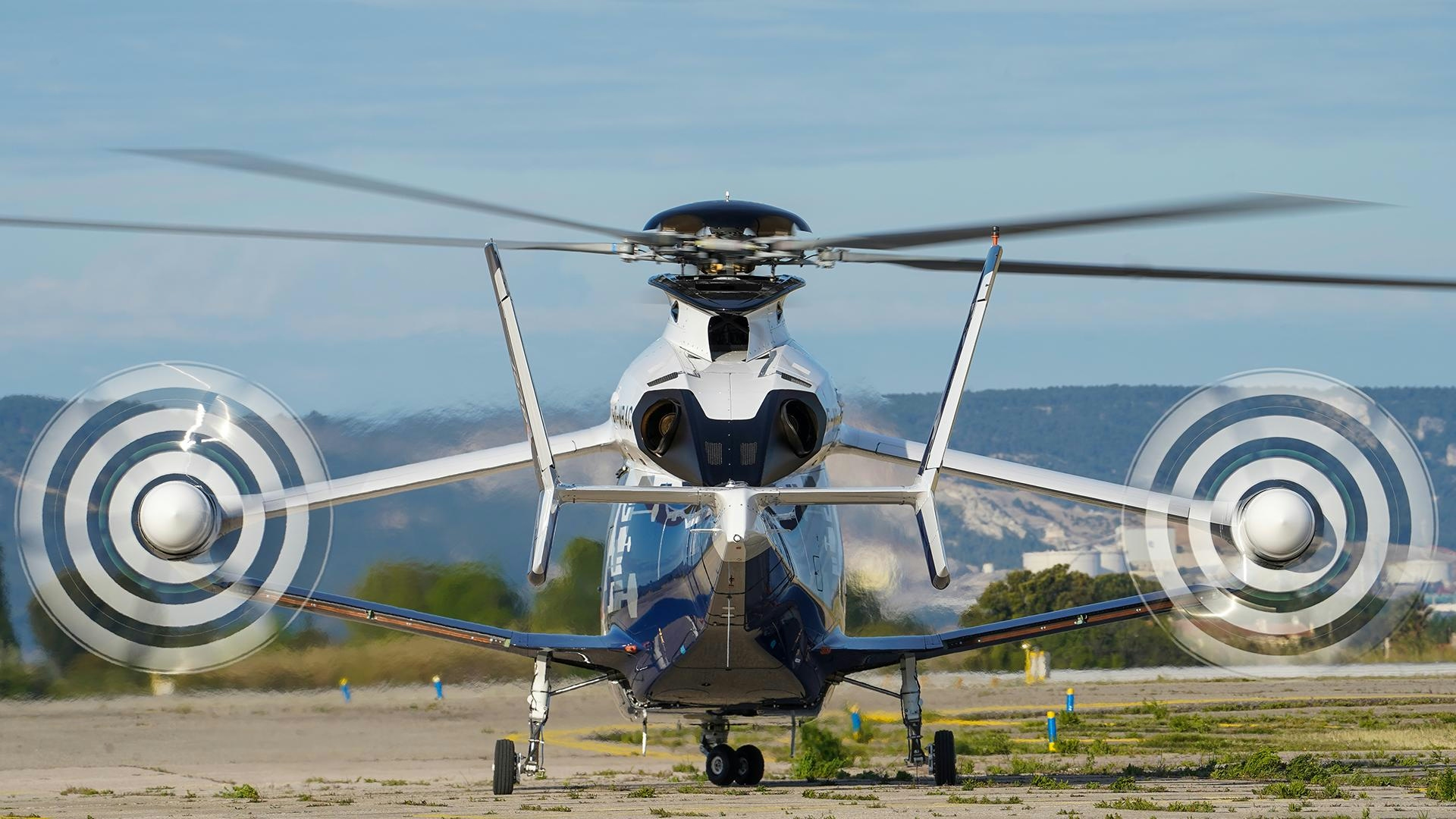
Airbus Helicopters and GE Aerospace have announced the extension of their collaborative research aimed at developing a next-generation rotorcraft propulsion system. This initiative seeks to achieve a significant reduction in fuel consumption compared to existing engines. The partnership has now entered its second phase, which will concentrate on refining detailed engine design concepts and assessing efficiencies at the component level. The initial phase, launched in early 2024, focused primarily on foundational research.

Objectives and Challenges of the Collaboration

The joint effort aspires to produce an engine that establishes new standards in efficiency, reliability, and environmental performance. According to a joint statement from the companies, the ongoing study will explore opportunities to substantially reduce fuel consumption and carbon dioxide emissions while preserving the performance, durability, and reliability required by next-generation rotorcraft. However, specific technical details such as the engine’s power class or targeted fuel-burn reductions have not been disclosed.

Elissa Lee, executive director of commercial turboshaft engines at GE Aerospace, highlighted the critical balance between sustainability and operational requirements. She noted that the collaboration is focused on understanding the necessary steps to deliver meaningful gains in sustainability and efficiency without compromising the demanding mission profiles of helicopter operators.

The project faces considerable challenges, including meeting stringent mission requirements alongside ambitious environmental and efficiency goals. Industry observers are closely monitoring the anticipated improvements in performance and emissions, which could have significant implications for the rotorcraft market. The initiative is also expected to intensify competition, prompting rival manufacturers to accelerate their own next-generation engine development programs. For instance, Korea Aerospace Industries is actively marketing its Surion helicopter internationally, while Safran’s Aneto engine is powering new Bell 214ST models, underscoring the competitive environment.

Strategic Implications for Airbus Helicopters

Historically, Airbus Helicopters has sourced propulsion systems primarily from France-based Safran Helicopter Engines and Pratt & Whitney Canada. Among its current production platforms, only the NH Industries NH90 is equipped with GE engines. The deepening collaboration with GE may indicate a strategic shift in Airbus Helicopters’ approach to propulsion, particularly as the company participates in NATO’s Next Generation Rotorcraft Capabilities study. This involvement could further position Airbus Helicopters at the forefront of advanced rotorcraft technology and influence future market dynamics.

As the project progresses into its next phase, the aerospace industry will be closely observing how Airbus Helicopters and GE address the technical and environmental challenges inherent in developing next-generation rotorcraft engines, and how their partnership may shape the future of rotorcraft propulsion.

More news
Kyrgyzstan to Adopt EMPIC GmbH Software for Flight Safety Oversight

Kyrgyzstan to Adopt EMPIC GmbH Software for Flight Safety Oversight

Kyrgyzstan to Adopt EMPIC GmbH Software for Flight Safety Oversight Modernizing Aviation Oversight Kyrgyzstan’s State Civil Aviation Agency has announced its intention to implement a flight safety oversight software system developed by the German company EMPIC GmbH. The agency confirmed that the system, which has already undergone successful testing, will be employed to automate certification and oversight processes, consolidate data from various aviation authorities into a unified database, and streamline inspectors’ workflows by significantly reducing paperwork. This initiative represents a major step toward modernizing the country’s aviation regulatory framework. The agreement was formalized during a signing ceremony attended by Daniyar Bostonov, head of the State Civil Aviation Agency, and Joerg Kottenbrink, Managing Director of EMPIC GmbH. Established in 2001 and based in Erlangen, Bavaria, EMPIC GmbH specializes in regulatory software tailored for aviation authorities. Its flagship product, EMPIC-EAP, is a modular and customizable platform designed to meet the specific needs of aviation regulators worldwide. Implementation Challenges and Industry Implications Despite the anticipated benefits, the transition to the new system presents several challenges. The agency must ensure that the software integrates seamlessly with existing infrastructure and secure sufficient funding to support its full implementation. Additionally, comprehensive training for personnel will be critical to ensure effective operation and to maximize the system’s potential advantages. The adoption of EMPIC’s software is expected to draw scrutiny from international aviation bodies, which will likely monitor the implementation closely to verify compliance with global safety standards. The competitive landscape for aviation oversight solutions may also prompt other software providers to offer alternative products, especially if concerns arise regarding EMPIC GmbH’s suitability for Kyrgyzstan’s specific regulatory environment. Local stakeholders have underscored the necessity of robust data privacy and security protocols to protect sensitive flight safety information managed within the new system. The State Civil Aviation Agency regards the deployment of EMPIC GmbH’s software as a pivotal move to enhance regulatory efficiency and align Kyrgyzstan’s aviation oversight with international best practices.
Why Hawaiian Airlines Is Waiting Until 2028 To Add A Premium Economy Cabin To Its Airbus A330 Fleet

Why Hawaiian Airlines Is Waiting Until 2028 To Add A Premium Economy Cabin To Its Airbus A330 Fleet

Hawaiian Airlines’ Premium Economy Upgrade: A 2028 Milestone Hawaiian Airlines has announced plans to introduce a dedicated Premium Economy cabin on its Airbus A330-200 fleet starting in 2028. This long-anticipated development addresses a notable gap in the airline’s product offering, which until now has consisted of a stark contrast between lie-flat First Class seats and standard Main Cabin accommodations. Despite operating transpacific flights lasting six to ten hours—routes where premium economy has become a standard feature for many carriers—Hawaiian has delayed implementing this intermediate class for decades. Strategic and Financial Factors Behind the Delay The airline’s hesitation to adopt a true Premium Economy product stems from a combination of strategic priorities, financial limitations, and broader industry timing. When Hawaiian last refurbished its A330 interiors roughly ten years ago, the decision was made to expand the “Extra Comfort” section, which offers additional legroom but does not constitute a fully differentiated premium economy cabin. This approach aligned with Hawaiian’s focus on a high-density, leisure-driven business model, allowing the airline to upsell incremental comfort without reducing the standard eight-abreast economy seating configuration. Over time, however, passenger expectations evolved significantly. Competitors such as All Nippon Airways introduced Hawaii-specific aircraft featuring expansive premium economy cabins with wider seats, increased pitch, enhanced dining options, and upgraded entertainment systems. These offerings clearly distinguished the mid-tier product from standard economy, highlighting the absence of a comparable option on Hawaiian’s A330s. Consequently, travelers faced a binary choice: pay a premium for extra legroom or make a substantial leap to lie-flat First Class seating, with no intermediate alternative. External challenges further complicated Hawaiian’s ability to invest in cabin upgrades. The COVID-19 pandemic severely disrupted international travel, while the devastating Maui wildfires and substantial aircraft commitments placed additional financial strain on the airline. The recent acquisition by Alaska Airlines, however, has provided Hawaiian with greater financial stability and a clearer strategic vision for its A330 fleet, enabling the airline to move forward with the Premium Economy introduction. Navigating Regulatory and Competitive Challenges Despite the planned 2028 rollout, Hawaiian Airlines faces several obstacles that could affect the timeline. Regulatory approval processes for new cabin configurations are often lengthy and complex, a challenge well known to Alaska Airlines. Additionally, the competitive environment is intensifying. American Airlines is aggressively upgrading its fleet by expanding first-class and extra-legroom seating and aims to equip all narrowbody aircraft with seatback entertainment by the early 2030s. International carriers such as Emirates are also raising the bar for premium economy, enhancing comfort and amenities to attract discerning travelers. These industry trends place pressure on Hawaiian not only to introduce a Premium Economy cabin but to ensure that the product meets or exceeds evolving customer expectations. As mid-tier cabins continue to perform strongly across the global airline industry, leaving this segment unaddressed has become increasingly untenable for Hawaiian. By 2028, Hawaiian Airlines intends to close this gap in its service offering. However, the airline must successfully navigate regulatory complexities and a competitive landscape to deliver a Premium Economy experience that resonates with today’s sophisticated travelers.
Engine Fault Causes Royal Navy Helicopter Crash Fatality

Engine Fault Causes Royal Navy Helicopter Crash Fatality

Engine Fault Causes Fatal Royal Navy Helicopter Crash An official investigation has determined that a mechanical failure in a Royal Navy helicopter engine was a critical factor in the death of a serviceman during a training exercise. The incident occurred on 4 September 2024, involving a Merlin Mk4 helicopter from Royal Naval Air Station (RNAS) Yeovilton in Somerset. Three crew members were engaged in night-flying exercises when the aircraft was compelled to make an emergency water landing approximately 25 nautical miles south of Lyme Regis, Dorset, at around 20:50 GMT. Investigation Reveals Engine Malfunction and Crew Response The service inquiry identified a split in a diaphragm within one of the helicopter’s engines as the initiating cause of the crash. This defect allowed excess fuel to enter the engine, causing it to operate at dangerously high speeds. Misinterpreting the situation, the crew believed that the number one and three engines had failed and proceeded to shut them down manually. Consequently, the remaining engine reached its overspeed limit and also shut off, resulting in a total loss of power and the helicopter’s descent into the sea. Lieutenant Rhodri Leyshon, the right-hand seat pilot, sustained serious injuries during the impact and was unable to escape as the helicopter submerged. He was recovered approximately two hours later and subsequently pronounced dead in hospital. The other two crew members suffered minor injuries. The helicopter was later retrieved from the seabed in two major sections and was declared beyond repair. Broader Context and Safety Implications This tragic event has intensified concerns regarding mechanical faults in military aviation. The Royal Navy crash follows a series of high-profile helicopter incidents worldwide, including a recent increase in crashes involving the US Army’s Apache helicopters linked to transmission failures. These developments have prompted heightened scrutiny of military helicopter reliability and safety protocols. In response, military organizations and industry competitors are implementing enhanced safety measures and focusing on technological advancements to mitigate the risk of similar accidents. Air Marshal Alan Gillespie, director general of the Defence Safety Authority, called on all commands to thoroughly review the 44 recommendations issued by the inquiry panel. Expressing condolences, he stated, “On behalf of the Defence Safety Authority and the wider Defence Aviation community, I offer my sincere condolences to Lt Leyshon's family, friends and colleagues.” The recent series of helicopter accidents highlights the urgent necessity for continuous improvements in aviation technology and the strict enforcement of safety standards to safeguard service personnel.
Joby Aviation Begins Texas Air Taxi Test Flights Amid Stock Decline

Joby Aviation Begins Texas Air Taxi Test Flights Amid Stock Decline

Joby Aviation Commences Texas Air Taxi Test Flights Amid Stock Market Pressures Joby Aviation (NYSE: JOBY) has initiated its first White House-endorsed electric air taxi demonstration flights in the Dallas-Fort Worth region, marking a pivotal step toward the company’s goal of launching commercial passenger services. The week-long series of test flights, conducted from September 10 to 15, forms part of the Federal Aviation Administration’s (FAA) Advanced Air Mobility and eVTOL Integration Pilot Program (eIPP). This initiative aims to collect operational data and establish potential routes to facilitate the future integration of electric vertical takeoff and landing (eVTOL) aircraft into commercial aviation. Demonstrations Amid Financial and Market Challenges The commencement of these flights coincides with a difficult period for Joby Aviation. On the opening day of the Texas demonstrations, the company’s stock reached a 52-week low of $6.25 before closing marginally higher at $6.31. This decline reflects mounting investor apprehension regarding the financial sustainability and market readiness of Joby’s technology, despite the company’s advancement toward the final phase of FAA type certification. Joby’s leadership remains resolute in its commitment to begin commercial passenger operations by the end of 2026. The Texas test flights, conducted alongside competitors Beta Technologies and Wisk Aero, are designed to demonstrate the safe operation of eVTOL aircraft in proximity to conventional air traffic at busy airports. Although these demonstration flights do not carry passengers, the data gathered will be instrumental for the FAA in developing regulatory frameworks to support the broader integration of eVTOL vehicles into the national airspace system. FAA Administrator Bryan Bedford emphasized the significance of these efforts, stating, “Advanced Air Mobility vehicles are the future of aviation and these demonstrations in Texas are critical to getting us there.” The flight schedule includes landings at DFW Corporate Aviation, round trips over Arlington, and routes connecting Alliance Airport with Toyota Motor North America’s headquarters in Plano. Joby’s founder and CEO, JoeBen Bevirt, described the program as a transformative moment for the industry. He highlighted the role of the Texas Department of Transportation (TxDOT) in facilitating the initiative, noting that the eIPP provides a valuable opportunity to introduce eVTOL aircraft into urban environments and accelerate the timeline toward commercial service. Financial Performance and Industry Context Despite these operational advancements, Joby continues to confront significant financial challenges. The company has yet to generate revenue from its electric aircraft operations. In the second quarter, Joby reported total revenue of $38.6 million, nearly all derived from Blade, a passenger air travel business acquired last year. Blade contributed $36.2 million, with passenger seat flights increasing by more than 50% year-over-year. Company management has identified aircraft availability, rather than passenger demand, as the primary limitation on growth. Joby has revised its full-year revenue forecast upward to a range of $115 million to $125 million, a projection that remains heavily dependent on Blade’s ongoing performance. Meanwhile, operating losses continue to widen, with the second-quarter deficit expanding to approximately $261 million, up from $234 million in the previous quarter and $168 million a year earlier. The company closed June with $2.3 billion in cash and short-term investments and anticipates cash burn of between $385 million and $415 million in the second half of the year. The Texas demonstrations also underscore broader challenges facing the advanced air mobility sector. As competitors such as Embraer accelerate their own eVTOL development programs, the race to commercialize air taxis intensifies. Regulatory, safety, and infrastructure obstacles remain substantial, and questions persist regarding the scalability and profitability of the air taxi model. Joby’s progress in Texas highlights both the potential and the complexities involved in integrating eVTOL technology into the U.S. airspace, as the company and the wider industry navigate the transition from demonstration projects to commercial operations.
Iberia Receives Full Approval for Airbus A350 Heavy Maintenance

Iberia Receives Full Approval for Airbus A350 Heavy Maintenance

Iberia Gains Full Regulatory Approval for Airbus A350 Heavy Maintenance Iberia has secured unrestricted certification from the Spanish Aviation Safety and Security Agency (AESA) to conduct comprehensive heavy maintenance on Airbus A350 aircraft. This milestone represents a significant enhancement of Iberia Maintenance’s capabilities, enabling the division to perform the full spectrum of approved heavy maintenance tasks on the A350 from the outset—a first for the airline. Extensive Preparation and Strategic Significance The approval culminates a two-year initiative launched at the end of 2022 to ready Iberia’s Heavy Maintenance division for servicing the Airbus widebody. Throughout this period, the airline implemented over 150 measures spanning engineering, workforce training, production processes, infrastructure upgrades, materials management, and equipment acquisition. The program also involved revising technical documentation, quality assurance procedures, organizational frameworks, and IT systems to meet stringent regulatory standards. Enrique Robledo, Director of Iberia Maintenance, highlighted the achievement as a testament to the division’s preparedness in terms of equipment, processes, documentation, and qualified personnel. The unrestricted certification not only enables Iberia to maintain its own A350 fleet but also positions the company as a competitive maintenance, repair, and overhaul (MRO) provider capable of servicing third-party operators of the A350. This expansion taps into a growing global market as the aircraft type accumulates flight hours and requires increasingly extensive maintenance checks. Competitive Landscape and Industry Context Iberia’s enhanced maintenance capabilities arrive amid a dynamic and competitive MRO sector. Industry analysts observe that rival airlines and independent providers are likely to respond by upgrading their own service offerings to protect market share. Recent developments, such as FL Technics’ expansion in the United Arab Emirates, illustrate how competitors are pursuing strategic partnerships and facility enhancements to capture a larger portion of the maintenance market. Simultaneously, some airlines are dedicating resources to lengthy approval processes for new premium cabin products, as seen with American Airlines and Lufthansa. These efforts may temporarily shift focus away from direct competition in heavy maintenance services. Heavy maintenance encompasses far more comprehensive inspections and repairs than routine line maintenance, demanding specialized facilities, advanced engineering expertise, and certified personnel. Regulatory approval is a prerequisite for any MRO provider to undertake such work on a specific aircraft type. AESA’s unrestricted authorization confirms that Iberia Maintenance has fulfilled all necessary requirements to deliver full heavy maintenance services on the A350 without the limitations that characterized earlier capability phases. With the Airbus A350 now integrated into Iberia’s heavy maintenance portfolio, the company strengthens its position within the sector and opens new avenues for growth. This certification aligns with Iberia’s broader strategic objective to develop its maintenance operations as a business serving both its own fleet and the wider aviation industry.
NetJets to Construct Terminal and Hangar at Dallas Love Field

NetJets to Construct Terminal and Hangar at Dallas Love Field

NetJets Announces Major Expansion at Dallas Love Field NetJets Aviation has unveiled plans to develop a substantial new facility at Dallas Love Field, comprising a 14,000-square-foot terminal and an 80,000-square-foot maintenance hangar. This initiative, branded as the Dallas NetJets Campus, will span over 100,000 square feet and represents a $35 million investment aimed at significantly expanding the company’s footprint in the region. Project Timeline and Development Phases Construction is scheduled to commence in November 2026, with completion anticipated by May 2028. The project will proceed in three distinct phases. Initially, six existing hangars and a terminal building will be demolished to clear the site. This will be followed by the construction of the new terminal facility. The final phase will involve building the maintenance hangar alongside additional campus infrastructure to support NetJets’ operations. Regulatory and Competitive Landscape The expansion comes amid ongoing federal restrictions on commercial flights at Dallas Love Field, a regulatory framework designed to control congestion and balance the interests of commercial and private aviation. These limitations present potential challenges that NetJets must navigate carefully to realize its development goals. Furthermore, the project is expected to heighten competition among private aviation providers in the Dallas area. Competitors such as VistaJet and Amalfi Jets may respond by upgrading their services or expanding their own facilities to maintain market share. The development will likely attract close attention from local authorities and airlines operating at Dallas-Fort Worth International Airport, given Love Field’s strategic role in the region’s aviation network. Despite these complexities, NetJets’ substantial investment underscores its confidence in the growing demand for private aviation services in North Texas. The new campus is poised to enhance the company’s operational capabilities and service offerings, reinforcing its position at one of the busiest urban airports in the United States.
Using AI in Aircraft Purchases

Using AI in Aircraft Purchases

Using AI in Aircraft Purchases Expert Guidance in a Complex Market David G. Mayer, a member of the global Aviation Practice Group at Shackelford, McKinley & Norton in Dallas, provides comprehensive legal counsel on a broad spectrum of private aircraft matters. His expertise encompasses regulatory compliance, tax planning, purchases, sales, leasing, financing, risk management, insurance, aircraft management and operations, hangar leasing, and related corporate issues. Mayer regularly represents a diverse clientele, including corporations, high- and ultra-high-net-worth individuals, flight departments, lessees, borrowers, operators, sellers, purchasers, managers, lessors, and lenders. Opportunities and Challenges of AI Integration The integration of artificial intelligence (AI) into the aircraft acquisition process is reshaping industry practices, offering significant potential benefits alongside notable challenges. AI technologies promise to streamline due diligence procedures, optimize financing structures, and improve risk assessment capabilities. Despite these advantages, many stakeholders find it difficult to quantify the direct returns on AI investments. The complexity involved in measuring AI’s impact on transaction efficiency and cost reduction often complicates the justification for initial expenditures by both buyers and sellers. Regulatory considerations further complicate the adoption of AI in aircraft purchases. As compliance requirements evolve, regulators are increasingly focused on ensuring transparency and accountability in AI-driven decision-making, particularly in high-value transactions. This heightened scrutiny may slow the pace of AI integration, as companies strive to align their systems with both domestic and international regulatory standards. Market Dynamics and Industry Responses The aviation sector’s response to AI’s expanding role has been cautious. Concerns about a potential bubble in the AI market have led investors to carefully monitor capital flows and regulatory developments. The risk of market concentration, where a limited number of dominant firms control critical AI technologies, has raised concerns about diminished competition and increased susceptibility to financial shocks. Some analysts warn that a surge in AI-driven debt could exacerbate the risk of a financial downturn, especially if regulatory pressures or shifts in investor sentiment trigger a market correction. Industry reactions to AI adoption vary widely. While some companies actively embrace AI to secure a competitive advantage, others adopt a more conservative stance due to uncertainties surrounding the long-term costs and benefits. The prospect of a near-term market correction, coupled with intensified scrutiny of AI-related expenses, is prompting many aviation stakeholders to proceed with caution. Throughout this evolving landscape, Mayer and his colleagues continue to assist clients in navigating the complexities of aircraft transactions, balancing the promise of AI with the inherent risks involved in its integration.
CIAM Unveils RPD-150T Engine to Replace Rotax 150 hp Model

CIAM Unveils RPD-150T Engine to Replace Rotax 150 hp Model

CIAM Introduces RPD-150T Engine to Replace Rotax 150 hp Models The Central Institute of Aviation Motors (CIAM) has announced the development of the RPD-150T, a new 150-horsepower rotary piston engine intended to supplant foreign-made Rotax engines in light aircraft and unmanned aerial vehicles (UAVs). This advancement was reported by the Russian publication *Tekhnosfera Rossiya*. Technical Features and Development The RPD-150T weighs 87 kilograms and incorporates several modern features, including turbocharging, a dry sump lubrication system, and a FADEC (Full Authority Digital Engine Control) system. CIAM has declared a service life exceeding 3,000 hours for the engine. Designed as a two-section unit, the RPD-150T is part of a broader series of Russian rotary piston engines with power outputs ranging from 50 to 500 horsepower. The design documentation necessary for production has already been completed, signaling readiness for manufacturing. Market Position and Challenges The RPD-150T is positioned to replace the Rotax 912, 914, and 915 engines, which currently dominate the Russian light aviation market, including light aircraft, ultralight planes, and autogyros. Rotax engines have gained popularity due to their compact size, relatively low weight, and reliable power output. However, CIAM faces significant challenges in ensuring that the RPD-150T matches or exceeds the reliability and performance standards established by these well-regarded foreign models. Gaining regulatory approval and certification will be critical hurdles that could influence the timeline for the engine’s widespread adoption. Furthermore, transitioning existing operators accustomed to Rotax engines will require careful planning and support to facilitate acceptance of the new technology. Competitive and Industry Context CIAM’s efforts unfold within a competitive landscape where major engine manufacturers such as General Electric and Pratt & Whitney Canada continue to advance their own propulsion technologies. The broader aviation engine sector demands substantial financial investment for innovation, as illustrated by recent setbacks in hydrogen propulsion projects like Stralis, which suffered from funding shortages. These factors underscore the risks and capital intensity involved in bringing new engine technologies to market. Despite these challenges, the introduction of the RPD-150T marks a significant step toward reducing Russia’s dependence on foreign engine suppliers and bolstering its domestic aviation industry. CIAM’s commitment to developing a comprehensive range of rotary piston engines reflects a strategic focus on supporting both manned and unmanned aviation sectors with indigenous technology.
Air Taxi Pilot Program Launches in Fort Worth

Air Taxi Pilot Program Launches in Fort Worth

Air Taxi Pilot Program Launches in Fort Worth Perot Field Fort Worth Alliance Airport has been selected as the launch site for Texas’s pioneering air taxi pilot program, marking a significant step toward integrating electric aircraft into the state’s transportation network. Known as "Project Nexus," the initiative seeks to establish a foundation for self-piloted planes, air taxis, and vertical take-off-and-landing (VTOL) aircraft to operate across Texas by 2029. The program officially commenced on September 10 with a demonstration attended by U.S. Transportation Secretary Sean Duffy, U.S. Senator Ted Cruz, and officials from the Texas Department of Transportation (TxDOT). Texas becomes the sixth state to participate in this federal initiative, which collaborates with aviation innovators BETA Technologies and Joby Aviation, alongside TxDOT, to develop regional air taxi services initially focused on Dallas, Austin, San Antonio, and eventually Houston. Phased Rollout and Testing Project Nexus is structured to unfold over three phases during the next three years. The first phase concentrates on piloted aircraft, including helicopters and fixed-wing planes, to collect operational data, validate air routes, and refine safety protocols. These initial flights will not carry passengers but will test flight operations between strategic locations, such as a Joby Aviation electric air taxi roundtrip between Fort Worth Alliance and Dallas Fort Worth International Airport. Additional test routes will include the Fort Worth Stockyards and Toyota Motor North America’s headquarters in Plano. The second phase will expand the program’s scope to airborne medical and cargo logistics, facilitating the transport of critical medical supplies and donor organs between rural and urban hospitals in the Austin and San Antonio regions. The final phase aims to introduce passenger flights aboard air taxis, connecting major cities within the Texas Triangle—Dallas-Fort Worth, Austin, Houston, and San Antonio. Building the Infrastructure for Electric Aviation A key objective of Project Nexus is to develop a scalable system that links urban centers, rural communities, and neighboring states as air mobility technology evolves. TxDOT Executive Director Marc Williams highlighted that the pilot program will "build a framework for how electric aircraft could one day connect people, goods, and communities across the state." The project also involves Plano-based VertiPorts by Atlantic, a company specializing in the development of takeoff and landing sites for hybrid aircraft. To accommodate the anticipated growth in electric aviation, the program will prioritize the development of charging infrastructure and operational facilities. Joby Aviation has designated Fort Worth Alliance as its long-term base for regional flight operations, underscoring the airport’s strategic importance in the emerging air taxi network. Opportunities and Challenges Ahead While the prospect of faster and cleaner transportation has been met with enthusiasm, Project Nexus faces several challenges, including regulatory approval, infrastructure development, and public acceptance. As the program advances, competition among companies such as Joby Aviation and Archer Aviation is expected to intensify, driving rapid technological progress. At the launch event, Senator Cruz emphasized Texas’s proactive approach, stating, “In Texas, we don’t wait for the future to arrive, we build it.” If successful, Project Nexus has the potential to transform travel, goods delivery, and emergency response across the Lone Star State, ushering in a new era of mobility.
Arcadia eFuels and MB Energy Strengthen eSAF Supply Chain

Arcadia eFuels and MB Energy Strengthen eSAF Supply Chain

Arcadia eFuels and MB Energy Strengthen eSAF Supply Chain Arcadia eFuels, a developer specializing in electric synthetic fuels, has entered into a Memorandum of Understanding (MoU) with energy company MB Energy to advance the decarbonization of European aviation. This strategic agreement seeks to establish a comprehensive infrastructure for the distribution, storage, and blending of synthetic aviation fuel (eSAF), addressing the urgent need for scalable, low-emission fuel solutions across Europe. Building a Robust eSAF Value Chain The partnership will focus on evaluating commercial and operational opportunities to create a resilient eSAF value chain throughout the continent. The initiative aims to integrate the entire process—from production using Power-to-Liquid technology to the final delivery of fuel to aircraft—thereby overcoming logistical challenges that have impeded the widespread adoption of sustainable aviation fuels. A central element of the collaboration is the development of a logistics framework encompassing transport, storage, blending, and delivery at major European airports. MB Energy will act as a strategic partner responsible for the purchase and distribution of eSAF volumes produced within the Arcadia eFuels project network. Amy Hebert, CEO of Arcadia eFuels, emphasized the importance of a holistic approach, stating, “Commercializing eSAF requires more than simply producing sustainable fuel; it requires the entire value chain. MB Energy’s expertise in logistics, storage, blending, and fuel distribution makes it an ideal partner to connect production with the aviation market. Together, we are helping to build the infrastructure needed to expand the use of eSAF across Europe.” Navigating Challenges in Sustainable Aviation Fuel Adoption The push for synthetic aviation fuels coincides with increasingly stringent European regulatory frameworks prioritizing the decarbonization of air transport. However, the transition to eSAF faces significant hurdles. Meeting the rising demand for sustainable aviation fuel necessitates substantial investment not only in production capacity but also in the supporting infrastructure. The complexity of transporting, storing, and blending synthetic fuels—challenges mirrored in other regions such as the U.S. Midwest corn belt—highlights the critical need for resilient and efficient supply chains. Moreover, the competitive landscape is evolving, with other companies likely to invest in similar infrastructure and production capabilities to secure market share. Geopolitical uncertainties, fluctuating tariffs, and escalating material and energy costs further complicate efforts to maintain supply chain resilience and sustainability. Jonathan Perkins, CEO of MB Energy, underscored the importance of collaboration, noting, “The future success of synthetic fuels for aviation will depend on solid cooperation throughout the entire value chain. Arcadia eFuels brings its production expertise, while MB Energy contributes infrastructure, logistics, market access, and customer relationships. Together, our goal is to explore how to establish scalable and reliable eSAF supply chains for the European aviation market.” This collaboration aligns with Arcadia eFuels’ broader strategy of forging alliances within the energy ecosystem to accelerate eSAF commercialization. For MB Energy, the partnership enhances its portfolio of low-emission solutions, reinforcing its role as a dependable energy provider amid a rapidly evolving market landscape.
line
Airbus Helicopters and GE to Continue Joint Research Collaboration









