
Trasforma le intuizioni dell’IA in azioni concrete

Tendenze
Categories
Aircraft Deliveries Slow as Supply Chain Issues Persist
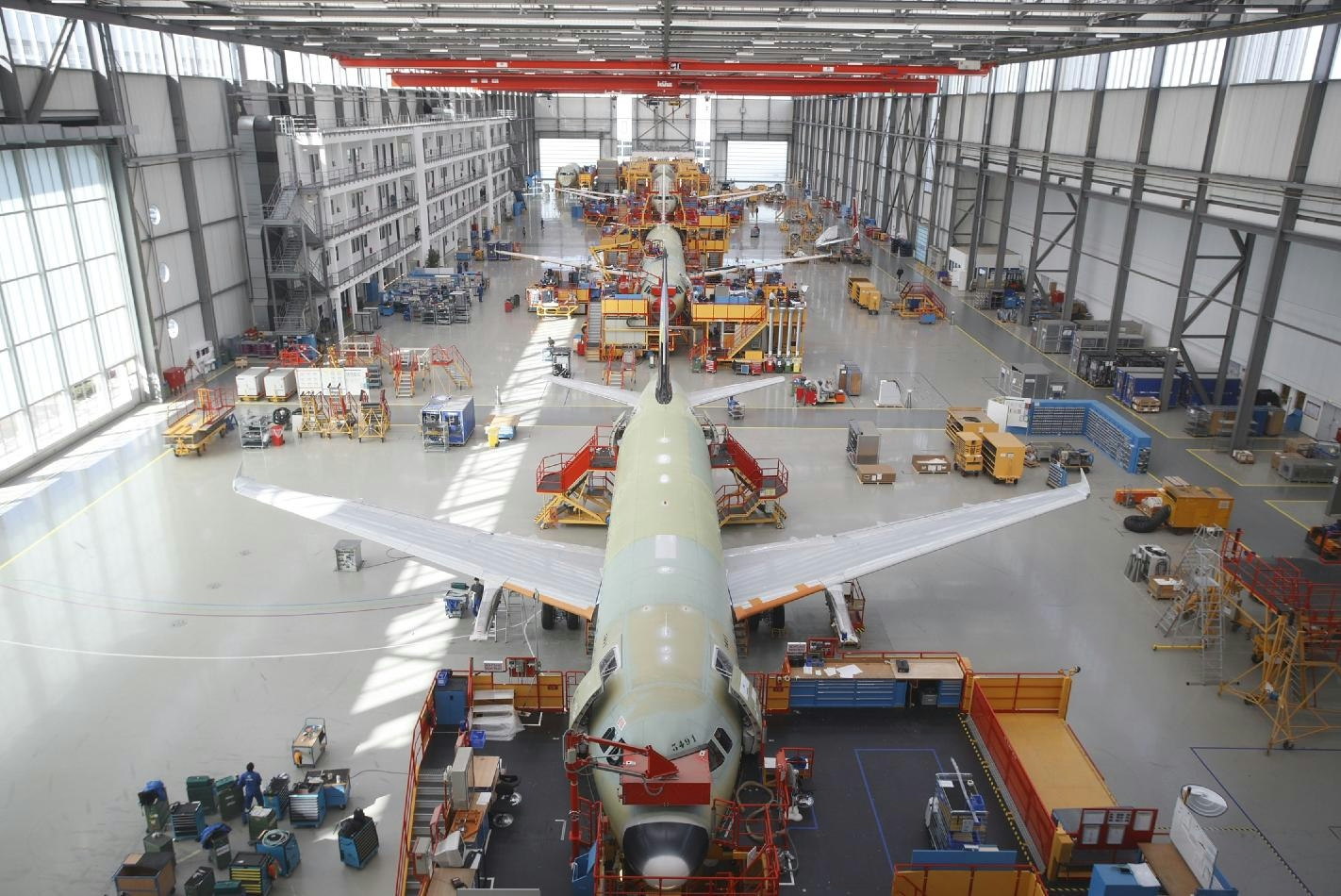
Aircraft Deliveries Slow as Supply Chain Issues Persist
The commercial aerospace and defence sector is experiencing increasing delays in aircraft deliveries, driven primarily by persistent supply chain constraints that surpass challenges related to labour, capital, and engineering. A recent analysis by Bain & Company, examining 15 major aerospace programmes across the United States and Europe, found that 87% of these programmes identified supplier bottlenecks as the chief obstacle to addressing record order backlogs.
Structural Production Gaps and Supply Chain Pressures
Bain’s report highlights a significant disparity between production growth targets and current output levels, with projected increases ranging from 20% to 500% above existing capacities between 2024 and early 2026. This gap is characterized as structural rather than temporary. Boeing’s order backlog has surged to $695 billion, while Airbus continues to pursue aggressive plans to increase monthly output of its A320 family, despite ongoing disruptions in engine and component supplies. These supply challenges are especially pronounced for low-cost and regional carriers, which depend heavily on timely fleet renewals to maintain operations.
Engine supply remains a critical bottleneck. CFM International’s LEAP engine programme, which powers a substantial portion of the global narrowbody fleet, is currently producing at 1.4 times its most recently disclosed output targets. Similarly, the Airbus A320 and Boeing 737 MAX programmes are operating at 1.5 and 1.2 times their target rates, respectively. These figures underscore the intense pressure on delivery schedules for airlines awaiting new aircraft.
The core constraint identified in the report lies in demand concentration among sub-tier suppliers responsible for engines, castings, forgings, and composite structures. These suppliers face the challenge of rapidly scaling production to meet simultaneous surges in demand from multiple manufacturers. Complicating this effort is the absence of a unified forecast that captures the full scope of combined demand, leaving suppliers struggling to keep pace. Moreover, scaling production places additional strain on unit economics, as capital expenditures and working capital requirements escalate amid heightened cash flow pressures. This dynamic is already influencing component pricing and threatens to further restrict parts availability, with potential repercussions for aftermarket services and maintenance costs.
Industry Resilience and Strategic Responses
Despite these challenges, the aerospace market has demonstrated resilience. Investor confidence remains robust, as evidenced by a record 142 commercial aircraft deliveries in May 2026. Nonetheless, ongoing supply chain disruptions pose a risk to Airbus’s internal target of 900 deliveries for the year and may complicate the industry’s broader objective of achieving net-zero carbon emissions by 2050. Delays in fleet renewals could slow the adoption of more fuel-efficient aircraft, hindering environmental progress.
Manufacturers and suppliers are actively implementing mitigation strategies to address these issues. GE Aerospace has pledged over $100 million in supplier investments for 2026, while Airbus’s Skywise data platform has contributed to a 33% reduction in A350 delivery lead times by enabling faster resolution of quality issues. Bain’s analysis concludes that digital forecasting and predictive supplier analytics will constitute the most significant competitive advantage for manufacturers over the next five years. As the industry strives to bridge the widening gap between burgeoning order books and actual production, competitors are adapting their supply chain management approaches to navigate the pressures of overheated demand, reflecting the sector’s ongoing struggle to reconcile growth ambitions with operational realities.

Etihad and Swissport Extend Global Partnership

Sepehran Airlines B737 Returns to Mashhad After Tyre and Engine Issues

Etihad Deploys Widebody Fleet to Meet Strong Demand

Korean Air Finalizes $36.2 Billion Deal with Boeing

Australia’s RFDS Queensland Section Orders Six King Air 260Cs

Korean Air Finalizes Order for 103 Boeing Jets and Engines

Embraer E195-E2 Features Distinctive Engine Placement Among Regional Jets

What Passengers Can Expect on Boeing’s New 777X Jet

How Ethiopian Airlines Became Africa’s Leading Carrier Amid Gulf Competition

Joby Aviation Extends Autonomous Flight Capabilities with Cross-Country Tour
