Immagine

Trasforma le intuizioni dell’IA in azioni concrete

Unisciti oggi alla lista d’attesa di AeroGenie!

Tendenze

Categories

Aircraft Spares, Rotables, and Logistics Market: Steady Growth Amid Rising Global Aviation Needs
July 17, 2025By ePlane AI
Aircraft Spares, Rotables, and Logistics Market: Steady Growth Amid Rising Global Aviation Needs
0
0
Aircraft Spares
Rotables Market
Aviation Logistics

Aircraft Spares, Rotables, and Logistics Market: Steady Growth Amid Rising Global Aviation Needs

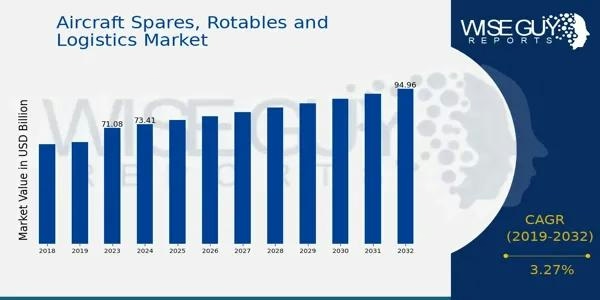
The global market for aircraft spares, rotables, and logistics is witnessing steady expansion, driven by a resurgence in aviation activity, aging aircraft fleets, and an intensified focus on operational efficiency and safety. Valued at $71.08 billion in 2023, the market is projected to increase to $73.41 billion in 2024 and is expected to reach $95.0 billion by 2032. This growth corresponds to a compound annual growth rate (CAGR) of 3.27% from 2025 to 2032, reflecting sustained demand across the sector.

Market Drivers and Emerging Trends

The expansion of both commercial and defense aviation fleets in developed and emerging economies is a key factor propelling market growth. Airlines and military operators are investing in advanced aircraft, which in turn elevates the demand for high-quality spares and rotables—components such as landing gears, avionics, and engines that are designed for repair and reuse. Rotables are particularly valued for their cost-effectiveness and essential role in maintenance cycles.

Increasing air passenger traffic, both domestically and internationally, places pressure on operators to maximize aircraft availability and reduce downtime. This dynamic has intensified the need for reliable logistics services and just-in-time inventory systems, ensuring the rapid delivery and turnaround of critical parts. Additionally, aging aircraft fleets contribute significantly to market demand, as older planes require more frequent maintenance and part replacements. Regulatory mandates from authorities such as the Federal Aviation Administration (FAA) and the European Union Aviation Safety Agency (EASA) further reinforce the necessity for timely part replacement and upkeep, making compliance both an operational and legal imperative.

Digitalization and Automation Transforming the Sector

The integration of digital technologies is reshaping the aircraft spares and logistics landscape. Predictive maintenance, powered by artificial intelligence (AI) and the Internet of Things (IoT), enables operators to proactively identify component wear, thereby reducing emergency replacements and minimizing aircraft downtime. Maintenance, Repair, and Overhaul (MRO) providers, along with logistics companies, are increasingly adopting innovations such as digital twins, blockchain technology, and real-time inventory management systems to enhance supply chain transparency and traceability.

Cloud-based fleet maintenance software and digital tracking tools have become standard industry practices, facilitating accurate forecasting, optimized inventory management, and accelerated service cycles. These technological advancements are critical for operators seeking to reduce turnaround times and improve overall aircraft readiness.

Market Challenges and Global Dynamics

Despite robust growth prospects, the market faces several challenges. The high cost of aircraft components and rotables can impose financial strain on smaller operators and MRO facilities. Furthermore, global tariffs present a significant risk by potentially disrupting supply chains and increasing operational costs. In response, companies are reevaluating their vendor networks, diversifying sourcing strategies, and relocating maintenance operations to countries less affected by tariffs to mitigate these challenges.

The broader aviation Maintenance, Repair, and Overhaul (MRO) market mirrors these trends, with an estimated value of $90 billion in 2024 and projections reaching $155 billion by 2034. The aviation safety compliance segment is also expanding, valued at $8 billion in 2024 and expected to grow to $13 billion by 2034, underscoring the sector’s ongoing commitment to safety and regulatory adherence.

Outlook

As global aviation activity continues to increase and fleets undergo modernization, demand for aircraft spares, rotables, and efficient logistics solutions is expected to remain strong. The continued adoption of digital technologies, adherence to regulatory requirements, and strategic supply chain management will be pivotal in shaping the market’s trajectory in the coming years.

More news
Storm Aviation expands GO Team into global AOG recovery hub

Storm Aviation expands GO Team into global AOG recovery hub

Storm Aviation Expands GO Team into Global AOG Recovery Hub Storm Aviation, a UK-based maintenance, repair, and overhaul (MRO) provider and a member of the FL Technics Group, has announced a strategic expansion of its GO Team to serve as the central coordination hub for Aircraft on Ground (AOG) recovery across the group’s worldwide network. This development enhances the existing rapid-response service by offering operators a unified point of contact for urgent technical recovery, thereby simplifying and accelerating the process of returning grounded aircraft to operational status. Enhanced Global Reach and Capabilities Leveraging FL Technics Group’s extensive infrastructure, which includes over 100 line maintenance stations and seven base maintenance hangars located in Lithuania, the UK, the Czech Republic, Indonesia, and the Dominican Republic, Storm Aviation’s expanded model significantly broadens its geographical coverage. The group’s spare parts inventory, strategically positioned in Dubai, Singapore, and Vilnius, further supports this global reach. Collectively, these assets span the Americas, Europe, Asia-Pacific, and the Middle East, enabling faster response times and more efficient coordination regardless of where an AOG event occurs. With three decades of experience in managing time-critical aircraft recoveries, Storm Aviation brings considerable operational expertise to its enhanced role. The GO Team is now able to deploy recovery specialists closer to the site of grounded aircraft, reducing response times while maintaining centralized oversight. This integrated approach combines Storm Aviation’s rapid deployment capabilities with the technical resources of the FL Technics Group, providing operators with streamlined support and access to a comprehensive range of services. Saulius Bajarunas, Chief Operating Officer of FL Technics Group, emphasized the significance of this development: “Storm Aviation’s GO Team acts as the lead coordinator for AOG recovery across the group. Our role is to put the best capability of the group—our engineers, tooling, approvals, and global footprint—behind every recovery the GO Team coordinates. For airlines, ACMI providers, lessors, and other aircraft operators, that means broader geographical coverage, faster access to technical resources, and simpler coordination when time is critical.” Streamlined Coordination Amid Industry Challenges AOG situations demand the swift mobilization of engineers, specialized tooling, spare parts, and maintenance approvals, often spanning multiple locations. Under the new operational model, a single request to Storm Aviation’s GO Team triggers the entire recovery process—from initial assessment and resource deployment to logistics management and return to service. This eliminates the need for operators to engage multiple contacts or coordinate with disparate partners across regions. Despite the promising expansion, Storm Aviation enters a competitive and challenging market environment. Established providers such as West Star Aviation have reported record demand for AOG services, underscoring the growing pressure to scale operations for rapid, global response. Industry analysts anticipate intensified competition as companies enhance their marketing efforts and service offerings to protect market share. Furthermore, ongoing supply chain constraints, including tightening parts availability highlighted by Aviation Week, pose additional challenges that could affect response times and service reliability across the sector. Thomas Buckley, CEO of Storm Aviation, reflected on the company’s evolving role: “Coordinating AOG recovery for the entire FL Technics Group is the next step in our story. Operators no longer have to chase multiple contacts across time zones. They have a single point of contact through our GO Team, and behind that team stands the entire capability of the FL Technics Group. Wherever your airline needs technical recovery assistance, we can mobilize faster and with greater certainty.” As Storm Aviation positions itself as a global AOG recovery hub, it confronts both significant opportunities and notable industry headwinds. The company’s success will depend on its ability to consistently deliver speed, reliability, and seamless coordination in an increasingly demanding market.
Why American Airlines’ Widebody Jets Sat Idle in Roswell for Five Years Before Vietnam Redeployment

Why American Airlines’ Widebody Jets Sat Idle in Roswell for Five Years Before Vietnam Redeployment

Why American Airlines’ Widebody Jets Sat Idle in Roswell for Five Years Before Vietnam Redeployment American Airlines, long associated with the iconic Boeing 747, has not operated the type for several decades. The airline retired its last standard 747 in 1985, followed by the final two 747SPs in 1992. During the COVID-19 pandemic, as airlines worldwide grounded aircraft in desert storage facilities, many observers assumed that American’s jets sent to Roswell International Air Center were 747s. In fact, the airline stored Boeing 767s and Airbus A330s, not the much larger 747s. Factors Behind Extended Storage in Roswell The prolonged idling of these widebody jets in Roswell, some for as long as five years, resulted from a combination of global and industry-specific challenges. The onset of the pandemic caused a sharp decline in international travel demand, but this was further exacerbated by broader market volatility and geopolitical tensions, including conflicts in the Middle East. These factors collectively suppressed global travel and diminished the immediate need for large, long-haul aircraft. Confronted with financial pressures and an uncertain recovery timeline, American Airlines made the strategic decision to streamline its fleet and reduce operational costs by placing several widebody aircraft into long-term storage. While some of these aircraft have since been repurposed—several Boeing 767s have been converted into freighters—others are preparing for redeployment abroad. Notably, eight former American Airlines Airbus A330s are slated to join Vietnam’s Sun PhuQuoc airline in 2026. This move reflects a resurgence in demand for widebody jets in select markets and aligns with Boeing’s forecast for 2026 to 2045, which anticipates steady demand for widebody aircraft despite recent disruptions. The narrative of pandemic-era 747 retirements is more relevant to carriers such as KLM, Qantas, and British Airways, whose jumbos entered a saturated secondhand market. These aircraft, preserved by desert climates, are unlikely to return to passenger service. For American Airlines, the pressing question remains which of its pandemic-retired widebodies will be reactivated and which will remain grounded indefinitely. American Airlines’ Fleet Evolution and Current Strategy American Airlines operates one of the world’s largest commercial fleets. In the 1970s and early 1980s, the airline flew Boeing 747s but shifted focus to twin- and tri-engine widebodies for long-haul routes after retiring the type. Throughout the 2000s, American maintained an all-Boeing mainline fleet until a significant Airbus A320-family order in 2011 diversified its lineup. Today, American’s mainline fleet centers on the Airbus A319, A320, A321, and Boeing 737 aircraft, while its widebody fleet consists exclusively of Boeing 777 and 787 Dreamliner variants. With approximately 1,029 aircraft in service and an average fleet age of 13.9 years, the airline continues to modernize and adapt to evolving market conditions. The five-year period during which American’s widebodies remained idle in Roswell highlights the complex interplay of global events, economic factors, and strategic fleet management decisions. As international travel recovers and new markets develop, these aircraft are positioned for renewed roles, underscoring the resilience and adaptability of both American Airlines and the broader aviation industry.
Airbus sees strong potential for A220 in Southeast Asia

Airbus sees strong potential for A220 in Southeast Asia

Airbus Sees Strong Potential for A220 in Southeast Asia Expanding Connectivity Across the Region Airbus has expressed strong confidence in the prospects of its A220 aircraft within Southeast Asia, a region where airlines are increasingly focused on expanding long, thin routes and improving connectivity between secondary cities. Anand Stanley, President of Airbus Asia Pacific, highlighted the unique suitability of the A220 for markets characterized by challenging geography, extensive distances, and route structures that favor smaller narrow-body aircraft. He pointed to Indonesia’s archipelagic layout, Malaysia’s diverse terrain, and the vast distances across Asia as factors that make point-to-point, long, thin routes particularly valuable. According to Stanley, the A220 is ideally positioned to meet these specific market demands. The A220 programme has achieved significant milestones, surpassing 1,100 aircraft orders worldwide, with notable momentum in the Asia Pacific region. Airbus recorded 815 gross orders in the first five months of 2026, including 379 in May alone. More than half of these orders, and the majority of those in May, originated from the greater Asia Pacific region, including China. Airbus forecasts demand for nearly 20,000 new aircraft in Asia Pacific over the coming years, with approximately 16,000 expected to be single-aisle models. Stanley emphasized that much of this growth will be driven by long, thin routes, reflecting the shared connectivity needs of ASEAN countries fueled by economic expansion and rising air travel demand. Competitive Landscape and Market Dynamics Despite the promising outlook, Airbus faces stiff competition in Southeast Asia from established manufacturers such as Boeing, with its 737 series, and ATR, both of which maintain strong regional footholds. Airlines in the region are carefully assessing the A220’s efficiency and capacity to address evolving network requirements, particularly as they seek to replace aging fleets and adapt to shifting market conditions. Competitors are likely to respond by enhancing their own regional aircraft offerings, especially as Airbus contemplates the development of a larger A220 variant to meet customer demands. A significant endorsement for the A220 came on May 6, when AirAsia announced an order for 150 A220-300 aircraft at Airbus’ Mirabel facility in Canada. This represents the largest single firm order for the A220 to date and marks AirAsia as a new customer. The airline also secured options for an additional 150 aircraft, potentially expanding its commitment to 300 jets from the A220 family. Deliveries are scheduled to begin in 2028, with AirAsia set to become the launch customer for the A220’s new 160-seat cabin configuration. AirAsia Group CEO Bo Lingam confirmed that Philippines AirAsia would be among the first to receive the new A220s as part of the group’s broader fleet renewal programme. Stanley underscored that AirAsia’s order illustrates the A220’s broad appeal, extending beyond full-service carriers to low-cost airlines as well. He described the A220 as a clean-sheet, modern design capable of delivering best-in-class performance for both market segments. As Southeast Asian airlines continue to modernize their fleets and expand their networks, the A220 emerges as a compelling option. However, Airbus will need to carefully navigate competitive pressures and evolving market demands to sustain its growth trajectory in the region.
The Airline That First Introduced Premium Economy

The Airline That First Introduced Premium Economy

The Airline That First Introduced Premium Economy Premium Economy has emerged as a fundamental component of long-haul air travel, offering a middle ground between the affordability of economy class and the luxury of business class. Airlines around the world now depend on this cabin category to provide passengers with wider seats, improved dining options, and increased personal space—amenities that appeal to travelers willing to pay a premium for enhanced comfort. What initially began as a niche experiment has since transformed into a significant revenue source, prompting carriers to retrofit aircraft and expand routes to accommodate growing demand. Origins and Industry Adoption The concept of Premium Economy originated in the early 1990s when airlines recognized a distinct gap between the cramped conditions of economy cabins and the high cost of premium seating. EVA Air was among the pioneers, formally introducing a dedicated intermediate cabin on its Boeing 747 fleet. This strategic move helped redefine industry standards regarding passenger comfort and cabin segmentation, establishing a model that would eventually be adopted globally. While EVA Air led the way, other carriers also saw the potential of this new class. Delta Air Lines, often credited as the first major U.S. airline to offer a Premium Economy product, faced the challenge of catering to rising demand for premium cabins while still appealing to budget-conscious travelers. As airlines increasingly targeted high-paying passengers, the divide between premium and economy classes widened. In response, some competitors introduced basic fares within premium cabins, making these seats more accessible but often excluding benefits such as premium lounge access. Meanwhile, airlines like Qantas invested heavily in premium cabins while maintaining strong economy offerings to serve a diverse passenger base. Evolution and Strategic Importance Over the past decade, Premium Economy has evolved from a supplementary option to a strategically vital cabin class. A decade ago, it was limited to select long-haul carriers and specific intercontinental routes. Today, it is nearly ubiquitous on widebody fleets across North America, Europe, Asia, and the Middle East. Airlines now design aircraft cabins with Premium Economy in mind, recognizing its ability to increase revenue without significantly reducing seat capacity. Several factors have driven this growth. Passenger expectations have shifted, with travelers seeking greater comfort on long-haul flights but unwilling to pay business class prices. Airlines, in turn, identified the financial advantages of creating a distinct cabin between economy and business. By offering wider seats, increased legroom, and upgraded amenities, carriers can command higher fares while utilizing less space than lie-flat business seats, thereby improving revenue per square foot of cabin space. The post-pandemic travel environment has further accelerated the expansion of Premium Economy. With tighter corporate travel budgets and a surge in leisure travel, airlines required products that appealed to self-funded premium travelers rather than solely corporate clients. Premium Economy met this demand, leading many carriers to expand the cabin across more aircraft types, retrofit existing fleets, and enhance service offerings to further distinguish it from economy class. Today, Premium Economy is firmly established as a core element of airline strategy, balancing the needs of premium and budget travelers while driving revenue growth and reshaping the passenger experience.
Why Pilots Sometimes Shut Down an Airbus A320 Engine During Taxi

Why Pilots Sometimes Shut Down an Airbus A320 Engine During Taxi

Why Pilots Sometimes Shut Down an Airbus A320 Engine During Taxi Passengers observing an Airbus A320 taxiing to or from the gate may notice an unusual sight: one engine’s fan blades remain stationary while the other continues to operate. This practice, known as single-engine taxiing, has become a widespread standard within the airline industry. Its adoption, however, extends beyond operational convenience, encompassing economic, environmental, and safety considerations. From Cost-Saving Measure to Industry Standard Single-engine taxiing initially emerged as an optional technique, primarily employed by ultra-low-cost carriers or during prolonged airport delays to conserve fuel. Over time, rising fuel prices and growing environmental concerns have driven airlines and manufacturers to emphasize operational efficiency more rigorously. What began as a marginal cost-saving tactic has evolved into a fundamental component of contemporary airline procedures. Airbus played a pivotal role in this transition by revising its official pilot documentation. The company relocated the single-engine taxi-in procedure from the Supplementary Procedures section to the Standard Operating Procedures within the Flight Crew Operating Manual. This change, implemented in coordination with aviation regulators, effectively established single-engine taxiing as the default recommendation for A320 flight crews worldwide. Consequently, airlines updated their operational manuals accordingly, and for pilots, shutting down Engine Two during taxi-in has become as routine as deploying flaps or activating the taxi light—except when specific environmental or mechanical conditions necessitate the use of both engines. The Economics and Safety Behind the Practice The primary impetus for single-engine taxiing is economic efficiency. Jet engines are optimized for performance at cruising altitudes rather than idling on the ground, where fuel consumption remains disproportionately high. Operating both engines during taxi, especially amid congested airport conditions, results in significant fuel burn. By shutting down one engine, pilots can reduce idle fuel consumption by nearly half. On average, an A320 saves approximately 8.8 pounds (four kilograms) of jet fuel per minute when taxiing on a single engine. When aggregated across thousands of daily flights, these savings yield considerable economic and environmental benefits. Safety considerations also influence the decision to taxi on one engine. Pilots may shut down an engine in response to malfunctions or to mitigate potential hazards prior to takeoff. In such instances, safety imperatives override efficiency concerns, with airlines prioritizing the well-being of passengers and crew. These safety-driven practices can affect market perceptions and encourage competitors to adopt similar protocols or revise their operational standards accordingly. Looking Ahead: The Future of A320 Operations The adoption and normalization of single-engine taxiing exemplify broader trends in aviation, where efficiency and safety are increasingly integrated. As Airbus prepares to introduce the A320’s successor, currently designated as eAction and expected to enter service around 2030, industry standards and market dynamics are poised to evolve further. Advances in aircraft design and operational procedures will continue to influence how airlines balance efficiency, safety, and environmental responsibility both on the ground and in flight.
Airbus Expands Manufacturing and Supply Chain Operations in India

Airbus Expands Manufacturing and Supply Chain Operations in India

Airbus Expands Manufacturing and Supply Chain Operations in India Airbus is transitioning from a vendor role to a strategic partner within India’s rapidly growing aviation and aerospace sector. Under the leadership of Jürgen Westermeier, President and Managing Director for India and South Asia, the company has significantly increased its investments across manufacturing, engineering, pilot training, supply chain development, and defence. These initiatives align closely with India’s Aatmanirbhar Bharat and Make in India programs, reflecting Airbus’s commitment to supporting the country’s drive for self-reliance and industrial advancement. Strengthening Presence in India’s Aviation Market In an exclusive interview with *Indian Aerospace & Defence*, Westermeier highlighted Airbus’s substantial share of India’s commercial aircraft fleet and its operation of the country’s first private-sector aircraft and helicopter final assembly lines. The company is accelerating both deliveries and localized production to meet the rising demand, positioning itself at the forefront of India’s expanding aviation landscape. Westermeier underscored India’s strategic importance to Airbus, citing robust economic growth projections of 6 to 7 percent and plans to expand the number of airports to over 200 by 2030. He noted that the current fleet of approximately 800 aircraft is expected to nearly triple within the next decade. Furthermore, the average number of trips per capita in India, currently at 0.13, is projected to increase to 0.29 by 2035, indicating significant untapped potential in both domestic and international air travel. Navigating Challenges and Competitive Pressures Despite these promising prospects, Airbus faces several challenges in expanding its operations in India. The company must contend with intensifying local competition, regulatory compliance complexities, and the integration of its global supply chain with India’s evolving manufacturing ecosystem. Competitors such as Embraer are also increasing production capacity and may implement strategic initiatives to strengthen their supply chains and market presence in India. This heightened competition is expected to prompt greater scrutiny and foster innovation throughout the sector. Nevertheless, Airbus’s expanding footprint is widely regarded as a positive development for India’s manufacturing industry. The company’s growth is anticipated to attract further investment from global aerospace firms, enhancing India’s role as a key player in the international aviation supply chain. Resilience Amid Global Uncertainties Addressing concerns related to global uncertainties, including geopolitical tensions in the Middle East, Westermeier acknowledged the complex and dynamic nature of the operating environment. He emphasized that while the air travel market is inherently cyclical, long-term demand remains robust. “Airlines require aircraft that combine strong economic performance, an attractive passenger experience, and operational versatility across diverse markets to thrive amid these fluctuations,” he stated. Recent delivery figures underscore this resilience: in May alone, Airbus delivered 81 aircraft to 45 customers and secured gross orders for 379 aircraft, with year-to-date deliveries up 8 percent compared to the previous year. By localizing helicopter manufacturing, expanding defence collaborations, and designating India as a “material country,” Airbus signals that India’s aviation success is integral to its global ambitions. The partnership between Airbus and India is set to drive the next phase of aviation growth and self-reliance, reinforcing a mutually beneficial relationship amid a rapidly evolving global landscape.
CFM International Aims to Increase Engine Deliveries

CFM International Aims to Increase Engine Deliveries

CFM International Aims to Boost Engine Deliveries Amid Durability Enhancements LONDON — CFM International, the principal engine supplier for Boeing and Airbus single-aisle aircraft, has announced plans to increase its engine deliveries by 15% this year. This target aligns with the growing production rates of aircraft manufacturers, who have identified jet engines as a critical bottleneck in scaling up output. Gael Meheust, CEO of CFM, expressed confidence in meeting the rising demand during a media briefing in London ahead of the Farnborough Air Show, stating that the company is well aligned with the ramp-up schedules set by airframers. Addressing Durability Challenges for the Leap-1B Engine CFM, a joint venture between General Electric Co. and France’s Safran SA, is simultaneously tackling durability issues affecting its Leap-1B engines, which power the Boeing 737 Max exclusively. These engines have encountered premature overhauls, particularly in harsh operating conditions characterized by heat and dust. In response, the company has accelerated efforts to enhance engine longevity. To mitigate these challenges, CFM has obtained approvals from both the U.S. Federal Aviation Administration (FAA) and European regulators for a high-pressure turbine durability kit and a reverse bleed system aimed at extending the lifespan of fuel nozzles. The upgraded durability kit has already been implemented on the Airbus A320, which offers customers a choice between two engine types, and is now approved for use on the 737 Max. Market Impact and Competitive Landscape The market has reacted positively to these technical advancements, with expectations that the time on wing for Leap-1B engines will double by 2027-2028. CFM’s proactive measures are viewed as essential to maintaining its leadership position amid increasing competition. Rivals such as MTU Aero Engines are expanding their aftermarket presence and deepening partnerships with GE Aerospace, intensifying the competitive environment. As CFM strives to meet heightened demand while resolving technical issues, its ability to deliver reliable engines at scale will remain under close scrutiny from aircraft manufacturers and airlines alike, both of whom depend on timely deliveries and enhanced engine performance.
HARS Grounds Last Flying Lockheed L-1049 Super Constellation to Raise Engine Funds

HARS Grounds Last Flying Lockheed L-1049 Super Constellation to Raise Engine Funds

HARS Grounds Last Flying Lockheed L-1049 Super Constellation Amid Fundraising Effort The Historical Aircraft Restoration Society (HARS) Aviation Museum has grounded its renowned Lockheed L-1049 Super Constellation, VH-EAG “Southern Preservation,” to initiate a global fundraising campaign aimed at securing a replacement engine. Based at Shellharbour Airport in New South Wales, Australia, HARS operates what is believed to be the world’s only airworthy Super Constellation of this model. The stretched L-1049 variant is widely recognized as one of the most significant surviving piston-engine airliners, embodying a pivotal era in aviation history. Museum officials have confirmed that an engine malfunction has necessitated the aircraft’s withdrawal from service. The Super Constellation now requires a replacement Wright R-3350 Duplex-Cyclone engine before it can resume flying displays and museum activities. In its campaign announcement, HARS appealed to the public for support, emphasizing the importance of contributions to fund the engine replacement and restore the aircraft to the skies for public enjoyment. Challenges in Preserving a Historic Aviation Icon Originally delivered to the U.S. Air Force in 1955 as Lockheed C-121C serial number 54-0157, VH-EAG celebrates its 70th anniversary this year. As one of the last operational military Super Constellations, the aircraft faces increasing difficulties in sourcing serviceable components, with costs rising accordingly. HARS is currently assessing the feasibility of rebuilding an existing spare engine from its inventory. Should this prove unviable, the museum anticipates the need to acquire a fully serviceable replacement engine at an estimated cost of AU$300,000 (approximately US$220,000). The grounding of VH-EAG underscores the broader challenges confronting historic aircraft preservation. The Super Constellation’s cultural and historical significance has elicited concern among aviation enthusiasts and preservationists, many of whom view the aircraft’s absence from the skies as a potential loss to global aviation heritage. Furthermore, HARS’s decision to ground the aircraft and seek public funding may invite scrutiny regarding the organization’s financial stability and long-term viability. This development could also prompt competitive responses within the aviation museum sector, as other institutions may intensify efforts to acquire similar aircraft or enhance their preservation initiatives, thereby heightening the urgency to safeguard aviation history. From Military Service to a Museum Treasure Before becoming Australia’s most celebrated piston-engine airliner, VH-EAG served over two decades with the United States Air Force and Air National Guard. Its assignments included service with the 1608th Military Air Transport Wing and various state Air National Guard units. After retirement to Davis-Monthan Air Force Base in 1977, the aircraft remained in storage, stripped for parts, and suffered interior contamination from nesting birds. The aircraft’s fortunes changed in 1990 when HARS members discovered it while sourcing parts for another restoration project. Recognizing its historical value, the society negotiated its rescue and, in 1991, commenced a five-year volunteer-led restoration at the Pima Air & Space Museum in Arizona. Supported by aviation organizations and Qantas Airways, this effort became one of Australia’s most ambitious aviation preservation projects. HARS’s current campaign to return the Super Constellation to flight highlights both the enduring appeal of this historic aircraft and the ongoing challenges faced in preserving aviation heritage. The museum is appealing to supporters worldwide to help ensure that VH-EAG can once again inspire future generations from the skies.
Biman Plans to Lease 10 Aircraft by 2027, Says Millat

Biman Plans to Lease 10 Aircraft by 2027, Says Millat

Biman Plans to Lease 10 Aircraft by 2027 to Expand International Operations Biman Bangladesh Airlines has announced plans to lease up to 10 aircraft by 2027 as part of a strategic effort to expand its international network and address current capacity shortfalls. This initiative is intended to bridge the gap until the arrival of 14 newly ordered Boeing aircraft, which are scheduled for delivery beginning in 2031. State Minister for Civil Aviation and Tourism, M Rashiduzzaman Millat, revealed on Sunday that the national carrier aims to secure these leased aircraft within the current year. He explained that the initial plan involves leasing three aircraft, with the potential to increase this number depending on operational requirements and the airline’s broader route expansion strategy. If fully implemented, this plan would increase Biman’s fleet from 19 to as many as 29 aircraft by 2027, representing a 52.6 percent growth and marking one of the most significant short-term expansions in the airline’s history. Navigating a Competitive Global Aviation Market Biman’s leasing ambitions come amid intensifying competition in the global aviation sector, where many major carriers are simultaneously pursuing fleet renewal and expansion. This heightened demand for leased aircraft could affect both availability and leasing costs. For instance, United Airlines plans to retire 80 older planes and expects to receive its first Boeing 737 Max 10 in 2027, a development likely to influence market dynamics. Similarly, WestJet has already leased its first Boeing 737 Max 10, reflecting a broader industry trend toward securing next-generation aircraft through leasing agreements. These factors underscore the challenging environment Biman faces as it seeks to augment its fleet. The global demand for leased aircraft is rising, requiring the airline to carefully navigate market conditions to realize its expansion objectives. Despite these challenges, Biman’s leadership remains confident that the planned fleet growth will enhance the airline’s ability to increase flight frequencies on existing international routes and explore new destinations, effectively positioning the carrier for growth ahead of the new Boeing deliveries in the early 2030s.
New CF6 Engines Improve Fuel Efficiency of the C-5M Galaxy

New CF6 Engines Improve Fuel Efficiency of the C-5M Galaxy

New CF6 Engines Enhance Fuel Efficiency and Longevity of the C-5M Galaxy The Lockheed Martin C-5 Galaxy has been a cornerstone of the United States Air Force’s (USAF) strategic airlift capabilities for more than fifty years, playing a critical role in numerous military operations worldwide. However, by the early 2000s, the aircraft’s original TF39 engines were increasingly inadequate, exhibiting declining performance, heightened maintenance requirements, and persistent shortages of spare parts. These issues posed significant risks to the operational readiness of the fleet. Modernization Through the F138 Turbofan Engine In response to these challenges, the USAF adopted the F138 turbofan, a military variant of General Electric’s CF6-80C2 commercial engine. This upgrade brought substantial improvements in performance, reliability, and, most importantly, fuel efficiency. These enhancements have extended the service life of the C-5M Galaxy, ensuring its continued relevance in the USAF’s strategic airlift operations through at least 2040. The C-5 Galaxy, the largest aircraft in the Air Force inventory, was first delivered to the 437th Airlift Wing at Charleston Air Force Base in June 1970. Over the following decades, the fleet was heavily utilized in major conflicts and operations, including the Vietnam War, Operation Just Cause, and Operations Desert Shield and Desert Storm. The aircraft’s missions ranged from transporting heavy equipment to conducting medical evacuations and supporting logistics for U.S. and allied forces. By 2006, the original TF39 engines had accumulated over two million flight hours, resulting in diminished fuel efficiency, reduced thrust, and lower mission-capable rates. Recognizing that the airframes retained approximately 80 percent of their service life, the Air Mobility Command launched a comprehensive modernization initiative in 1998. Lockheed Martin secured a contract in 2001 to execute the C-5 Reliability Enhancement and Re-engining Program (RERP), initially focusing on four aircraft. The first F138 engines were delivered for testing in 2004, with the inaugural flight occurring in June 2006. By 2009, a $299 million production contract was awarded for nine aircraft, contributing to an overall program value of around $4.5 billion. The final upgraded C-5 was delivered in 2014, and by 2018, 52 aircraft had been modernized, including 49 C-5Bs, two C-5Cs, and one C-5A. These upgraded models were redesignated as the C-5M Super Galaxy, with the C-5Cs receiving the C-5M-SCM (Space Cargo Modification) designation. Impact and Industry Response The integration of the CF6-based engines required extensive testing and certification to meet stringent safety and reliability standards. The resulting improvements in fuel efficiency have attracted attention beyond the military sector, stimulating interest among commercial and logistics operators seeking more efficient airlift solutions. This trend has prompted competitors to accelerate their own engine development programs. Notably, Rolls-Royce is advancing its UltraFan 30 concept, while CFM has certified durability kits for the Leap 1B engine to achieve performance gains comparable to those of the C-5M Galaxy. With these upgrades, the C-5M Super Galaxy exemplifies the benefits of modernization, combining a proven airframe with advanced propulsion technology to address the evolving demands of global air mobility.
line









