
Trasforma le intuizioni dell’IA in azioni concrete

Tendenze
Categories
Are C-17 Globemaster Engines Derived from Boeing 757?
Are C-17 Globemaster Engines Derived from Boeing 757?
Shared Lineage but Distinct Variants
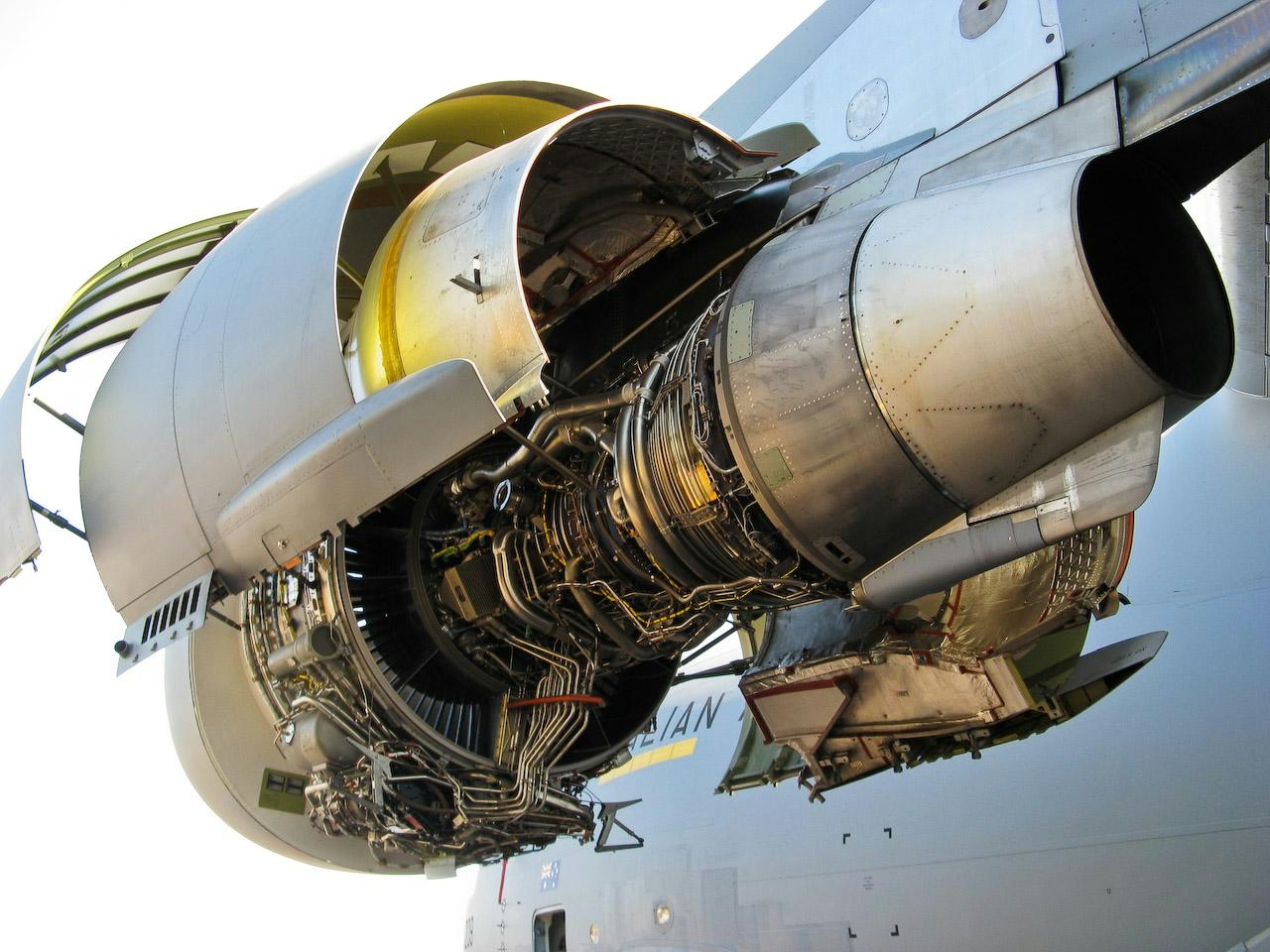
The assertion that the U.S. Air Force’s C-17 Globemaster III is powered by Boeing 757 engines is a common but oversimplified claim within the aviation community. The C-17, introduced in the 1990s as a strategic and tactical airlifter, is equipped with four Pratt & Whitney F117-PW-100 turbofan engines. These engines are not directly transplanted from the Boeing 757; rather, they share a common heritage. The F117 is a military adaptation of the Pratt & Whitney PW2000 family, specifically derived from the PW2040 model that powers certain Boeing 757 variants. While the engines share design foundations, the F117s are distinct variants engineered to meet the rigorous demands of military operations.
This differentiation is critical. The F117 engines on the C-17 have been ruggedized to enhance reliability, maintainability, and performance in challenging environments, distinguishing them from their commercial counterparts. Claims suggesting that the C-17 uses the “same engine” as the 757 can be misleading, as they imply identical hardware and operational characteristics, which is not the case.
The C-17’s Operational Role and Challenges Ahead
The C-17 Globemaster III serves as a versatile workhorse capable of transporting outsized cargo, vehicles, and personnel. Its design incorporates an advanced high-lift wing, powerful thrust reversers, and robust systems that enable operations from short, unimproved airstrips. Typically crewed by a pilot, copilot, and loadmaster, the aircraft can be rapidly reconfigured for diverse missions, including airdrops and aeromedical evacuations, allowing it to deliver directly into austere environments and reduce dependence on intermediate hubs.
Despite its capabilities, the future of large military airlifters such as the C-17 and the larger C-5 Galaxy faces significant challenges. Extending the operational life of these aircraft may incur costs as high as €200,000 per month per plane, raising concerns about long-term sustainability. These financial pressures coincide with rapid advancements in engine technology and evolving market dynamics, complicating decisions about fleet modernization and replacement.
Broader Industry Context
In the commercial aviation sector, Boeing continues to exert considerable industrial and political influence despite recent financial difficulties. However, competition is intensifying as airlines increasingly adopt newer models like the Airbus A321XLR to replace aging fleets, including the Boeing 757. This shift reflects a broader industry trend toward more efficient, next-generation aircraft. Meanwhile, manufacturers such as Embraer are making strides in resolving technical challenges with their geared turbofan (GTF) engines, marking a pivotal moment for their E2 twinjets and further intensifying the technological competition within the sector.
In conclusion, while the C-17 Globemaster III’s engines share a lineage with those used on the Boeing 757, they are distinct variants tailored to different operational requirements. This distinction highlights the complexity of modern engine development and the evolving landscape of both military and commercial aviation.

Etihad Airways Suspends Airbus A380 Flights on Key Route

Aditya Birla Group Seeks Approval for Aircraft Leasing in GIFT City

Qatar Airways Highlights Innovation and Connectivity at Arabian Travel Market 2026

Hong Kong's Five-Year Plan Includes Andrew Fan's Aircraft Parts Processing Hub Proposal

ACIA Aero Leasing Delivers ATR72-600 to Air Nostrum

RTX Appoints Jill Albertelli as Head of Pratt & Whitney

TAT Technologies Joins Beyond Aero Hydrogen Aircraft Program

AURAK Study Highlights Barriers to Air Taxi Adoption in Emerging Economies

Xiamen Air Selects Altitude for 787 Maintenance at Heathrow

Etihad and Swissport Extend Global Partnership
