Immagine

Trasforma le intuizioni dell’IA in azioni concrete

Unisciti oggi alla lista d’attesa di AeroGenie!

Tendenze

Categories

Australia, New Zealand, and U.S. Agree on C-130J Support Pact
May 15, 2026By ePlane AI
Australia, New Zealand, and U.S. Agree on C-130J Support Pact
0
0
C-130J Super Hercules
International Defense Cooperation
Lockheed Martin

Australia, New Zealand, and U.S. Formalize C-130J Support Agreement

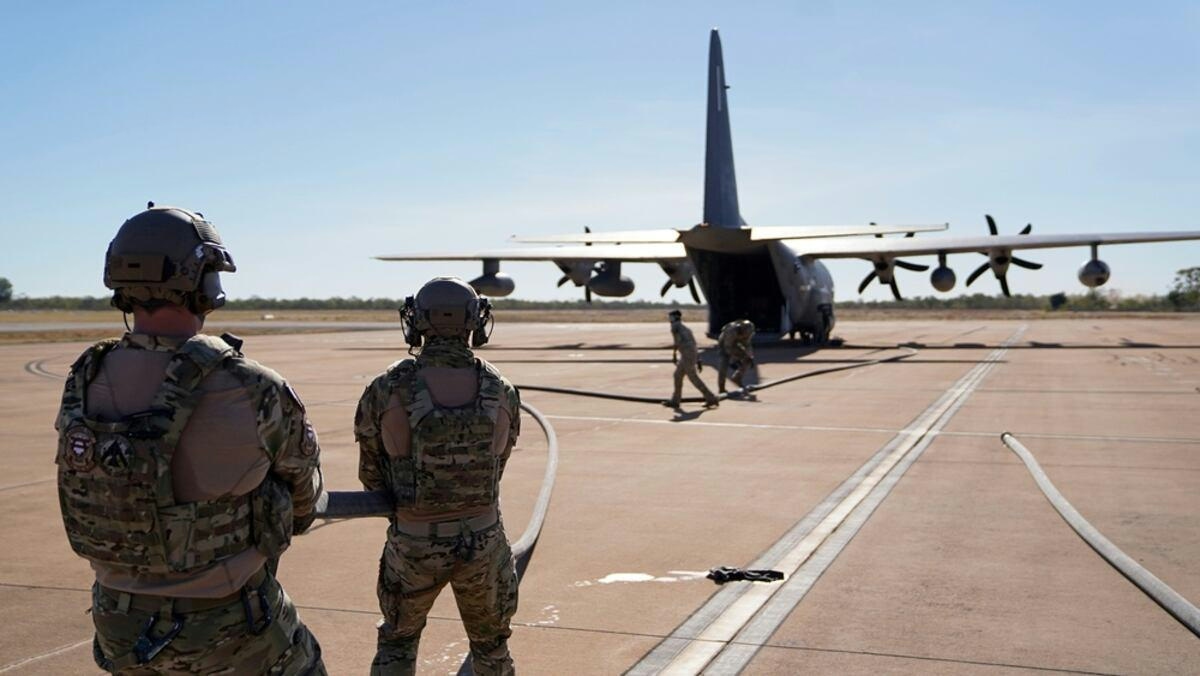
The air forces of Australia, New Zealand, and the United States have entered into a formal agreement to enhance cooperation in sustaining the Lockheed Martin C-130J tactical transport aircraft, a key platform operated by all three nations. The pact is designed to improve interoperability, cross-servicing, and logistics support, according to the U.S. Air Force (USAF).

Expanding Trilateral Collaboration

This new agreement builds upon a 2019 arrangement between the USAF and the Royal Australian Air Force (RAAF), which facilitated cross-maintenance for both the Boeing C-17 and the C-130J. The earlier pact yielded tangible results, including USAF personnel repairing a RAAF C-17 in Alaska and Australian teams servicing U.S. aircraft on home soil. The current trilateral framework broadens the scope of collaboration to include the Royal New Zealand Air Force (RNZAF), which recently joined the C-130J community with the delivery of five aircraft in late 2024.

The USAF remains the largest global operator of the C-130J, with 304 aircraft in service, according to aviation analytics firm Cirium. The RAAF currently operates 12 C-130Js but plans to modernize its fleet by acquiring 20 new aircraft. Meanwhile, New Zealand’s recent induction into the C-130J fleet marks a significant expansion of its tactical airlift capabilities.

Air Marshal Stephen Chappell, chief of the RAAF, highlighted the operational advantages of the agreement, stating, “We continue to work seamlessly with our closest allies and partners, and signing this [letter of understanding] further enhances our operational effectiveness and contributes to collective deterrence through readiness and integration across our platforms. This agreement boosts our C-130J cross-servicing interoperability and logistics support for all three of our nations.”

Challenges and Market Implications

While the pact promises to streamline maintenance processes and improve aircraft readiness, it also introduces challenges. Harmonizing logistics support and ensuring the interchangeability of parts across three distinct national systems may encounter bureaucratic and logistical obstacles. Overcoming these complexities will be essential to fully realize the benefits of the agreement.

The pact’s market impact could be substantial. Enhanced cooperation is likely to increase demand for C-130J maintenance services and spare parts, potentially benefiting companies engaged in aircraft support and logistics. In response, competitors may seek to strengthen their own sustainment capabilities or pursue alternative partnerships to maintain their tactical airlift capacity.

Australia’s broader plans to expand its C-130J fleet and replace its C-27J transports with commercial aircraft may further influence regional and global dynamics within the tactical airlift sector. As the three nations advance this partnership, their ability to navigate logistical challenges and optimize shared resources will be closely monitored by industry experts and allied air forces worldwide.

More news
Carburetor Ice Causes Skydiving Plane to Crash

Carburetor Ice Causes Skydiving Plane to Crash

Carburetor Ice Causes Skydiving Plane Crash Near Upolu Airport A Cessna 182B skydiving aircraft experienced a loss of engine power during its descent near Upolu Airport (PHUP) in Hawi, Hawaii, resulting in a crash that caused substantial damage to the plane and minor injuries to the pilot. According to a recent National Transportation Safety Board (NTSB) report, the incident highlights the dangers of carburetor icing and emphasizes the need for improved pilot training and safety measures. Sequence of Events and Emergency Response The pilot had completed a skydiving drop from 8,500 feet mean sea level and initiated a spiraling descent back to the airport. During this phase, the throttle was reduced to idle, and 20 degrees of flaps were deployed. The pilot then applied full carburetor heat while gradually enriching the engine mixture. At approximately 300 feet above ground level, the mixture was confirmed to be full rich, the propeller was set forward, and carburetor heat was fully engaged. However, when the pilot attempted to increase throttle, the engine failed to respond. Despite following emergency procedures to restore power, the engine could not be restarted. The pilot executed a forced landing in a field about one mile west of the airport. Uneven terrain caused the nose gear to collapse, inflicting significant damage to the fuselage and engine compartment. Investigation Findings and Weather Conditions Post-accident examination revealed no mechanical malfunctions or failures in the engine or fuel system. The gascolator contained 100LL aviation fuel, and only trace amounts of water were detected in the fuel tanks. Weather data from Kailua/Kona Keahole Airport (PHKO), located approximately 34 miles south, recorded a temperature of 84°F, a dew point of 71°F, and relative humidity of 81%. According to the Federal Aviation Administration’s (FAA) Carburetor Ice Probability Chart, these conditions present a high risk of serious carburetor icing at glide power. The FAA’s Pilot’s Handbook of Aeronautical Knowledge explains that carburetor ice is most likely when temperatures are below 70°F and humidity exceeds 80%, but it can occur at temperatures as high as 100°F. During prolonged descents with closed or reduced throttle settings, the engine cools rapidly, increasing susceptibility to carburetor icing. The handbook advises pilots to apply full carburetor heat before reducing throttle and to maintain it during descent, as well as to periodically open the throttle to keep the engine warm. Conclusion and Implications for Aviation Safety The NTSB determined that the probable cause of the accident was a loss of engine power due to carburetor ice formation during the extended descent, with the pilot’s delayed application of carburetor heat contributing to the outcome. This incident underscores the critical importance of timely carburetor heat application, especially in humid conditions. Aviation experts emphasize that enhanced pilot training on recognizing and managing carburetor icing is essential to prevent similar accidents. The event may also prompt increased scrutiny of aircraft maintenance protocols and could lead to higher insurance premiums for aircraft susceptible to carburetor icing. In response, some manufacturers and industry competitors are exploring new technologies and safety features aimed at mitigating the risk of carburetor ice in future aircraft models.
Engine Checks Conducted 70 Times Per Second Before Every Takeoff

Engine Checks Conducted 70 Times Per Second Before Every Takeoff

Engine Checks Conducted 70 Times Per Second Before Every Takeoff The moment an aircraft begins its takeoff roll is marked by a surge of noise and a sudden compression against the seatback, an exhilarating experience for passengers. For the flight crew and the aircraft’s advanced avionics, however, this phase represents the most critical juncture of departure. Before accelerating down the runway, pilots deliberately pause to allow the engines to stabilize at an intermediate thrust setting. During this brief but essential interval, the Full Authority Digital Engine Control (FADEC) system performs continuous verification of every internal parameter—from fuel flow to exhaust gas temperature—ensuring perfect synchronization across both engines. The Importance of Intermediate Thrust Stabilization This pause is far more than a regulatory formality; it is a vital safety protocol designed to prevent asymmetric thrust, which can cause hazardous yawing at low speeds when the rudder has limited effectiveness. The intermediate thrust setting provides the massive fan and compressor assemblies time to overcome their significant rotational inertia. Meanwhile, the FADEC system executes up to 70 high-speed checks per second, amounting to thousands of verifications within moments, to confirm that both engines operate in complete harmony. Unlike automotive engines, where the throttle directly controls power output, a modern airliner’s thrust lever functions as a request to the FADEC. The engines themselves are enormous high-bypass turbofans, with fan diameters exceeding 10 feet and multi-stage compressor spools weighing thousands of pounds. These components cannot deliver immediate, symmetric thrust from idle without risking compressor stalls, surges, and mechanical stress. The intermediate stabilization—typically maintained between 50% and 60% N1—acts as a kinetic buffer, ensuring balanced airflow and pressure ratios before full takeoff power is applied. This procedure is particularly critical for today’s powerful, thrust-intensive engines. By holding at approximately 55% N1, the flight crew ensures both engines are synchronized before the aircraft accelerates to speeds where directional control becomes paramount. Should one engine lag due to wear or system demands, the aircraft could yaw toward the weaker engine, a risk effectively mitigated by this careful stabilization. Operational Challenges and Industry Implications The sophistication of these engine checks introduces new operational challenges. The vast volume of data generated by FADEC systems demands advanced technology for effective management and interpretation, increasing the complexity of engine monitoring. Airlines may encounter higher operational costs due to more frequent engine checks and potential delays if any parameter falls outside acceptable limits. Consequently, maintenance schedules and budgets are being adjusted to accommodate these rigorous protocols, with some carriers investing in enhanced engine monitoring systems to maintain a competitive advantage. The broader aviation market is also responding to these developments. As airlines adapt to these advanced safety measures, competitors are expected to adopt similar practices to ensure regulatory compliance and passenger safety. Financial markets may witness shifts in operational strategies across the sector, with various stakeholders making significant adjustments to address the evolving landscape of engine management and safety protocols. Ultimately, the split-second pause before takeoff exemplifies the complexity and precision of modern aviation, balancing safety, technology, and operational efficiency at the very moment flight commences.
USS John F. Kennedy Begins Acceptance Trials Ahead of Delivery

USS John F. Kennedy Begins Acceptance Trials Ahead of Delivery

USS John F. Kennedy Begins Acceptance Trials Ahead of Delivery The John F. Kennedy, the second nuclear-powered aircraft carrier in the Gerald R. Ford class, departed Newport News on August 12 to commence acceptance trials, a pivotal phase preceding its official delivery to the U.S. Navy. Identified as Pre-Commissioning Unit (PCU) John F. Kennedy, the vessel—soon to be commissioned as USS John F. Kennedy (CVN 79)—will undergo rigorous evaluations of its systems and equipment during these final manufacturer-led sea trials to verify compliance with Navy standards. Delays and Technical Challenges Originally scheduled for delivery in 2025, the 100,000-ton carrier experienced significant delays due to technical difficulties with its Advanced Arresting Gear (AAG) and Advanced Weapons Elevators (AWE). The Kennedy embarked on its initial manufacturer trials in January 2026, with the current acceptance trials marking its second major sea voyage. In the interim, Navy personnel have conducted extensive drills and readiness exercises aboard the ship to prepare both crew and vessel for operational deployment. A key milestone in the ship’s preparation was the deadload testing of its Electromagnetic Aircraft Launch System (EMALS) on June 26, 2026, showcasing the carrier’s advanced launch capabilities. Unlike its predecessor, USS Gerald R. Ford, the Kennedy will be delivered fully equipped to operate the F-35C Lightning II stealth fighter. This capability was secured following Congressional intervention and schedule adjustments, necessitating modifications such as reinforced jet blast deflectors and specialized maintenance systems tailored for the fifth-generation aircraft. Strategic Implications and Future Deployment The Kennedy’s acceptance trials occur amid ongoing challenges within the U.S. naval shipbuilding sector, which has struggled with delivering vessels on time, within budget, and meeting required standards. These delays have elicited skepticism from industry observers and market analysts regarding the Navy’s ability to maintain delivery schedules. Meanwhile, international competitors have cited these setbacks as evidence of their own efficiencies and technological progress in shipbuilding. Upon commissioning, the Kennedy is slated to be homeported at Naval Base Kitsap-Bremerton in Washington, becoming the first Ford-class carrier stationed on the U.S. West Coast. This strategic location will facilitate regular deployments to the Indian and Pacific Oceans. The carrier is expected to arrive at its new homeport no earlier than 2029, following a $145 million upgrade to the base’s electrical infrastructure that commenced in May 2025. The Kennedy will replace the aging USS Nimitz (CVN 68), which is approaching decommissioning. However, the Nimitz will remain in service temporarily to help the Navy fulfill its legal obligation to operate at least eleven aircraft carriers, although it is unlikely to undertake extended deployments again. As the Kennedy progresses through its final trials, its development is closely monitored within the Navy and by industry stakeholders, given the broader implications for U.S. naval readiness and the credibility of the nation’s shipbuilding industry.
Bell Australia Expands Aftermarket Services with New Hydraulics Capabilities

Bell Australia Expands Aftermarket Services with New Hydraulics Capabilities

Bell Australia Expands Aftermarket Services with New Hydraulics Capabilities Bell Textron has significantly enhanced its component, repair, and overhaul (CRO) facility in Clontarf, Brisbane, by introducing hydraulic component maintenance and repair services for the first time in the Asia-Pacific (APAC) region. This development marks a substantial expansion of the facility, which has grown from a modest 50m² workshop to an 800m² standalone site, underscoring Bell’s deepening commitment to the Australian rotary wing market. Facility Upgrades and Service Enhancements The expansion includes a major upgrade to non-destructive testing (NDT) capabilities, featuring a new NDT room that is three times larger than the original space. Alongside this, Bell has increased the number of qualified technicians to meet growing demand. The upgraded CRO shop now offers a comprehensive range of hydraulic services, including inspection, testing, repair, and overhaul of Bell aircraft components and assemblies. These enhancements are designed to reduce operator downtime, lower maintenance costs, and provide tailored support that aligns with customers’ operational and budgetary needs. Over the past year, these improvements have contributed to a 50% increase in Bell’s component capability. Dean Ashton, general manager of Bell Textron Australia, emphasized the strategic importance of the expansion, stating, “This expansion reflects a major investment in our operations and a clear, long-term commitment to the Australian rotary wing market. By upgrading our facilities, introducing new services, and growing our team, we are strengthening our ability to provide reliable, responsive, and locally driven support for operators across Australia and the wider Asia-Pacific region.” Industry Challenges and Strategic Responses Bell’s expansion occurs amid broader industry challenges, notably a shortage of structural technicians within the Australian automotive aftermarket sector. This shortage poses potential risks to service capacity and response times as Bell scales its new hydraulics capabilities. Nevertheless, the market response is anticipated to be positive, given Bell’s strong reputation and the increasing demand for dependable aftermarket support in the region. The move may also encourage competitors to enhance their own service offerings or differentiate their capabilities to maintain market share. To further support its customers, Bell Australia has established a dedicated CRO logistics team aimed at streamlining freight forwarding, improving turnaround times, and optimizing spares management through better demand forecasting and inventory control. The expansion has also created new employment opportunities, with the CRO shop doubling its workforce over the past 18 months. Bell has invested in apprenticeship programs and expanded factory training for technicians, thereby building a robust pipeline of skilled talent while maintaining rigorous quality standards. Certifications and Future Outlook The Clontarf facility holds certifications from CASA 145, FAA, and TCCA, ensuring compliance with global aviation standards. Bell Australia’s hydraulic services currently encompass the overhaul and repair of hydraulic servos for Bell 205, 206, 212, 407, and 412 models. Additionally, integrated servo and valve assemblies are available for the Bell 212 and 412, with further capability expansions planned. As Bell continues to invest in its Australian operations, the company aims to develop a comprehensive aftermarket support ecosystem that addresses the evolving needs of customers across the APAC region, positioning itself for sustained growth and service excellence in the years ahead.
Brussels Airport Starts Building Quieter Aircraft Engine Test Facility

Brussels Airport Starts Building Quieter Aircraft Engine Test Facility

Brussels Airport Initiates Construction of Quieter Aircraft Engine Test Facility Brussels Airport has launched the construction of a new ground run-up enclosure (GRE) designed to substantially reduce noise generated during aircraft engine testing following maintenance. This €15 million project, slated for completion by March 2027, forms a central component of the airport’s broader sustainability agenda and its commitment to minimizing environmental impact. Design and Noise Reduction Measures The facility will adopt a U-shaped design featuring 15-meter-high acoustic barriers engineered to decrease engine testing noise by up to 10 decibels—a reduction generally perceived as halving the sound intensity. This improvement is expected to provide significant relief to residents in nearby communities such as Humelgem and Steenokkerzeel, who have historically been affected by the noise from engine run-up tests. These tests are mandatory safety procedures conducted after aircraft maintenance to verify engine performance before aircraft return to service. Covering approximately 8,000 square meters—slightly larger than a football pitch—the enclosure will be capable of accommodating large widebody aircraft, including models such as the Airbus A350 and Boeing 787. Construction has commenced with foundational work and paving, with the installation of acoustic barriers to follow. Currently, engine tests are performed in open areas, exposing surrounding neighborhoods to elevated noise levels. The new facility will enable these essential procedures to be conducted with significantly reduced noise emissions while maintaining operational safety standards. Operational Impact and Industry Context Brussels Airport conducts between 150 and 200 engine run-up tests annually, all scheduled between 7:00 a.m. and 10:00 p.m. to minimize disruption to local communities. The construction of the enclosure is not expected to interfere with ongoing airport operations, and the facility is anticipated to be fully operational by March 2027. While this initiative represents a major advancement toward quieter and more sustainable airport operations, it also presents challenges, including high construction costs, regulatory compliance, and the integration of advanced noise-reduction technologies. The project is likely to attract attention from environmentally conscious travelers and airlines, potentially enhancing Brussels Airport’s competitive position. In response, rival airports may accelerate their own sustainability efforts or invest in similar noise mitigation solutions. The aviation industry as a whole is evolving, with companies such as GE Aerospace investing in the development of quieter and more efficient engine technologies. As both airports and manufacturers prioritize sustainability and noise reduction, innovation in this domain is expected to play an increasingly pivotal role in shaping the competitive landscape. Brussels Airport’s new engine test facility exemplifies the growing emphasis on balancing operational requirements with environmental responsibility, setting a benchmark for quieter and more community-friendly airport practices.
EVA Air Orders Five LEAP-1A Spare Engines Worth $131 Million

EVA Air Orders Five LEAP-1A Spare Engines Worth $131 Million

EVA Air Commits $131 Million to Acquire Five LEAP-1A Spare Engines EVA Air has approved the purchase of five LEAP-1A30S spare engines from CFM International, with the transaction valued at up to US$131 million. The airline’s board authorized the acquisition on August 13, 2026, aiming to enhance operational reliability and ensure sufficient spare capacity for its fleet powered by LEAP-1A engines. This strategic investment is intended to support the airline’s ongoing maintenance requirements and operational continuity. The deal, negotiated at prevailing market prices, involves CFM International, the engine manufacturer, which is an independent supplier with no related-party affiliation to EVA Air. Despite the operational benefits, the substantial financial commitment has attracted scrutiny regarding its impact on the airline’s profitability and budgetary flexibility. Industry analysts have highlighted that such a significant capital outlay could exert pressure on EVA Air’s financial resources, particularly given the persistent challenges facing the global aviation sector. Competitive Implications and Strategic Focus EVA Air’s decision may also influence competitive dynamics within Taiwan’s aviation market. Its primary competitor, China Airlines, might reconsider its own strategies for engine maintenance and spare parts inventory in response to EVA Air’s move to secure a robust spare engine stockpile. This development underscores the importance of operational reliability and fleet readiness in a highly competitive environment. Ultimately, EVA Air’s investment reflects a commitment to maintaining high service standards and minimizing operational disruptions, even as it manages the financial complexities associated with significant capital expenditures.
Vietnam's Aviation Law 2025: Implications for Investment and Aircraft Financing

Vietnam's Aviation Law 2025: Implications for Investment and Aircraft Financing

Vietnam’s 2025 Aviation Law: Transforming Investment and Aircraft Financing Vietnam has embarked on a significant overhaul of its aviation regulatory framework with the enactment of the Law on Civil Aviation of Vietnam No. 130/2025/QH15, known as the 2025 Aviation Law. Replacing the previous 2006 legislation, this law will take effect on 1 July 2026 and aims to modernize the sector by providing a clearer legal foundation for aircraft financing, facilitating non-state investment in airports, and regulating cross-border aircraft operations. These reforms are designed to attract increased foreign investment and enhance the efficiency of industry practices. Modernizing Infrastructure and Expanding Capacity The 2025 Aviation Law is a cornerstone of Vietnam’s broader strategy to upgrade its aviation infrastructure in line with ambitious national development goals. The government’s revised airport plan envisions a network of 36 airports capable of handling over 249 million passengers annually by 2030. Achieving this expansion will require an estimated investment of VND 577.572 trillion (approximately US$22.2 billion). The rapid growth of Vietnam’s aviation market is evident in 2025 figures, which recorded 83.5 million passengers and 1.5 million tonnes of cargo, representing year-on-year increases of 10.7% and 18.5%, respectively. These trends highlight the sector’s dynamic development and the expanding opportunities for foreign investors seeking to participate in Vietnam’s aviation market. Enhanced Legal Protections for Aircraft Lessors and Financiers A notable advancement under the new law is the strengthened legal framework supporting creditor rights in aircraft financing. The 2025 Aviation Law explicitly incorporates Irrevocable Deregistration and Export Request Authorisations (IDERAs) into primary legislation. Article 21 empowers the Civil Aviation Authority of Vietnam (CAAV) to revoke an aircraft’s registration and airworthiness certificates and to deregister the aircraft without prior court approval when acting on a registered IDERA. Furthermore, Article 15 clarifies that an export certificate of airworthiness is not mandatory unless stipulated by the importing jurisdiction. Despite these improvements, Article 21 primarily addresses deregistration, export procedures, and inter-agency cooperation, but does not elaborate on the transfer of possession, technical records, or the resolution of local liabilities. Vietnam’s adherence to the Cape Town Convention preserves certain non-consensual interests, including the right to arrest or detain aircraft for unpaid taxes or public service fees. Consequently, lessors and financiers are advised to complement IDERAs with enforcement strategies tailored to Vietnam’s specific regulatory environment to effectively manage these local considerations. Facilitating Private Investment in Airport Infrastructure The 2025 Aviation Law also establishes a more transparent and supportive regulatory environment for private sector participation in airport development. Article 5 promotes business freedom, fair competition, and the protection of foreign investors’ lawful interests, thereby encouraging diverse investment models. Article 30 permits public-private partnerships (PPP) and other business investment arrangements, subject to market access and investor selection criteria. Investors are also authorized to develop dual-use facilities and enhance public airport assets without the need to transfer land-use rights or asset ownership, providing greater flexibility in infrastructure development. Industry Response and Emerging Challenges The aviation market is expected to respond favorably to the new law, which modernizes aircraft leasing regulations and reinforces the legal basis for private investment in airport infrastructure. However, airlines will face new requirements related to fleet development planning, potentially increasing operational costs and complexity. Regional competitors may adjust their strategies to align with the evolving regulatory landscape or risk losing ground as Vietnam’s aviation sector becomes more streamlined and attractive to investors. The 2025 Aviation Law represents a pivotal development for Vietnam’s aviation industry, offering enhanced protections for financiers and clearer pathways for private and foreign investment, while simultaneously introducing new operational challenges for industry stakeholders.
Manna Air Launches Delivery Service in Tulsa

Manna Air Launches Delivery Service in Tulsa

Manna Air Launches Drone Delivery Service in Tulsa Manna Air Delivery has officially inaugurated its first commercial drone delivery service in Tulsa, marking a significant advancement in urban logistics. Operating from its base near Cherry Street, the company now offers rapid delivery of food and everyday essentials using unmanned aircraft. This initiative represents a novel approach to meeting consumer demand for swift and contactless delivery options. Demonstration and Early Partnerships The launch event included a live demonstration flight, illustrating the process by which orders are loaded onto the drone before it ascends to an altitude of 200 feet. The aircraft then travels to the customer’s location, descending to approximately 50 feet to ensure a gentle and precise delivery. Manna Air reports that once an order is loaded, delivery can be completed in as little as three minutes. Several local businesses have partnered with Manna Air to participate in this pioneering service. Among them are Andolini’s Pizzeria, Paréa Coffee, Sapori, and Firefly Brew. Mike Bausch, owner of Andolini’s, highlighted the adaptations made to accommodate the drone’s size and weight restrictions, noting the excitement of witnessing food deliveries by air. Similarly, Rashel Hudson of Firefly Brew expressed optimism about drone delivery as a disruptive alternative to traditional platforms such as DoorDash and Uber Eats. Al Hashemi, owner of Sapori, emphasized the mutual benefits the service offers to both restaurants and consumers. Service Area, Operations, and Community Response Currently, Manna Air’s delivery radius extends two miles from its Cherry Street base. Customers can verify eligibility through the Manna app by entering their address, which also facilitates order placement and real-time tracking of the drone during delivery. Initially, the service will operate on a limited schedule, with plans to expand to daily operations from 9 a.m. to 9 p.m. as the program develops. Orders are collected from partner businesses by Manna staff, who then load the packages onto drones that undergo rigorous pre-flight and weekly safety inspections. Certified personnel monitor each flight in real time to ensure operational safety. Terri O’Keeffe, director of corporate affairs for Manna Air Delivery, cited Tulsa’s rich aviation heritage and skilled workforce as key factors in selecting the city for the service launch. While the reception among Tulsa residents has been largely positive, with many appreciating the convenience and affordability of drone delivery, some community members have raised concerns regarding potential noise pollution and the impact on residential neighborhoods. Despite these concerns, competitive responses have been minimal as Manna Air focuses on establishing its presence in a market with growing demand for drone-based delivery solutions. Looking ahead, Manna Air intends to expand its service area within Tulsa, although no specific timeline has been announced for this growth.
Royal Aeronautical Society Australia Broadens Eligibility for David Warren Innovation Award

Royal Aeronautical Society Australia Broadens Eligibility for David Warren Innovation Award

Royal Aeronautical Society Australia Broadens Eligibility for David Warren Innovation Award The Royal Aeronautical Society Australian Division has announced a significant expansion in the eligibility criteria for its inaugural David Warren Innovation Award. Originally limited to Australian companies, the award now welcomes submissions from individual innovators, including independent researchers, engineers, and inventors. This change reflects the Society’s commitment to fostering inclusivity and recognising the diverse origins of innovation within the aerospace sector. Alongside this broadened eligibility, the submission deadline has been extended to 5:00pm on Tuesday, 18 August 2026, allowing additional time for applicants to prepare their entries. Honouring Independent Ingenuity in Aerospace Innovation Named after Dr David Warren, the Australian scientist credited with inventing the first flight data and cockpit voice recorder—commonly known as the “black box”—the award aims to celebrate the spirit of independent creativity that has had a profound impact on global aviation safety. Air Vice-Marshal Margaret Staib AM AM(Mil) CSC FRAeS, President of the Royal Aeronautical Society Australian Division, emphasised the importance of recognising individual contributions. She noted that innovation often arises from the dedication of a single visionary, citing Dr Warren’s experience overcoming scepticism as an individual inventor before his breakthrough transformed aviation safety worldwide. By opening the award to individuals, the Society seeks to honour this legacy and provide a platform for Australia’s most talented independent minds to influence the future of aerospace. Encouraging Diverse Innovation Across Aerospace Fields The Society invites nominations from both individuals and organisations engaged in civil and military aerospace sectors. Eligible fields include advanced materials, propulsion systems, avionics, and flight scheduling software, among others. Applicants are required to demonstrate how their innovations address current industry challenges and contribute to improved operational outcomes. The expanded eligibility and extended deadline are expected to attract a wider and more diverse range of applicants, enhancing the competitiveness of the award. The Society has also highlighted the importance of clear communication to ensure potential candidates fully understand the revised criteria. Industry analysts suggest that this development may inspire other organisations to introduce similar innovation awards, potentially with unique criteria or additional incentives aimed at attracting top-tier innovators. The recipient of the David Warren Innovation Award will be granted a $5,000 travel stipend to support further professional development and engagement within the aerospace community. Entries are currently open and will close at 5:00pm on Tuesday, 18 August 2026.
Boeing Chief Says Company Needs More Time to Stabilize Finances Before Launching New Jet

Boeing Chief Says Company Needs More Time to Stabilize Finances Before Launching New Jet

Boeing Prioritizes Financial Stability Over New Jet Development Boeing has announced a delay in launching an all-new commercial aircraft as the company concentrates on restoring its financial health and stabilizing production of its existing models. Chief Executive Kelly Ortberg indicated that Boeing requires “a couple more years” before it is prepared to initiate development of a new jet, which could eventually succeed the 737 MAX. This measured approach reflects a cautious financial strategy with significant implications for both Boeing and the broader aviation sector. Financial and Operational Challenges Ortberg outlined three critical prerequisites for committing to a new airplane program: robust financial footing, mature technology, and adequate market demand. Speaking to CNBC, he stressed that achieving these conditions will take additional time. Boeing’s current financial position underscores this prudence, with the company closing the first quarter of 2026 carrying $47.2 billion in debt alongside $20.9 billion in cash and marketable securities. The launch of a new aircraft would necessitate substantial investments in engineering, certification processes, factory modernization, and supplier agreements. These demands come at a time when Boeing is still addressing quality control issues, increasing production rates, and resolving delays in existing programs. Airline customers have reinforced Boeing’s cautious stance. According to Ortberg, carriers are urging the manufacturer to “focus on your existing product line” and improve reliability before introducing new models. This customer feedback has led Boeing to prioritize financial recovery and the dependability of its current fleet rather than accelerating new aircraft development. Industry analysts now anticipate that Boeing will not unveil a new narrow-body jet until later in the decade, as the company aims to position itself more competitively against Airbus’ A320 family in the future. Environmental Considerations and Industry Outlook Despite postponing a new aircraft launch, Boeing highlights the environmental advancements achieved with its current fleet. The 737 MAX series, for instance, consumes 20% less fuel and emits 20% less carbon dioxide compared to the aircraft it replaces. Each new-generation 737 can reduce carbon dioxide emissions by up to 8 million pounds annually, offering airlines immediate benefits in fuel savings and emissions reductions. These gains can be realized more quickly by replacing older jets with more efficient models rather than waiting for a clean-sheet design. However, the distinction between fleet growth and fleet replacement remains critical. Introducing more efficient aircraft while older models remain operational can still lead to an overall increase in emissions. Delaying the introduction of a new aircraft also postpones the next significant advancement in fuel efficiency. The International Air Transport Association (IATA) notes that each new generation of aircraft has historically cut emissions by 15 to 20%, contributing to an 80% improvement in fleet fuel efficiency over the past five decades. IATA projects that technological progress could prevent between 138 million and 154 million U.S. tons of carbon dioxide emissions by 2050, potentially reducing aviation’s in-flight energy consumption by up to 10%. While technological innovation is vital, it alone will not resolve aviation’s climate challenges. Sustainable aviation fuels are expected to play a crucial role in achieving future emissions targets. For now, Boeing remains focused on stabilizing its financial and operational foundations, laying the groundwork for a potential new aircraft program when both the company and the market are ready.
line









