
Trasforma le intuizioni dell’IA in azioni concrete

Tendenze
Categories
Boeing Resumes Narrowbody Aircraft Studies as Crisis Eases
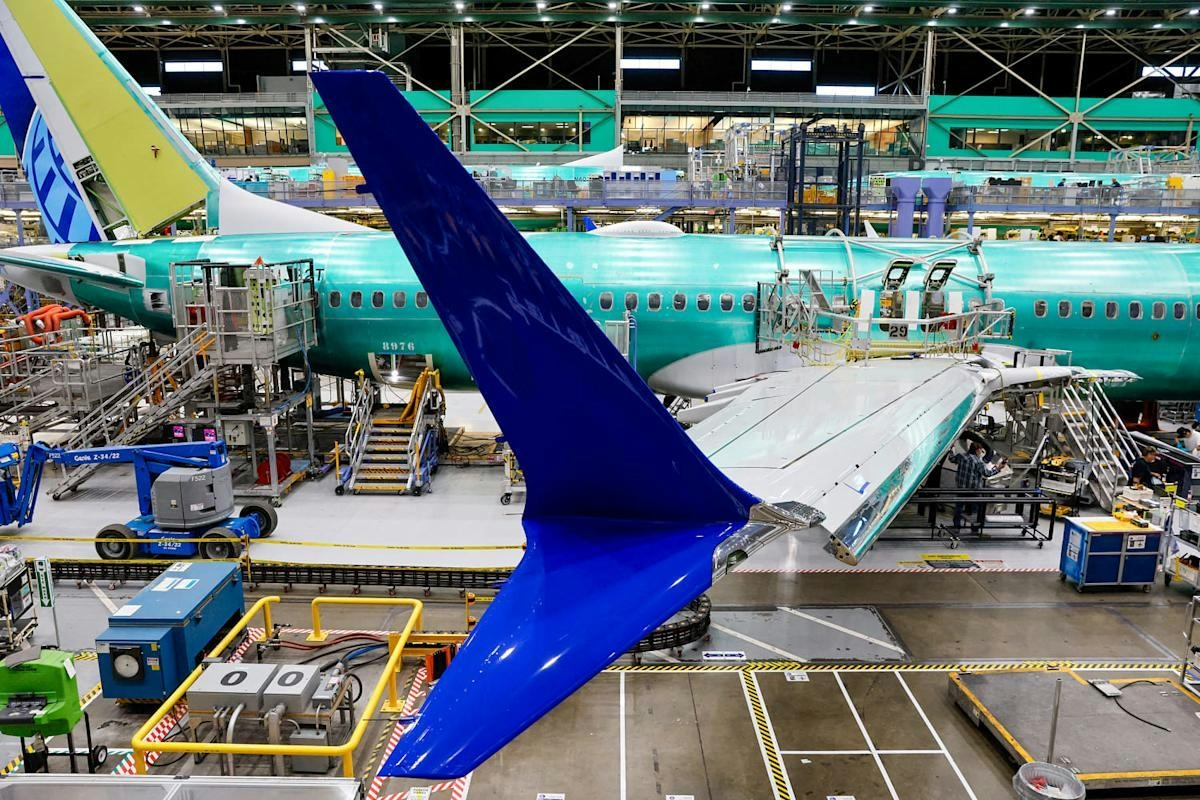
Boeing Resumes Narrowbody Aircraft Studies Amid Market Recovery
Boeing is intensifying internal research on a new commercial aircraft aimed at the upper segment of the single-aisle market, where Airbus currently holds a dominant position with its A321neo family. According to a Bloomberg report, Boeing plans to initiate preparatory work on this project next year, targeting a launch toward the end of the decade and entry into service by the mid-2030s.
Bridging the Gap in the Single-Aisle Market
The proposed aircraft is intended to fill a niche between traditional narrowbodies and smaller widebodies, effectively reviving concepts from Boeing’s previously shelved New Mid-market Airplane (NMA) studies, informally known as the “797.” While sometimes described as a successor to the 737, the new jet’s size and capabilities align more closely with the larger segment currently led by the A321neo. Boeing envisions a future family beginning at the size of the 737 MAX 10, with potential expansion into additional variants.
Over the past decade, airlines have shown a clear preference for larger single-aisle aircraft that offer greater range and capacity. Smaller models such as the Boeing 737 MAX 7 and Airbus A319neo have experienced limited demand, whereas newer, more efficient aircraft like the Airbus A220 and Embraer E195-E2 have gained traction in lower-capacity markets.
Design Philosophy and Technological Approach
Boeing is reportedly adopting a lower-risk strategy for its new aircraft, emphasizing conventional technologies over radical innovations. The company has scaled back its focus on the Transonic Truss-Braced Wing (TTBW) concept, instead exploring a traditional tubular fuselage design paired with ducted turbofan engines. The aircraft is expected to feature highly efficient wings with increased span, thinner profiles, and folding wingtips similar to those on the Boeing 777X.
Exploratory collaboration with suppliers is intensifying as Boeing evaluates technologies likely to be available within the next decade. Studies include redesigned cockpit concepts aimed at enhancing pilot interaction and assessments of alternative propulsion layouts, such as a small auxiliary engine near the tail. While Boeing is engaged in discussions with engine manufacturers about future propulsion systems, it reportedly shows limited interest in open-fan concepts like the CFM RISE demonstrator, which Airbus is considering. Instead, Boeing favors ducted engine architectures, potentially incorporating future developments derived from RISE technology.
Challenges and Market Outlook
Despite this renewed focus, Boeing faces several challenges as it advances its narrowbody aircraft studies. Ongoing geopolitical tensions with China could affect delivery schedules and long-term order books in the Asia-Pacific region, a critical market for both Boeing and Airbus. Nonetheless, market reactions have been positive, buoyed by Boeing’s return to net profitability in 2025 and a narrower loss reported in the first quarter of 2026. The company’s progress in securing certifications for new 737 MAX variants and maintaining steady deliveries may strengthen its competitive position, although responses from rivals remain uncertain.
Much of Boeing’s future product strategy remains tied to the certification of the delayed 777-9, which continues to consume significant engineering resources. As Boeing navigates these challenges, its next-generation narrowbody project will be closely monitored by airlines and industry observers worldwide.

Etihad Airways Suspends Airbus A380 Flights on Key Route

Aditya Birla Group Seeks Approval for Aircraft Leasing in GIFT City

Qatar Airways Highlights Innovation and Connectivity at Arabian Travel Market 2026

Hong Kong's Five-Year Plan Includes Andrew Fan's Aircraft Parts Processing Hub Proposal

ACIA Aero Leasing Delivers ATR72-600 to Air Nostrum

RTX Appoints Jill Albertelli as Head of Pratt & Whitney

TAT Technologies Joins Beyond Aero Hydrogen Aircraft Program

AURAK Study Highlights Barriers to Air Taxi Adoption in Emerging Economies

Xiamen Air Selects Altitude for 787 Maintenance at Heathrow

Etihad and Swissport Extend Global Partnership
