
Trasforma le intuizioni dell’IA in azioni concrete

Tendenze
Categories
Can Retired Military Aircraft Power U.S. Data Centers?
Can Retired Military Aircraft Power U.S. Data Centers?
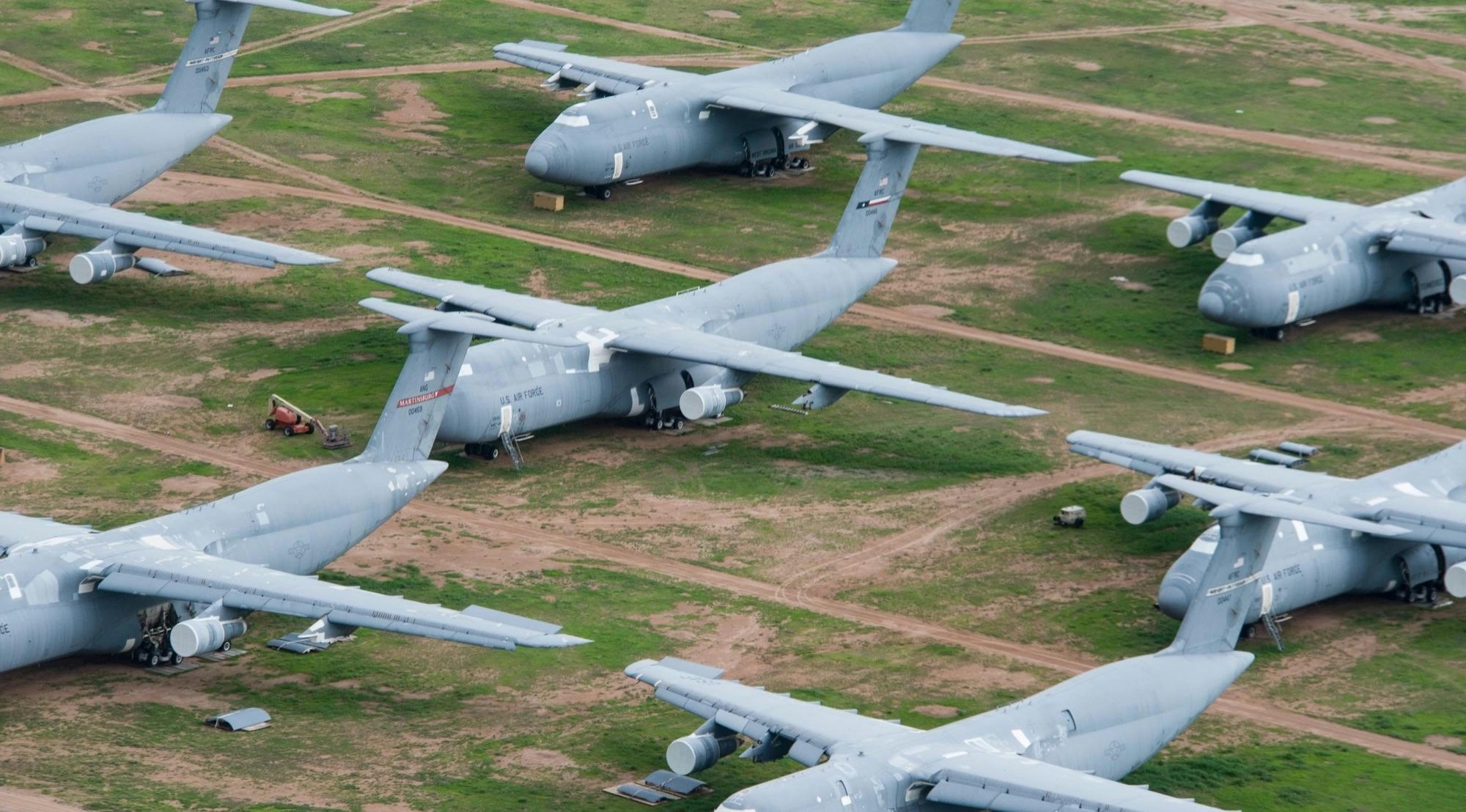
In the arid expanse of the Arizona desert, thousands of retired military aircraft lie dormant in orderly rows at the Aerospace Maintenance and Regeneration Group, commonly known as the “Boneyard,” located at Davis-Monthan Air Force Base. For decades, this facility has symbolized the final chapter for American airpower. However, a recent analysis by the U.S. Energy Information Administration (EIA) proposes a novel possibility: these decommissioned aircraft engines could be repurposed to help power the nation’s rapidly expanding data centers.
Rising Electricity Demand and Emerging Solutions
The EIA’s latest Today in Energy briefing highlights that engines from retired U.S. military aircraft could theoretically generate up to 40,000 megawatts (MW) of electricity—surpassing Arizona’s current total capacity by approximately 10%. Although this figure remains theoretical, it underscores a significant potential resource as the United States confronts soaring electricity demand, particularly driven by data centers supporting artificial intelligence and cloud computing technologies.
Utilities nationwide are struggling to accommodate the explosive growth of data centers. In many regions, developers face prolonged delays in securing grid connections. Conventional approaches, such as constructing new power plants or expanding grid infrastructure, are often slow and expensive. Market responses reflect this challenge: 65% of contractors anticipate continued growth in data center construction, while major technology companies increasingly seek long-term electricity contracts to stabilize their power supply amid market volatility.
In response, some energy developers have begun exploring unconventional power sources. In states like Texas, modified jet engines—originally designed for aircraft—are being adapted as stationary generators, each capable of producing approximately 48 MW, sufficient to power a small town or a large data center. This emerging trend raises the question of whether the extensive inventory of retired military engines at the Boneyard could serve as a substantial, untapped energy reserve.
The Boneyard’s Engine Inventory
As of March 2025, Davis-Monthan Air Force Base houses roughly 4,000 retired military aircraft encompassing multiple generations and mission profiles. These aircraft are equipped with four primary types of turbine engines: turbojets, turbofans, turboshafts, and turboprops. The EIA’s analysis excludes older turbojets due to their low efficiency and afterburning turbofans because they are unsuitable for stationary power generation. Despite these exclusions, the remaining engines still represent considerable potential.
Turbofan engines, in particular, are notable for their capacity. The EIA estimates that these engines alone could collectively provide around 32,000 MW of electricity. This is significant given that turbofan technology forms the basis of aeroderivative gas turbines, a well-established technology widely used in stationary power generation.
Challenges and Market Dynamics
Repurposing military aircraft engines for electricity generation presents several challenges. The conversion process is complex and costly, especially when compared to other alternatives such as recycling nuclear reactors from decommissioned Nimitz-class supercarriers, which themselves face substantial technical and regulatory obstacles. Additionally, community opposition and regulatory scrutiny frequently hinder new data center projects, often delaying or preventing their development.
In light of the growing demand for electricity, the U.S. government has instructed PJM Interconnection—the nation’s largest grid operator—to conduct auctions that allow technology companies to bid on new electricity generation capacity. This initiative reflects the urgency to secure reliable power sources as data center expansion accelerates.
While the concept of powering America’s digital infrastructure with engines from its military past remains largely theoretical, the intensifying search for innovative energy solutions is prompting a reevaluation of even the most unconventional resources. As the nation’s electricity needs continue to grow, retired military aircraft engines may yet find a surprising new role in the country’s energy landscape.

Etihad Airways Suspends Airbus A380 Flights on Key Route

Aditya Birla Group Seeks Approval for Aircraft Leasing in GIFT City

Qatar Airways Highlights Innovation and Connectivity at Arabian Travel Market 2026

Hong Kong's Five-Year Plan Includes Andrew Fan's Aircraft Parts Processing Hub Proposal

ACIA Aero Leasing Delivers ATR72-600 to Air Nostrum

RTX Appoints Jill Albertelli as Head of Pratt & Whitney

TAT Technologies Joins Beyond Aero Hydrogen Aircraft Program

AURAK Study Highlights Barriers to Air Taxi Adoption in Emerging Economies

Xiamen Air Selects Altitude for 787 Maintenance at Heathrow

Etihad and Swissport Extend Global Partnership
