
Trasforma le intuizioni dell’IA in azioni concrete

Tendenze
Categories
Chippewa County Demonstrates Advanced Digital Airspace Infrastructure for Commercial and Public Safety Use
Chippewa County Advances Digital Airspace Infrastructure for Commercial and Public Safety
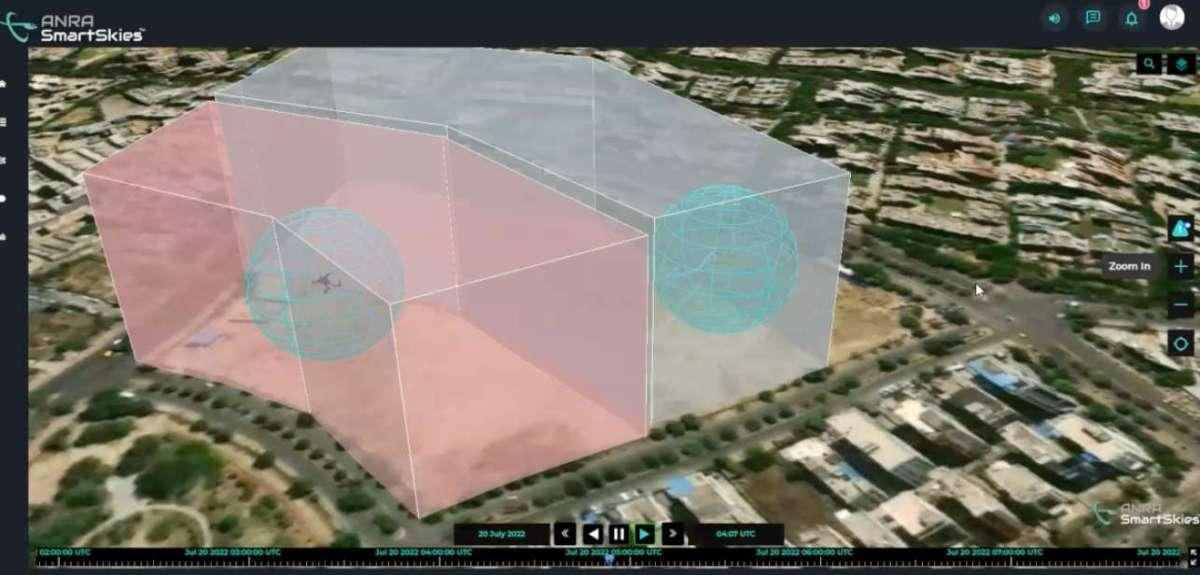
Chippewa County has concluded a year-long initiative aimed at demonstrating cutting-edge digital airspace infrastructure, establishing the region as a frontrunner in commercial and public safety drone operations. The project culminated in a series of live demonstrations held from June 15 to 18, which showcased the capabilities of FAA-approved Uncrewed Aircraft System Traffic Management (UTM) and integrated airspace awareness. These technologies were shown to safely support complex drone activities, including operations in proximity to the U.S.-Canada border.
Collaborative Efforts and Technical Deployment
Funded by Michigan’s Office of Future Mobility and Electrification (OFME) and the Michigan Mobility Funding Platform, the initiative brought together a diverse coalition of government agencies, industry leaders, academic institutions, utilities, and volunteer organizations. ANRA Technologies, a global provider specializing in unified airspace and mission management solutions, led the technical deployment in partnership with the Chippewa County Economic Development Corporation (CCEDC) and other key stakeholders.
The project demonstrated the integration of digital UTM and Counter-Uncrewed Aircraft Systems (C-UAS) services to facilitate commercial drone operations in near-border environments. This approach addressed the challenges posed by both cooperative and non-cooperative aircraft, ensuring enhanced situational awareness and safety. The complexity of the airspace required close coordination with the Federal Aviation Administration (FAA), NAV Canada, Chippewa County International Airport, and the Kinross Correctional Facility, highlighting the regulatory and logistical intricacies involved in managing flights within one of Michigan’s most demanding airspaces.
Diverse operational use cases were featured throughout the demonstrations. Censys Technologies conducted infrastructure inspection flights, while the Michigan Tech Research Institute (MTRI) supported aerial inspections and railroad research. Utility inspection demonstrations were enabled by Cloverland Electric Cooperative at the St. Marys Falls Hydropower Plant. Additionally, Lighthouse Avionics and Guardian RF deployed optical and radio frequency detection technologies to provide real-time monitoring of drone activity at critical sites. RIIS LLC conducted flight operations around the Kinross Correctional Facility, illustrating improved detection and tracking capabilities for both authorized and unauthorized drones.
Industry Challenges and Broader Implications
Despite the successful demonstrations, integrating advanced digital airspace infrastructure with existing systems continues to present significant challenges. Ensuring regulatory compliance, achieving technological compatibility, and coordinating among multiple stakeholders remain critical hurdles. The project’s achievements are expected to stimulate increased investment in similar technologies as industry participants respond to evolving standards and operational requirements.
The competitive landscape is likely to intensify, with companies accelerating innovation either by adopting comparable solutions or developing alternative approaches. This momentum is further supported by broader initiatives such as the FAA’s Wilbur System and recent contracts awarded to Air Space Technologies, both of which emphasize a sector-wide commitment to modernizing air traffic control and digital airspace management.
A Blueprint for Future Drone Operations
By securing necessary regulatory approvals and demonstrating operational safety within a complex airspace environment, Chippewa County’s initiative serves as a model for integrating digital airspace management into commercial and public safety applications. The collaborative framework—uniting correctional authorities, airport stakeholders, aviation regulators, and technology partners—underscores the transformative potential of digital infrastructure to enhance drone operations across Michigan’s Upper Peninsula and beyond.

Etihad and Swissport Extend Global Partnership

Sepehran Airlines B737 Returns to Mashhad After Tyre and Engine Issues

Etihad Deploys Widebody Fleet to Meet Strong Demand

Korean Air Finalizes $36.2 Billion Deal with Boeing

Australia’s RFDS Queensland Section Orders Six King Air 260Cs

Korean Air Finalizes Order for 103 Boeing Jets and Engines

Embraer E195-E2 Features Distinctive Engine Placement Among Regional Jets

What Passengers Can Expect on Boeing’s New 777X Jet

How Ethiopian Airlines Became Africa’s Leading Carrier Amid Gulf Competition

Joby Aviation Extends Autonomous Flight Capabilities with Cross-Country Tour
