
Trasforma le intuizioni dell’IA in azioni concrete

Tendenze
Categories
Could AI Replace Human Pilots?
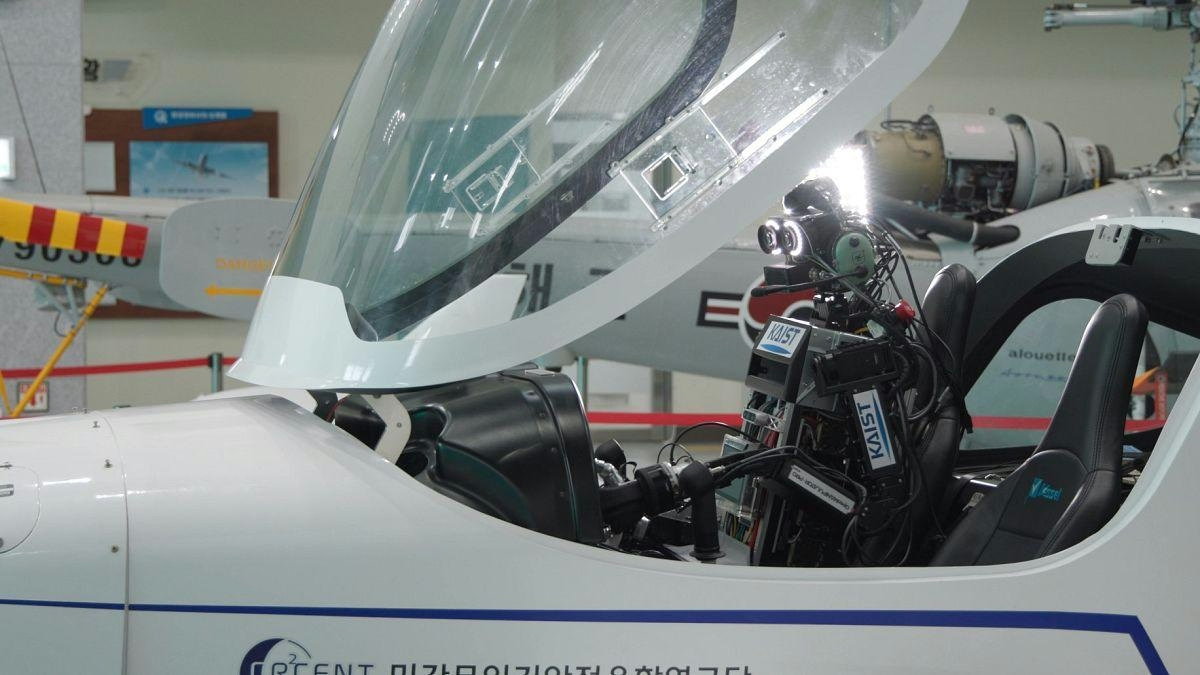
Could AI Replace Human Pilots?
Recent developments in aviation technology have brought the question of artificial intelligence (AI) replacing human pilots into sharper focus. Two notable flights illustrate the current capabilities and limitations of AI and automation in the cockpit. On December 20, 2025, a Beechcraft King Air departing Aspen experienced a sudden loss of cabin pressurization at flight level 230. The two pilots donned oxygen masks and allowed the aircraft to land autonomously at Rocky Mountain Metropolitan Airport near Denver, marking the first real-world deployment of Garmin’s Emergency Autoland system since its introduction in 2019. Several months later, in May 2026, CNN reported from the right seat of a Merlin Labs Cessna Caravan, where an AI system managed takeoff, communicated with a simulated air traffic controller, and responded over the radio, all while the test pilot refrained from manual control.
These events have intensified ongoing discussions within aviation circles about whether AI will eventually render human pilots obsolete. Despite the technological progress, the consensus remains that AI will not replace pilots on passenger airliners in the near future. Regulatory frameworks, technological constraints, and economic considerations continue to pose significant barriers. While AI is already reshaping pilot roles and enabling pilotless operations in cargo and other non-passenger sectors, fully autonomous passenger flights remain a distant prospect.
Automation Versus AI: Clarifying the Distinction
Automation has been integral to commercial aviation for decades, with systems such as autopilot, autothrust, autoland, and fly-by-wire managing much of routine flight operations. The critical difference between traditional automation and AI lies in decision-making processes. Conventional automation operates strictly within pre-programmed parameters, executing defined tasks without deviation. In contrast, AI systems learn from data and adapt to novel situations, potentially handling a wider array of unexpected events. Stanford researcher Mykel Kochenderfer highlights that current cockpit automation functions within narrowly defined limits, whereas AI aspires to manage a broader spectrum of contingencies.
Garmin’s Autoland system exemplifies advanced conventional automation. During its inaugural real-world emergency, the system activated automatically when cabin altitude reached unsafe levels, successfully completing the landing with pilot consent. However, the system’s automated radio transmissions mistakenly reported pilot incapacitation, underscoring the limitations of scripted responses compared to nuanced human judgment.
Airbus has pursued more ambitious AI applications through its ATTOL project, which employed onboard image recognition to enable autonomous taxiing, takeoff, and landing on an A350-1000 aircraft after more than 500 test flights. The objective is to allow pilots to concentrate on strategic decision-making rather than manual control. The subsequent DragonFly demonstrator simulated pilot incapacitation scenarios, with the A350 autonomously diverting and landing safely. Despite these advances, Airbus stresses that such technologies are designed to augment, not replace, the traditional two-pilot flight deck.
Regulatory and Economic Challenges
The primary focus in recent years has shifted from eliminating pilots entirely to reducing crew numbers. Initiatives like Extended Minimum Crew Operations (eMCO) propose allowing one pilot to rest while the other manages the aircraft during cruise phases. However, regulatory scrutiny has intensified, with fund managers warning that AI could become one of the most heavily regulated sectors, potentially impeding its adoption in aviation. Economists at the European Central Bank have also cautioned that AI-driven economic booms may precipitate market corrections, injecting further uncertainty into investments in autonomous flight technologies.
Simultaneously, workforce pressures are mounting as airlines and manufacturers plan for growth amid AI-driven transformation. Many organizations face challenges in adapting to these changes, highlighting the necessity for clear communication, robust governance, and practical support for employees and management navigating this transition.
The Future of Piloting in an AI-Driven Era
AI is undeniably transforming aviation, yet regulatory, economic, and workforce considerations ensure that human pilots will remain indispensable, particularly in passenger operations, for the foreseeable future. While automation technologies will continue to evolve and assume greater responsibilities, the prospect of an empty cockpit remains unlikely in the near term.

Etihad Airways Suspends Airbus A380 Flights on Key Route

Aditya Birla Group Seeks Approval for Aircraft Leasing in GIFT City

Qatar Airways Highlights Innovation and Connectivity at Arabian Travel Market 2026

Hong Kong's Five-Year Plan Includes Andrew Fan's Aircraft Parts Processing Hub Proposal

ACIA Aero Leasing Delivers ATR72-600 to Air Nostrum

RTX Appoints Jill Albertelli as Head of Pratt & Whitney

TAT Technologies Joins Beyond Aero Hydrogen Aircraft Program

AURAK Study Highlights Barriers to Air Taxi Adoption in Emerging Economies

Xiamen Air Selects Altitude for 787 Maintenance at Heathrow

Etihad and Swissport Extend Global Partnership
