
Trasforma le intuizioni dell’IA in azioni concrete

Tendenze
Categories
DoD Provides Aerospace and Sensor Data for Federal AI Science Initiative
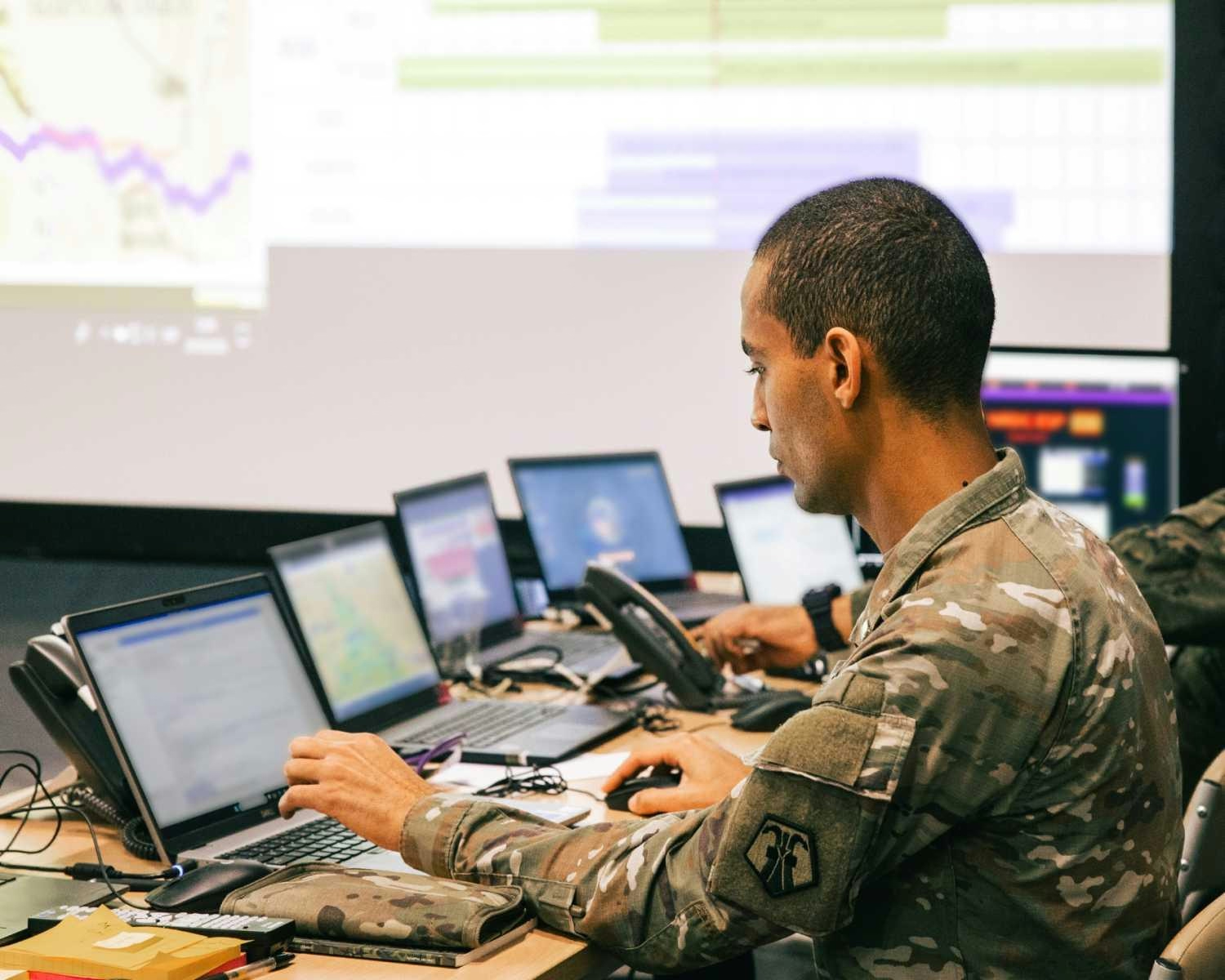
DoD Contributes Extensive Aerospace and Sensor Data to Federal AI Science Initiative
WASHINGTON — The Department of Defense (DoD) has announced its commitment to provide decades of validated aerospace, hydrodynamic, acoustic, and sensor data to the Genesis Mission, a White House-led artificial intelligence (AI) initiative designed to accelerate scientific discovery. This initiative integrates AI models, high-performance computing, and vast scientific datasets to foster innovation across multiple disciplines. Spearheaded by the Department of Energy (DOE), the Genesis Mission aims to establish an AI-for-science infrastructure that connects government research organizations, national laboratories, industry, and academia.
Integration of Defense Data and AI Technologies
Through the Genesis Mission’s American Science and Security Platform, developed by the DOE, the DoD plans to link its extensive data repositories, computing resources, scientific instruments, and AI tools. This integration is expected to enhance advanced research and technology development, enabling automated design loops, decision superiority, and accelerated innovation in national security technologies. For the defense sector, the initiative promises significant advancements in AI-assisted engineering, including rapid simulation, design optimization, and comprehensive analysis of complex aerospace and sensor systems.
This development reflects a broader transformation within aerospace and defense toward AI-enabled digital engineering. Machine learning models will complement traditional physics-based simulations, digital twins, and high-performance computing rather than replace them. AI tools are anticipated to empower engineers to evaluate a greater number of design options, identify performance trade-offs more effectively, and reduce development timelines. Potential applications span aerodynamic optimization, propulsion system development, autonomous platforms, sensing technologies, and advanced manufacturing processes.
Challenges and Strategic Implications
The DoD’s decision to share sensitive aerospace and sensor data introduces significant challenges related to data security and privacy. Protecting classified and proprietary information will be paramount as the initiative progresses, particularly given the competitive global environment. International rivals, notably China, are expected to intensify their own AI research and development efforts in response, heightening the technological competition. Additionally, the initiative may attract regulatory scrutiny and provoke ethical debates concerning the use of AI in defense, as policymakers and the public consider the balance between innovation and potential risks.
Market responses to the DoD’s involvement are anticipated to include heightened interest and investment in AI-driven defense technologies. Defense contractors and technology firms are likely to accelerate their AI initiatives to maintain competitiveness, while the broader industry will closely monitor regulatory developments and ethical considerations.
Financial Commitment and Future Prospects
The DoD plans to invest over $200 million in fiscal year 2026 and more than $1.3 billion in fiscal year 2027 to advance critical National Science & Technology Challenges aligned with the Genesis Mission. A key element of this funding is the Digital Biosecurity Forge (DB-FORGE), a high-performance computing environment developed in partnership with Lawrence Livermore National Laboratory. DB-FORGE is slated to receive $30 million in 2026, scaling up to $150 million in 2027, supporting research in biotechnology, human health, and biosecurity.
Emil Michael, Undersecretary of War for Research and Engineering, emphasized the strategic importance of these investments, stating, “The Department is scaling investments across AI, quantum computing, and biotechnology to turn our decades of data into a catalyst for scientific discovery to support the American warfighter.”
The long-term success of the Genesis Mission will hinge on the effective transformation of government research data into secure, usable AI training and validation resources, while carefully navigating the intertwined challenges of security, ethics, and global competition in a rapidly evolving technological landscape.

Hong Kong's Five-Year Plan Includes Andrew Fan's Aircraft Parts Processing Hub Proposal

ACIA Aero Leasing Delivers ATR72-600 to Air Nostrum

RTX Appoints Jill Albertelli as Head of Pratt & Whitney

TAT Technologies Joins Beyond Aero Hydrogen Aircraft Program

AURAK Study Highlights Barriers to Air Taxi Adoption in Emerging Economies

Xiamen Air Selects Altitude for 787 Maintenance at Heathrow

Etihad and Swissport Extend Global Partnership

Sepehran Airlines B737 Returns to Mashhad After Tyre and Engine Issues

Etihad Deploys Widebody Fleet to Meet Strong Demand

Korean Air Finalizes $36.2 Billion Deal with Boeing
