
Trasforma le intuizioni dell’IA in azioni concrete

Tendenze
Categories
EHang and Tsinghua University Launch JILAAT to Advance Low-Altitude Aviation Technology
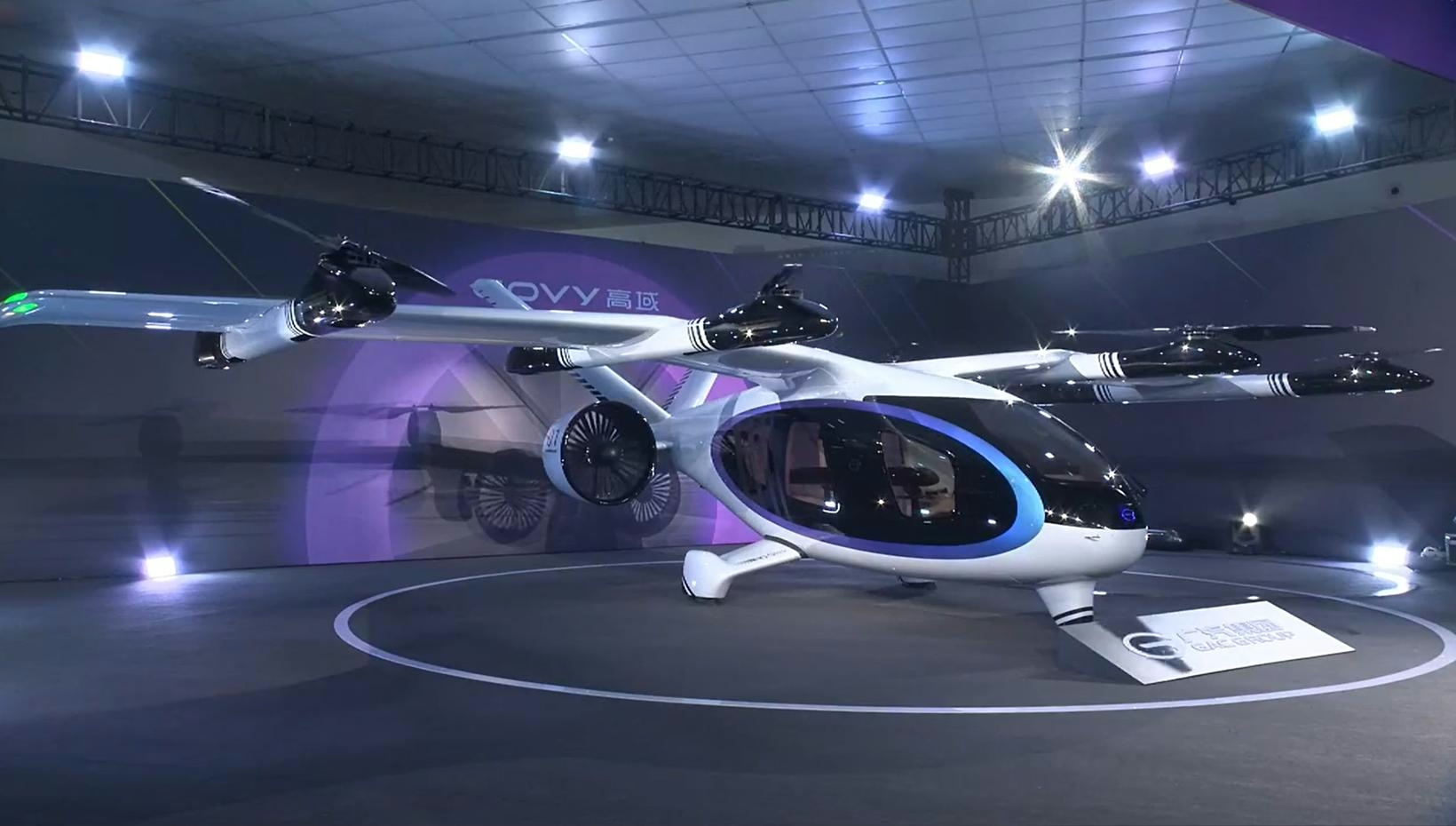
EHang and Tsinghua University Establish JILAAT to Advance Low-Altitude Aviation Technology
GUANGZHOU, China, July 11, 2025 – EHang Holdings Limited (Nasdaq: EH), a global leader in Urban Air Mobility (UAM) technology, has announced the creation of the Joint Institute for Low Altitude Aviation Technology (JILAAT) in collaboration with Tsinghua University, one of China’s foremost academic institutions. The institute is designed to become a premier center for research, innovation, and talent cultivation in the rapidly developing field of low-altitude aviation.
A Strategic Partnership for Innovation and Development
The launch ceremony was attended by prominent figures including Tsinghua University President and Chinese Academy of Sciences Academician Luming Li, Executive Vice President Rong Zeng, and EHang Chief Operating Officer Zhao Wang. President Li praised EHang for pioneering a new model of university-enterprise collaboration and reaffirmed Tsinghua’s dedication to leveraging its educational and research capabilities to support the safe and intelligent expansion of the low-altitude economy.
JILAAT will draw on expertise from multiple departments within Tsinghua University, encompassing Aerospace Engineering, Vehicle and Mobility, Architecture, Computer Science, Automation, Mechanical Engineering, and Electrical Engineering. The institute’s core mission is to tackle critical technological challenges, accelerate academic research, and facilitate the industrialization of low-altitude aviation technologies.
By combining Tsinghua’s academic resources with EHang’s extensive experience in research, development, manufacturing, and commercial deployment of low-altitude aircraft, the partnership aims to translate cutting-edge research into practical applications. This collaboration is expected to enhance China’s standing in the global advanced air mobility (AAM) sector and promote sustainable growth within the low-altitude aviation ecosystem.
Challenges and Market Dynamics
Despite the promising prospects, the initiative faces several challenges. Regulatory complexities remain a significant concern, as the low-altitude aviation sector continues to navigate evolving government policies and safety standards. Technological uncertainties, particularly regarding the integration of autonomous systems and airspace management, also present potential obstacles. Additionally, competition is intensifying, with companies such as Sora and Zipline expanding their AAM offerings and forging strategic partnerships with logistics firms like DHL Express to develop drone delivery solutions.
Market response to EHang’s recent advancements has been encouraging. The company has secured substantial orders for its electric vertical takeoff and landing (eVTOL) aircraft, including a 50-unit contract with Guizhou Province and an agreement for 41 aircraft with Changchun Tech Zone. These deals reflect growing confidence in EHang’s technology and the broader potential of low-altitude aviation.
As JILAAT commences its operations, both EHang and Tsinghua University are positioned to play a critical role in shaping the future of urban air mobility, driving technological innovation, and addressing the challenges inherent in the low-altitude aviation sector.

Etihad Airways Suspends Airbus A380 Flights on Key Route

Aditya Birla Group Seeks Approval for Aircraft Leasing in GIFT City

Qatar Airways Highlights Innovation and Connectivity at Arabian Travel Market 2026

Hong Kong's Five-Year Plan Includes Andrew Fan's Aircraft Parts Processing Hub Proposal

ACIA Aero Leasing Delivers ATR72-600 to Air Nostrum

RTX Appoints Jill Albertelli as Head of Pratt & Whitney

TAT Technologies Joins Beyond Aero Hydrogen Aircraft Program

AURAK Study Highlights Barriers to Air Taxi Adoption in Emerging Economies

Xiamen Air Selects Altitude for 787 Maintenance at Heathrow

Etihad and Swissport Extend Global Partnership
