Immagine

Trasforma le intuizioni dell’IA in azioni concrete

Unisciti oggi alla lista d’attesa di AeroGenie!

Tendenze

Categories

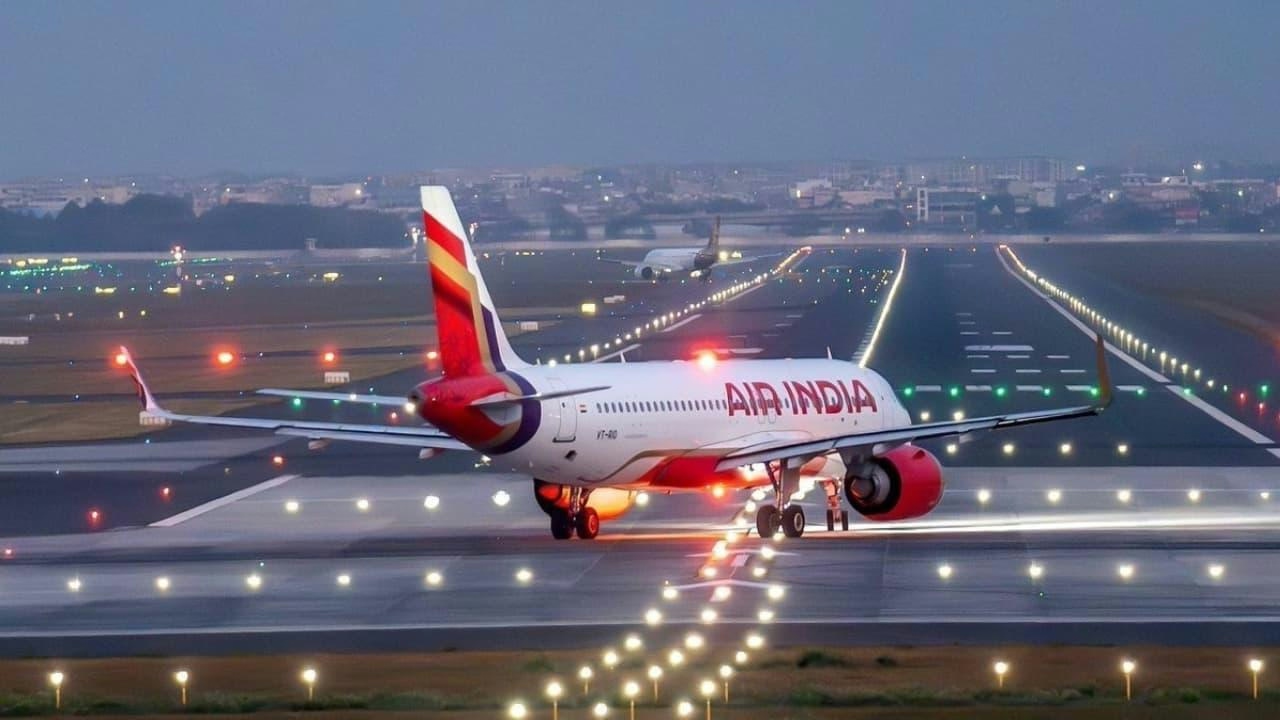
Engine Fire Reported on Air India Bengaluru-Delhi Flight; All Passengers Safe
May 21, 2026By ePlane AI
Engine Fire Reported on Air India Bengaluru-Delhi Flight; All Passengers Safe
0
0
Air India
Engine Fire
Airbus A321

Engine Fire on Air India Bengaluru-Delhi Flight: All Passengers Safe

An Air India flight operating from Bengaluru to Delhi declared a full emergency on Thursday night after the cockpit crew received an engine fire warning during the aircraft’s final approach. The Airbus A321, registered VT-CIO and operating as Flight AI 2802, landed safely on runway 29R at Indira Gandhi International Airport at 9:30 pm. Airport operations were temporarily suspended as emergency protocols were activated.

Incident Details and Response

According to sources, the engine fire indication was received just before landing. The cockpit crew confirmed the warning and adhered to standard operating procedures to extinguish the fire after touchdown. Following the safe landing, the aircraft was towed off the runway, and all 180 passengers and crew disembarked without injury. Emergency services were on standby throughout the process, ensuring passenger safety and swift response.

The Directorate General of Civil Aviation (DGCA) has initiated an investigation into the incident. In an official statement, Air India confirmed that the crew received a fire indication from one of the engines during the final approach and followed all prescribed safety protocols to land the aircraft safely. The airline emphasized that all passengers and crew are safe and have disembarked normally.

Broader Context and Implications

This event occurs amid increased scrutiny of aviation safety both within India and internationally. Recent incidents, including a Swiss flight aborting takeoff in Delhi and a Turkish Airlines aircraft catching fire in Nepal, have heightened concerns over airline safety standards. For Air India, the engine fire incident may prompt intensified regulatory oversight, potential compensation claims from passengers, and reputational challenges. Market analysts suggest that such occurrences can influence airline stock valuations and encourage competitors to highlight their own safety records.

Air India has committed to conducting a thorough investigation in coordination with relevant authorities and pledged to provide verified updates as the inquiry progresses. The airline reaffirmed its dedication to passenger safety and compliance with regulatory standards while authorities work to determine the cause of the engine fire.

More news
Malaysia's MJets Air Wet Leases a Boeing 737-800SF

Malaysia's MJets Air Wet Leases a Boeing 737-800SF

Malaysia's MJets Air Initiates Wet Lease of Boeing 737-800SF Amid Shifting Market Conditions MJets Air, operating out of Kuala Lumpur International Airport, has begun wet leasing a Boeing 737-800SF freighter from Ascend Airways Malaysia, according to ADS-B flight tracking data. The aircraft, registered 9M-ASC (msn 33813), commenced operations under MJets Air’s “KXP” code on June 18, 2026. Currently stationed at Kuching Airport, the freighter services cargo routes connecting Ho Chi Minh City, Yangon, Kuala Lumpur International, and Mumbai International. Aircraft Background and Corporate Context The 21.6-year-old Boeing 737-800SF is equipped with CFM International CFM56 engines and was delivered to Ascend Airways Malaysia in September 2025. It served as the carrier’s inaugural aircraft and played a key role in its certification process. Ascend Airways Malaysia operates as part of the Avia Solutions Group and is affiliated with the now-defunct UK-based Ascend Airways, which ceased operations and surrendered its air operator’s certificate in April 2026. Market Environment and Industry Implications MJets Air’s decision to wet lease this freighter occurs amid tightening demand within the business aviation sector, despite a cautiously optimistic outlook among brokers. The increasingly competitive environment is driving airlines to consider strategic measures such as wet leasing to sustain or expand their operational networks. Industry analysts have observed that other carriers, including Finnair, are exploring similar wet-lease arrangements to bolster their service capabilities. The broader market dynamics are also shaped by Boeing’s accelerated delivery schedules and a notable increase in new aircraft orders, factors that may influence the availability and pricing of freighters like the 737-800SF. Furthermore, ongoing contract negotiations between Boeing and its engineers’ union have the potential to affect production timelines and costs, which could, in turn, impact the wet-lease market in the near future. Efforts to obtain comments from both Ascend Airways Malaysia and MJets Air were unsuccessful by the time of publication.
Brisbane Airport Begins Using Sustainable Aviation Fuel

Brisbane Airport Begins Using Sustainable Aviation Fuel

Brisbane Airport Initiates Use of Sustainable Aviation Fuel Brisbane Airport has commenced the use of sustainable aviation fuel (SAF), marking a pivotal advancement in Australia’s commitment to decarbonising its aviation sector. This initiative, supported by the Australian Renewable Energy Agency (ARENA), arrives amid growing challenges in expanding SAF production and adoption within the industry. Infrastructure Upgrades and Implementation With funding from ARENA, Viva Energy Australia has completed the refurbishment of a storage tank at its Pinkenba Terminal. This upgrade enables the storage, blending, and supply of SAF directly to Brisbane Airport, allowing aircraft to be refuelled with this lower-emission alternative. Additionally, a “book and claim” system has been introduced, permitting airlines and corporate customers to purchase SAF and accurately track the associated emissions reductions. ARENA’s CEO, Darren Miller, highlighted the significance of this development, noting the aviation sector’s complexity in achieving decarbonisation. He stated, “Sustainable aviation fuel will play a critical role in reducing emissions using today’s aircraft and infrastructure. This project demonstrates how we can begin supplying SAF through existing fuel systems, while laying the groundwork for a domestic industry.” Challenges and Future Prospects Despite this progress, the widespread adoption of SAF remains constrained by several obstacles. Globally, SAF constitutes only 0.8% of the jet fuel supply as of 2026, a figure that falls far short of the levels required to meet the aviation industry’s net zero emissions target by 2050. The high production costs of SAF continue to be a significant barrier, as evidenced by recent experimental efforts converting biogas from a California dairy farm into aviation-grade fuel. The market remains dominated by cheaper kerosene, and airlines face potential disruption if unprepared for forthcoming European Union regulations mandating sustainable fuel use from 2030. In response to these challenges, ARENA is actively supporting a portfolio of projects designed to accelerate the development of a domestic SAF industry. This includes a $3.15 million investment in Wildfire Energy to pilot the integration of its MIHG technology with methanol synthesis. The project aims to produce methanol and conduct a feasibility study for a Queensland facility that would convert waste into SAF. To date, ARENA has committed $36.7 million to six projects under its Sustainable Aviation Fuel Funding Initiative. The agency also manages the Future Made in Australia Innovation Fund, which allocates $250 million towards low-carbon liquid fuels. By supporting initiatives across the entire supply chain—from production to distribution and utilisation—ARENA seeks to facilitate Australia’s aviation sector transition to lower emissions, despite ongoing global supply and cost challenges.
Impact of New Aircraft Deliveries and Debt Plans on AerCap Holdings Investors

Impact of New Aircraft Deliveries and Debt Plans on AerCap Holdings Investors

Impact of New Aircraft Deliveries and Debt Plans on AerCap Holdings Investors AerCap Holdings N.V. has recently advanced its role in global airline fleet modernization by delivering new, fuel-efficient aircraft to Thai Airways and Azerbaijan Airlines. The delivery of Azerbaijan Airlines’ first A321neo represents a significant milestone in the carrier’s ongoing fleet renewal strategy. These transactions occur against the backdrop of a robust global demand for aircraft, with the aerospace sector experiencing record-high delivery volumes. However, the industry continues to grapple with challenges, notably Airbus’s announcement of delays affecting A320neo series jets scheduled for delivery in 2027 and 2028. Such postponements may disrupt AerCap’s delivery schedules and have potential repercussions on its financial performance. In parallel with these operational developments, AerCap Funding, a subsidiary of AerCap Holdings, has filed a shelf registration statement to enable the potential issuance of debt securities. This strategic move preserves the company’s flexibility in securing funding as it supports airline fleet renewal programs worldwide. For investors, the combination of ongoing fleet expansion and funding adaptability underscores AerCap’s critical position in facilitating global airline modernization, while also highlighting the capital-intensive nature of its business model. Investment Narrative and Financial Outlook Investing in AerCap necessitates an understanding of its capital-intensive aircraft leasing model, which depends on disciplined risk management, balanced funding strategies, and sustained airline demand. The recent deliveries to Thai Airways and Azerbaijan Airlines provide modest reinforcement to near-term lease activity. However, the new shelf registration draws attention to funding costs and leverage, which represent key risks should market conditions deteriorate or increased debt levels compress profit margins. The broader industry context adds further complexity. While strong global demand is driving record aircraft deliveries, the announced delays by Airbus could impede AerCap’s ability to fulfill contractual obligations and meet revenue forecasts. These delays also bear significance for the aviation sector’s ambitious 2050 net-zero carbon emissions target, potentially influencing investor sentiment toward lessors like AerCap that are central to fleet renewal and sustainability initiatives. Looking ahead, AerCap projects revenues of $8.3 billion and earnings of $2.0 billion by 2029, reflecting a 1.4% annual decline in revenue and a substantial decrease in earnings from the current $3.9 billion. Despite these projections, some analysts identify potential upside of up to 12% from the current share price. However, valuations vary widely, with fair value estimates ranging from US$92 to US$166 per share, reflecting divergent views on funding risks and market resilience. Given AerCap’s dependence on capital markets and exposure to delivery delays, investors must carefully consider multiple perspectives before forming an investment thesis. The interplay between capital commitments, potential debt issuance, and evolving market conditions will be pivotal to AerCap’s performance in the coming years.
The Real Purpose Behind Airlines’ New Business Class Suites

The Real Purpose Behind Airlines’ New Business Class Suites

The Real Purpose Behind Airlines’ New Business Class Suites When airlines introduce their latest international business class cabins, the emphasis is often on luxury: high-thread-count bedding, curated champagne, and private suites with sliding doors. These enhancements are marketed as the pinnacle of passenger comfort and hospitality, particularly for frequent flyers. However, beneath this veneer of opulence lies a more pragmatic motivation—economic survival in an industry facing increasingly narrow profit margins. The Shift Toward Premium Seating The International Air Transport Association (IATA) projects that pure flight operations will yield a modest profit margin of just 3.9% in 2026, equating to a net profit of $7.90 per passenger. With volatile fuel prices and rising labor costs, airlines can no longer rely on economy class tickets to generate substantial returns. Consequently, the aircraft cabin has transformed into a critical asset management platform, with luxury business class suites serving as a key driver of high-margin revenue. This shift is evident in the reconfiguration of modern twin-aisle aircraft. Airlines are removing standard economy rows to accommodate more premium suites, reversing the traditional strategy of maximizing passenger volume in the rear of the plane. International routes increasingly feature cabin layouts where premium seating occupies a significantly larger proportion of the space. Delta Air Lines exemplifies this trend. Its newest long-haul aircraft allocate nearly 50% of cabin space to premium classes, a notable increase from 30% in older models. This strategic reallocation protects airlines from low-yield fare competition and ensures higher revenue generation per flight hour. The financial impact is tangible: in the first quarter of 2026, Delta reported a record $14.2 billion in revenue, with premium ticket sales rising 14% year-over-year to $5.4 billion—approaching parity with main cabin revenue. When combined with other high-yield segments such as cargo and maintenance, non-economy revenue now accounts for 62% of Delta’s total income. Navigating Operational Challenges and Competitive Responses Despite the clear financial incentives, the transition to premium cabins is not without challenges. Airlines face technical difficulties with new aircraft models, as demonstrated by United Airlines’ recent grounding of its 787 Dreamliner fleet due to technical issues. Such disruptions can delay the introduction of new business class products and negatively affect the passenger experience. Competition within the industry is also intensifying. United Airlines, for instance, is launching a “Eurobusiness” configuration on its new Airbus A321XLR aircraft, which involves blocking middle seats in economy to provide additional space and blur the distinction between business and economy classes. This approach reflects a broader industry trend of experimenting with cabin layouts to capture premium revenue while mitigating operational risks. At the same time, fluctuating profits and unpredictable fuel costs continue to complicate fare structures and strategic planning. Airlines must carefully balance the appeal of premium cabins against market demand and operational reliability. Economic Imperatives Behind Luxury Today’s ultra-premium business class suites are less a symbol of luxury for its own sake and more a strategic response to financial pressures. As airlines contend with thin margins and cost volatility, the front of the plane has become central to their business models. The evolution of business class cabins represents a calculated adaptation to economic realities, reshaping the aviation landscape one suite at a time.
Airline CEO Calls for Government and Private Sector Partnership to Boost Aviation

Airline CEO Calls for Government and Private Sector Partnership to Boost Aviation

Airline CEO Advocates for Enhanced Government-Private Sector Collaboration to Advance Aviation The Managing Director of Aero Contractors, Ado Sanusi, has emphasized the urgent need for a strengthened partnership between the Nigerian Federal Government and private sector operators to accelerate the development of the country’s aviation industry and support broader economic growth. This call was made during a recent working visit by Hajia Hadiza Usman, Special Adviser to the President on Policy Coordination and Head of the Central Results Delivery Coordination Unit (CRDCU), to Aero Contractors’ facilities, including its Maintenance, Repair and Overhaul (MRO) centre. Engagement Between Policymakers and Industry Stakeholders During her visit, Usman engaged directly with Aero Contractors’ management and engineering teams to gain a deeper understanding of how government policies might better facilitate private investment and innovation within the aviation sector. Following the tour, Sanusi described the interaction as highly encouraging, underscoring the importance of direct dialogue between policymakers and industry players in fostering an enabling environment for business growth. He highlighted Usman’s keen interest in the sector’s challenges and opportunities as a positive indication of the government’s commitment to refining policies that enhance aviation performance. Sanusi remarked, “It was an honour to welcome Hadiza Bala Usman to Aero Contractors. Her genuine curiosity and insightful questions reflected a sincere interest in how government can better support the growth of our aviation industry. Though not an aviator by background, her command of policy and institutional development was evident, aligning with the results-driven mandate she leads at the CRDCU.” He further stressed that meaningful engagement between public officials and private operators is essential for crafting practical solutions that will boost investment, improve service delivery, and increase the aviation sector’s contribution to Nigeria’s GDP. Sanusi expressed optimism about the future of the industry, praising Usman as a dedicated public servant focused on delivering measurable outcomes. Showcasing Engineering Excellence and Industry Potential The visit also provided an opportunity for Aero Contractors to demonstrate its engineering capabilities and ongoing commitment to advancing the aviation sector through innovation and technical excellence. Usman reportedly expressed satisfaction with the modern equipment and highly skilled workforce at the MRO facility, which continues to provide critical maintenance support to airlines across Nigeria and the wider West and Central African region. Sanusi highlighted that the facility has accumulated decades of engineering expertise and adheres to internationally recognized standards, thereby strengthening aircraft maintenance capacity on the continent. Contextual Challenges and Industry-Wide Calls for Collaboration Sanusi’s appeal for enhanced government-private sector collaboration comes amid mounting challenges facing the global aviation industry. Infrastructure capacity constraints, as noted by Signature Aviation CEO Tony Lefebvre earlier in 2026, threaten to limit growth unless addressed through coordinated efforts. The necessity of robust partnerships to sustain profitability has also been emphasized by American Airlines’ head of partnerships, Jeff Ogar. Market volatility, including route reassessments prompted by geopolitical conflicts such as the Gulf war, further complicates the operating environment, as observed by SalamAir CEO Adrian Hamilton-Manns. Meanwhile, competitors are adapting through strategic initiatives like long-term ACMI agreements, exemplified by EuroAtlantic’s new direction under CEO Pauls Calitis. Within this challenging landscape, Sanusi’s advocacy for stronger collaboration between government and private sector actors reflects a broader industry consensus. It is widely recognized that only through joint efforts can the aviation sector surmount current obstacles, unlock new opportunities, and make a more substantial contribution to economic development.
How AI Quietly Became the Backbone of Today’s Aviation Industry

How AI Quietly Became the Backbone of Today’s Aviation Industry

How AI Quietly Became the Backbone of Today’s Aviation Industry Every traveler is familiar with the frustration of hearing, “The flight has been delayed due to mechanical issues.” While such announcements remain common across airports worldwide, artificial intelligence (AI) is increasingly operating behind the scenes to mitigate these disruptions. From predictive maintenance to dynamic pricing, AI has become an indispensable yet often invisible foundation of modern aviation. Transforming Maintenance and Operations A prominent example of AI’s impact is Delta Airlines’ Advanced Predictive Engine (APEX) system, which continuously monitors engine health in real time and optimizes maintenance schedules. According to Airways Magazine, APEX contributed to a remarkable reduction in maintenance-related cancellations at Delta, dropping from 5,600 annually in 2010 to just 55 by 2018. This significant improvement underscores how AI-driven predictive maintenance is effectively minimizing delays and cancellations, directly benefiting passengers. Beyond aircraft upkeep, AI is being integrated across various operational domains to reduce costs, increase revenue, and enhance safety. Machine learning algorithms now monitor engine and component health, enabling maintenance to be scheduled only when necessary, thereby reducing unnecessary downtime. In ground operations, AI manages passenger flow and optimizes aircraft turnaround times. Digital twin models simulate real-time airport ramp activities, including baggage handling, refueling, and cleaning, improving overall efficiency. AI also plays a critical role in route optimization by dynamically adjusting flight paths in response to weather conditions and air traffic, resulting in fuel and time savings. In revenue management, AI systems analyze millions of pricing scenarios within milliseconds, taking into account factors such as holidays, competitor fares, and real-time demand to maximize airline revenue. Additionally, AI-powered assistants and chatbots handle passenger inquiries, reducing reliance on physical help desks and alleviating the workload on ground staff. Challenges and Strategic Considerations Despite these advances, the rapid adoption of AI in aviation presents challenges. Recent volatility in technology stocks, including those of major aerospace companies, reflects growing market skepticism regarding the sustainability of substantial AI investments. Both investors and industry leaders are scrutinizing whether the high costs associated with AI integration yield sufficient corporate benefits. Airlines are increasingly emphasizing the importance of maintaining human oversight in AI-driven processes. Ensuring that AI serves to augment rather than replace human expertise is viewed as essential for maximizing productivity and avoiding the risks associated with improper implementation. In response, competitors within the aviation sector are adopting a measured approach to AI deployment. Many are carefully assessing the return on investment and aligning AI initiatives with broader business strategies to secure long-term viability and sustain a competitive advantage. As AI technology continues to evolve, its role in aviation is expected to expand further. The industry faces the ongoing challenge of balancing innovation with prudent investment and thoughtful integration, aiming to ensure that AI remains a dependable backbone rather than a costly experiment in the future of air travel.
Boeing 787-9 Flight Required Fuel Stop After 30-Minute Detour

Boeing 787-9 Flight Required Fuel Stop After 30-Minute Detour

Boeing 787-9 Flight on Perth–London Route Requires Fuel Stop After Detour The Boeing 787-9 Dreamliner, widely celebrated for its ultra-long-haul capabilities, encountered operational challenges on Qantas’ flagship Perth–London route, highlighting the complexities of pushing commercial aviation to its limits. The route, spanning 9,009 miles (14,499 km) with a scheduled block time of 17 hours and 45 minutes, was designed to operate nonstop at the edge of the aircraft’s maximum advertised range. However, a 30- to 45-minute detour necessitated by geopolitical restrictions over Middle Eastern airspace forced Qantas to introduce a mandatory refueling stop in Singapore, disrupting the nonstop service. Operational Constraints and Fuel Limitations The 787-9’s maximum fuel capacity stands at 33,380 gallons (126,370 liters), theoretically sufficient for such extensive flights. Under standard conditions of 59°F (15°C), this volume corresponds to approximately 112 US tons (101.6 metric tons) of jet fuel. However, elevated temperatures common in Australia cause jet fuel to expand and reduce in density. At 86°F (30°C), the same tank volume holds only about 110.3 US tons (100.1 metric tons), representing a loss of nearly two tons of fuel mass. This reduction, though seemingly minor, significantly impacts flight planning for maximum-range missions, as the aircraft cannot carry additional fuel mass beyond its tank volume. Given the fixed empty weight of the airframe, airlines must adjust passenger payload to maintain safety margins and statutory fuel reserves. This often results in limiting ticket sales to compensate for the reduced fuel density. When unforeseen factors such as detours increase fuel consumption, the nonstop segment becomes operationally unfeasible, as demonstrated by Qantas’ decision to add a refueling stop. Broader Context and Industry Implications The challenges faced by the 787-9 on this route come amid wider scrutiny of the aircraft’s reliability. Recent technical issues, including United Airlines’ grounding of several Dreamliners due to recurring Traffic Alert and Collision Avoidance System (TCAS) malfunctions, have raised concerns within the industry. These setbacks have the potential to affect Boeing’s market reputation and sales, even as some operators, such as Riyadh Air, continue to expand their 787-9 fleets, signaling confidence in the aircraft despite isolated problems. Additionally, the dominance of General Electric engines over Rolls-Royce in powering the 787 fleet is influencing Boeing’s supply chain and partnership dynamics, adding complexity to the aircraft’s operational environment. The suspension of Qantas’ nonstop Perth–London service underscores the delicate balance required in ultra-long-haul aviation. While the 787-9 remains a significant technological achievement, its real-world performance is subject to a range of unpredictable factors including weather conditions, geopolitical developments, and technical reliability, illustrating the inherent limitations even in the most advanced commercial aircraft.
Top 7 Routes for the Airbus A350-1000 in 2026

Top 7 Routes for the Airbus A350-1000 in 2026

Top Routes for the Airbus A350-1000 in 2026 The Airbus A350-1000, while still relatively uncommon with just over 100 aircraft in service and 367 on order, occupies a significant position in the global aviation landscape. Designed as the direct successor to the Boeing 777-300ER, the A350-1000 distinguishes itself through its exceptional range—surpassing that of any other airliner currently in production—and its operational efficiency across both ultra-long-haul and transatlantic routes. Although Boeing’s 777X series competes in this segment, its larger size aligns it more closely with the 747 category, leaving the A350-1000 as a versatile and efficient option for airlines seeking to balance capacity and range. The competitive environment for the A350-1000 is evolving rapidly. The introduction of other ultra-long-haul aircraft, notably Boeing’s 777X, presents challenges to Airbus’s market share. Airlines and passengers increasingly prioritize non-stop flights, as evidenced by Qantas’s record-breaking Sydney-London service, which may influence carriers such as Emirates and Qatar Airways to expand their long-haul operations to maintain competitive advantage. Additionally, regulatory and operational complexities—particularly those associated with the ultra-long-range (ULR) variant of the A350-1000—are expected to impact deployment strategies and profitability. Drawing on data from aviation analytics firm Cirium, the following are the seven routes projected to feature the highest frequencies of A350-1000 operations in 2026. Pointe-à-Pitre to Paris Orly: A High-Density Leisure Route Air Caraïbes, headquartered in Guadeloupe, operates some of the densest A350-1000 configurations worldwide, with seating capacities reaching up to 480 in a ten-abreast economy layout—among the narrowest in the industry. The airline’s long-haul hub at Paris Orly serves as a critical connection point to several leisure destinations, including Punta Cana, Santo Domingo, Cayenne, Martinique, and Cancun. The Pointe-à-Pitre to Paris Orly route alone is expected to see up to two daily A350-1000 flights, amounting to 499 annual frequencies. Air Caraïbes’ fleet includes both premium-heavy and all-economy variants of the A350-1000, underscoring its focus on high-capacity leisure travel. Doha to São Paulo: Qatar Airways’ Strategic Long-Haul Link Qatar Airways stands as the largest operator of the A350-1000, with 42 aircraft ordered and 29 delivered. The Doha to São Paulo route is a vital long-haul connection for the carrier, scheduled to operate 500 A350-1000 frequencies annually. Qatar’s A350-1000s are configured with the airline’s acclaimed QSuites business class, offering either 24 or 46 suites alongside up to 371 economy seats. This premium cabin product is central to Qatar Airways’ strategy to meet rising passenger expectations for comfort on extended flights. As airlines continue to refine their fleet strategies, the A350-1000’s adaptability and operational efficiency will be critical factors amid the introduction of new aircraft models and shifting market demands. Regulatory challenges and operational considerations, especially for ultra-long-haul variants, will remain pivotal in determining the future deployment of the A350-1000 on these key global routes.
PrivatPort Expands Global FBO Network

PrivatPort Expands Global FBO Network

PrivatPort Expands Global FBO Network with New Dubai Operations Center PrivatPort has announced a significant expansion of its global Fixed Base Operator (FBO) network, increasing its dedicated locations from seven to nine. This growth includes the addition of two new FBO facilities in Mexico, reinforcing the company’s presence in key international business aviation markets. Central to this expansion is the launch of a 24/7 Operations Control Center (OCC) based in Dubai, which will serve as a centralized hub for coordinating PrivatPort’s global missions. Centralized Coordination through Dubai Operations Control Center Scheduled to be fully operational by August 2026, the Dubai OCC will provide continuous, round-the-clock support across multiple time zones. It will act as a single point of contact for flight coordination, ground handling, passenger and crew services, and real-time mission adjustments. This centralized approach aims to streamline operations by reducing the fragmentation often experienced when multiple providers and communication channels are involved in international aviation missions. PrivatPort’s hybrid operating model combines dedicated local FBO facilities with access to a broader international ground-services network, leveraging Swissport’s established infrastructure at over 70 locations worldwide. Through the Dubai OCC, operators and brokers will be able to manage all mission requirements—from initial requests to post-flight completion—via a single PrivatPort team. The OCC will oversee a comprehensive range of services, including flight planning, permits, airport and runway slots, fuel, catering, transportation, and crew and passenger support. It will also handle changes and contingencies as missions progress across different airports and jurisdictions, ensuring greater operational continuity. Josua Hildbrand, PrivatPort’s CEO, highlighted the importance of the new OCC in connecting the company’s expanding network. He stated, “Expanding our dedicated FBO network is only one part of the equation. The Dubai Operations Control Centre connects these locations and our wider ground network through one operational team, giving operators and brokers greater consistency, visibility and continuity from the initial request through to mission completion.” Market Context and Competitive Landscape PrivatPort’s expansion comes amid a competitive environment dominated by established FBO networks such as Jet Aviation and Premier FBO Network. These incumbents have secured substantial market share and maintain partnerships with major fuel suppliers like Titan Aviation Fuels. As PrivatPort grows its footprint, industry reactions are expected to vary. Some stakeholders view the expansion as a catalyst for increased competition and innovation, while others anticipate strategic countermeasures from rivals, including new partnerships, intensified marketing efforts, and potential price adjustments to protect their market positions. Currently, PrivatPort’s dedicated FBO network spans Switzerland, Morocco, New Zealand, and Mexico, complemented by executive aviation support at more than 70 airports worldwide. The company’s new centralized operational structure is designed to deliver tailored services at each airport, supported by continuous coordination through the Dubai OCC. This approach aims to provide clients with a seamless and reliable experience across PrivatPort’s expanding international network.
Pilot Salaries on the World's Longest Commercial Flights in 2026

Pilot Salaries on the World's Longest Commercial Flights in 2026

Pilot Salaries on the World’s Longest Commercial Flights in 2026 The Demands of Ultra-Long-Haul Operations Singapore Airlines flight SQ22, which covers the 9,537-mile (15,348 km) route from Singapore Changi Airport to New York, exemplifies the challenges of ultra-long-haul commercial aviation. With a flight time approaching 19 hours, this journey ranks among the longest scheduled flights globally. Operating such extended routes, defined as flights exceeding 16 hours, requires not only exceptional physical endurance and rigorous fatigue management but also specialized training to address the unique operational and safety complexities inherent in prolonged time aloft. Rising Compensation Amid Pilot Shortages In 2026, pilot compensation for these marathon flights has reached unprecedented levels, driven by a global shortage of experienced crew members and strengthened union negotiations. Senior widebody captains and first officers now receive remuneration packages comparable to those of leading corporate executives. This surge in pay reflects the intricate responsibilities of their roles and the intense competition among airlines to attract and retain qualified personnel. Unlike conventional salaried roles, commercial pilot pay is calculated based on block hours—the period from aircraft pushback to parking at the destination gate. Aviation regulations limit pilots to 1,000 flight hours annually, significantly less than the typical 2,000-hour work year, to mitigate fatigue risks. Given that a single ultra-long-haul leg can consume a substantial portion of a pilot’s monthly allowable hours, each hour flown carries considerable financial weight. Crew Structure and Financial Implications To ensure safety on flights exceeding 12 hours, airlines employ augmented or “heavy” crews, usually comprising four pilots: two captains and two first officers. These crews operate in shifts, with two pilots actively flying while the others rest in designated compartments. Importantly, all pilots receive full block-hour credit for the entire flight duration, including periods spent off-duty, which means their elevated hourly rates apply throughout the journey. This arrangement significantly escalates the direct labor costs associated with ultra-long-haul flights. For instance, a single New York–Singapore leg requires airlines to cover the salaries of four senior widebody pilots, substantially increasing operational expenses. Consequently, pilots can accumulate their monthly target of 75 to 80 credited hours with only three or four international trips, allowing for extended rest periods between flights. Industry-Wide Effects and Strategic Adjustments The rising salaries and specialized training requirements for ultra-long-haul operations have broader implications for the aviation industry. Only a limited pool of pilots is qualified for these demanding routes, intensifying compensation demands. Airlines, confronted with higher labor costs, are revising ticket pricing strategies to preserve profitability. Simultaneously, competitors are launching their own ultra-long-haul services to maintain market relevance, triggering a competitive bidding environment for experienced pilots and further driving wage increases across the sector. As the economics of ultra-long-haul flying continue to evolve, they are reshaping not only pilot compensation but also the operational strategies and cost structures that define the world’s longest commercial flights.
line









