
Trasforma le intuizioni dell’IA in azioni concrete

Tendenze
Categories
FAA Issues Emergency Directives for Rolls-Royce Trent 700 and 800 Engines
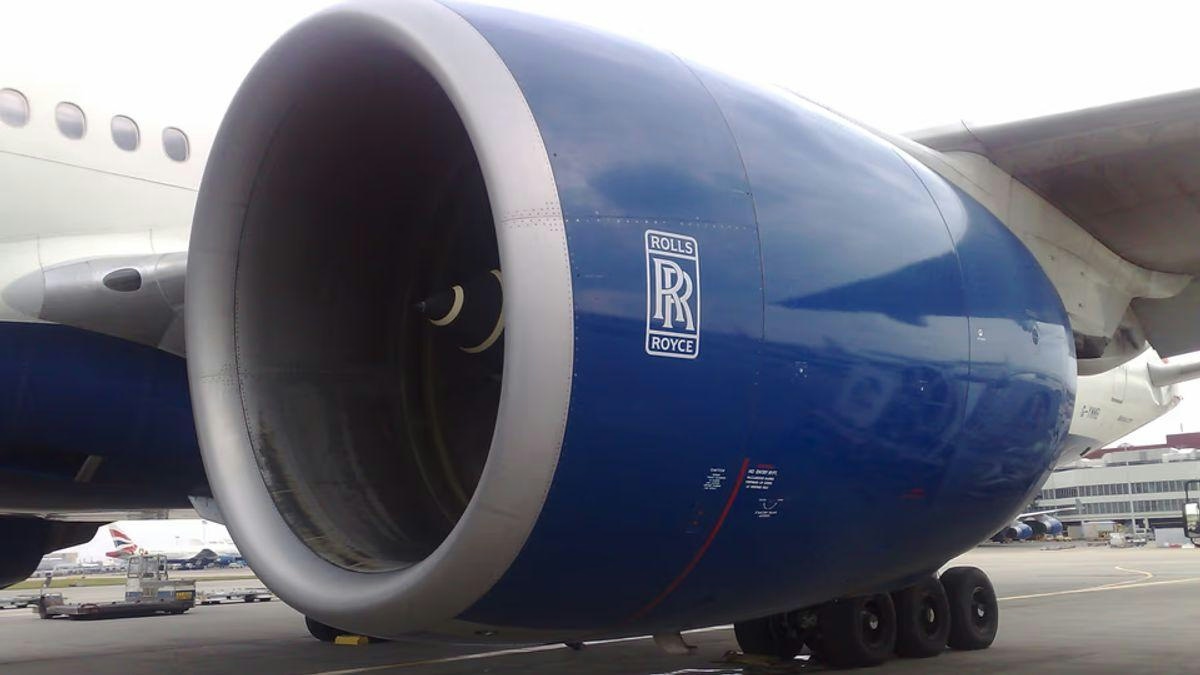
FAA Issues Emergency Directives for Rolls-Royce Trent 700 and 800 Engines
The U.S. Federal Aviation Administration (FAA) has issued two Emergency Airworthiness Directives (2026-18-51 and 2026-18-52) targeting Rolls-Royce Deutschland RB211 Trent 700 and Trent 800 engines, effective immediately. These directives, adopted on September 5, follow the European Union Aviation Safety Agency’s (EASA) emergency measures issued a day earlier. The FAA’s actions are poised to have significant operational and market implications for airlines and engine manufacturers worldwide.
Scope and Compliance Requirements
The directives specifically apply to Trent 700 engines (RB211 Trent 768-60, 772-60, 772B-60), which power Airbus A330-200 and A330-300 aircraft, as well as the Beluga XL and A330 MRTT. They also cover Trent 800 engines (RB211-Trent 875-17, 877-17, 884-17, 884B-17, 892-17, 892B-17, 895-17) used on first-generation Boeing 777-200, 777-200ER, and 777-300 aircraft. Notably, the directives do not affect newer engine models such as the Trent 7000 on the A330neo, Trent XWB on the A350, Trent 1000 on the 787, or the GE90 and engines powering the 777X.
Operators are required to ensure that no more than one affected oil pump part is installed on any twin-engine aircraft. Aircraft may remain in service only if engine assignments are reconfigured to prevent two affected parts from being installed on the same airframe. Immediate compliance is mandatory, and the issuance of special flight permits is prohibited under these directives.
Safety Concerns and Regulatory Context
The emergency directives respond to findings of “non-conformities associated with low oil pressure events in pumps with low accumulated time,” as reported by EASA. The FAA has highlighted the risk of premature pump failure caused by internal rotor cracking. Both agencies warn that such failures could lead to in-flight engine shutdowns and, in the worst-case scenario, dual engine failure, severely compromising aircraft controllability. These directives are considered interim measures, with the possibility of further rulemaking should a permanent solution—such as part replacement or repetitive inspections—be identified.
Beyond the Trent 700 and 800 series, the FAA has recently mandated additional safety measures for Rolls-Royce-powered Boeing 787s, requiring replacement of certain fan cowl parts within four years following Boeing’s February 2026 guidance on inadequate debris protection on the right engine’s inboard side. The FAA has also ordered inspections of hundreds of Boeing 737 Max jets after reports of cracks in older models that share similar design and manufacturing processes.
Industry Impact and Compliance
The emergency directives are expected to increase operational costs and maintenance demands for affected airlines, potentially disrupting flight schedules and reducing fleet availability. Competitors may seek to capitalize on the situation by promoting alternative engine options to airlines aiming to mitigate risk and maintain operational reliability.
The FAA mandates strict adherence to all actions and deadlines outlined in the corresponding EASA emergency directives, with only minor exceptions such as the entry-into-force date. While the FAA has not issued its own detailed procedures, it reserves the right to implement further measures as necessary.
As the aviation industry responds to these emergency directives, airlines and manufacturers face intensified scrutiny regarding engine reliability and safety, with potential ripple effects across the global aviation market.

Etihad Airways Suspends Airbus A380 Flights on Key Route

Aditya Birla Group Seeks Approval for Aircraft Leasing in GIFT City

Qatar Airways Highlights Innovation and Connectivity at Arabian Travel Market 2026

Hong Kong's Five-Year Plan Includes Andrew Fan's Aircraft Parts Processing Hub Proposal

ACIA Aero Leasing Delivers ATR72-600 to Air Nostrum

RTX Appoints Jill Albertelli as Head of Pratt & Whitney

TAT Technologies Joins Beyond Aero Hydrogen Aircraft Program

AURAK Study Highlights Barriers to Air Taxi Adoption in Emerging Economies

Xiamen Air Selects Altitude for 787 Maintenance at Heathrow

Etihad and Swissport Extend Global Partnership
