
Trasforma le intuizioni dell’IA in azioni concrete

Tendenze
Categories
Five Commercial Aircraft Programs Canceled by Boeing and Airbus
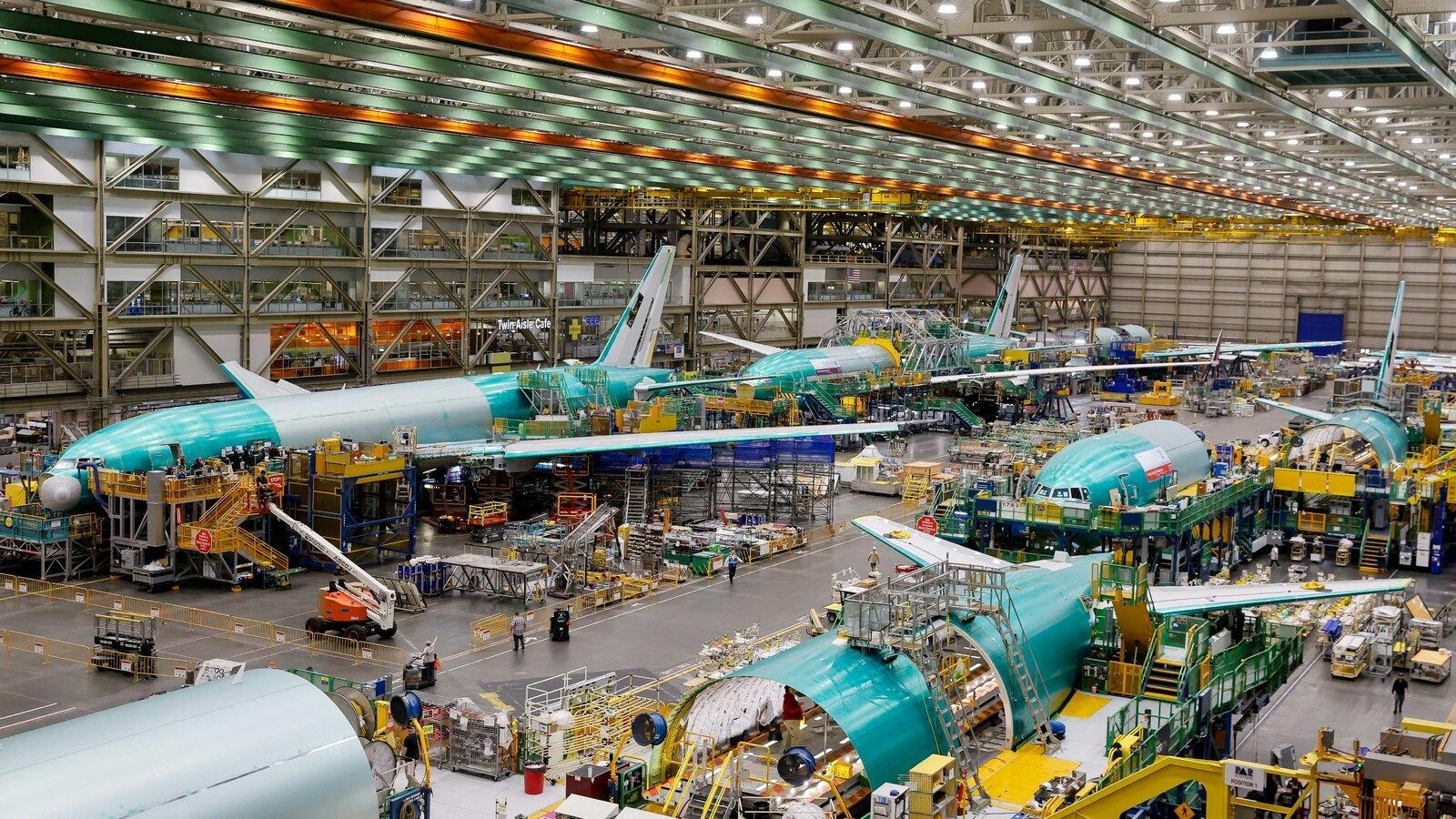
Five Commercial Aircraft Programs Canceled by Boeing and Airbus
Over the years, Boeing and Airbus have introduced numerous ambitious aircraft designs, many of which never progressed beyond the conceptual stage. While some of these proposals contributed to advancements in aviation technology, others were ultimately abandoned due to prohibitive development costs, unfavorable timing, or a lack of sufficient interest from airlines. Even the most technically sound projects can falter if carriers are unwilling to commit, particularly in an industry influenced by shifting strategic priorities, engine supply challenges, and intensifying competition.
Industry Challenges and Market Dynamics
Recent developments in the aviation sector underscore these persistent challenges. Engine shortages, as emphasized by United Airlines CEO Scott Kirby, are currently limiting airline expansion and complicating fleet planning. United Airlines itself canceled its Airbus A350 order following a contractual dispute with Rolls Royce, the exclusive engine supplier for the aircraft. Concurrently, American Airlines is actively pursuing new widebody aircraft orders to remain competitive with rivals such as Delta and United, reflecting a broader strategic recalibration as airlines navigate supply constraints and market pressures. Airbus, meanwhile, remains cautious about launching a larger variant of its A220 model, hindered by lukewarm interest from leasing companies and ongoing debates regarding the aircraft’s range and performance capabilities.
These contemporary challenges mirror the difficulties encountered by previous aircraft programs. The following are five notable commercial aircraft projects from Boeing and Airbus that were ultimately canceled before entering service.
Boeing 767-400ERX
In 2000, Boeing announced the 767-400ERX, a long-range iteration of its 767-400ER model. This design incorporated higher-thrust engines, reinforced airframe structures, and increased fuel capacity, targeting a range exceeding 6,150 nautical miles—approximately 525 nautical miles more than the standard 767-400ER. The aircraft was intended to accommodate roughly 245 passengers in a three-class configuration, similar to the existing model, but required a higher maximum takeoff weight and, critically, new engines. To mitigate development risks, Boeing planned to equip the 767-400ERX with the same engines being developed for the concurrently planned 747X. However, when the 747X program was canceled due to insufficient airline interest, the associated engine development was also terminated. With only Kenya Airways placing a firm order and no additional commitments forthcoming, Boeing discontinued the 767-400ERX project in 2001, redirecting its focus toward the 777 family and the new 7E7 program, which eventually evolved into the 787 Dreamliner.
Boeing 747X
In the late 1990s and early 2000s, Boeing endeavored to modernize its iconic jumbo jet to compete with Airbus’s A380. At the 1996 Farnborough Airshow, Boeing unveiled the 747-500X and 747-600X variants, designed to offer increased passenger capacity and extended range. Despite the technical promise of these models, the program failed to attract sufficient airline interest, largely due to the substantial costs involved and a shifting market environment that favored more efficient, smaller widebody aircraft. The cancellation of the 747X had a cascading effect, directly impacting related projects such as the 767-400ERX.
Airbus and Other Canceled Programs
While Boeing’s canceled projects are well documented, Airbus has also faced setbacks with certain aircraft variants. The company has exhibited caution in advancing larger or more specialized versions of existing models, such as an expanded A220, amid uncertain market demand and reservations from leasing companies concerning the aircraft’s range and performance. These instances illustrate how even well-conceived aircraft programs can be derailed by market realities, supply chain limitations, and evolving airline strategies.
The cancellation of these programs highlights the intricate balance between technical innovation, market demand, and industry constraints—a dynamic that continues to influence the trajectory of commercial aviation.

Etihad Airways Suspends Airbus A380 Flights on Key Route

Aditya Birla Group Seeks Approval for Aircraft Leasing in GIFT City

Qatar Airways Highlights Innovation and Connectivity at Arabian Travel Market 2026

Hong Kong's Five-Year Plan Includes Andrew Fan's Aircraft Parts Processing Hub Proposal

ACIA Aero Leasing Delivers ATR72-600 to Air Nostrum

RTX Appoints Jill Albertelli as Head of Pratt & Whitney

TAT Technologies Joins Beyond Aero Hydrogen Aircraft Program

AURAK Study Highlights Barriers to Air Taxi Adoption in Emerging Economies

Xiamen Air Selects Altitude for 787 Maintenance at Heathrow

Etihad and Swissport Extend Global Partnership
