Immagine

AeroGenie — Il tuo copilota intelligente.

Chiedi qualsiasi cosa. Analizza tutto. Agisci immediatamente.

Tendenze

Categories

Flying Taxis Are Now Real. But Would You Want Them Flying Over Your House?
April 30, 2026By ePlane AI
Flying Taxis Are Now Real. But Would You Want Them Flying Over Your House?
0
0
Urban Air Mobility
Joby Aviation
Electric Air Taxi

Flying Taxis Are Now Real. But Would You Want Them Flying Over Your House?

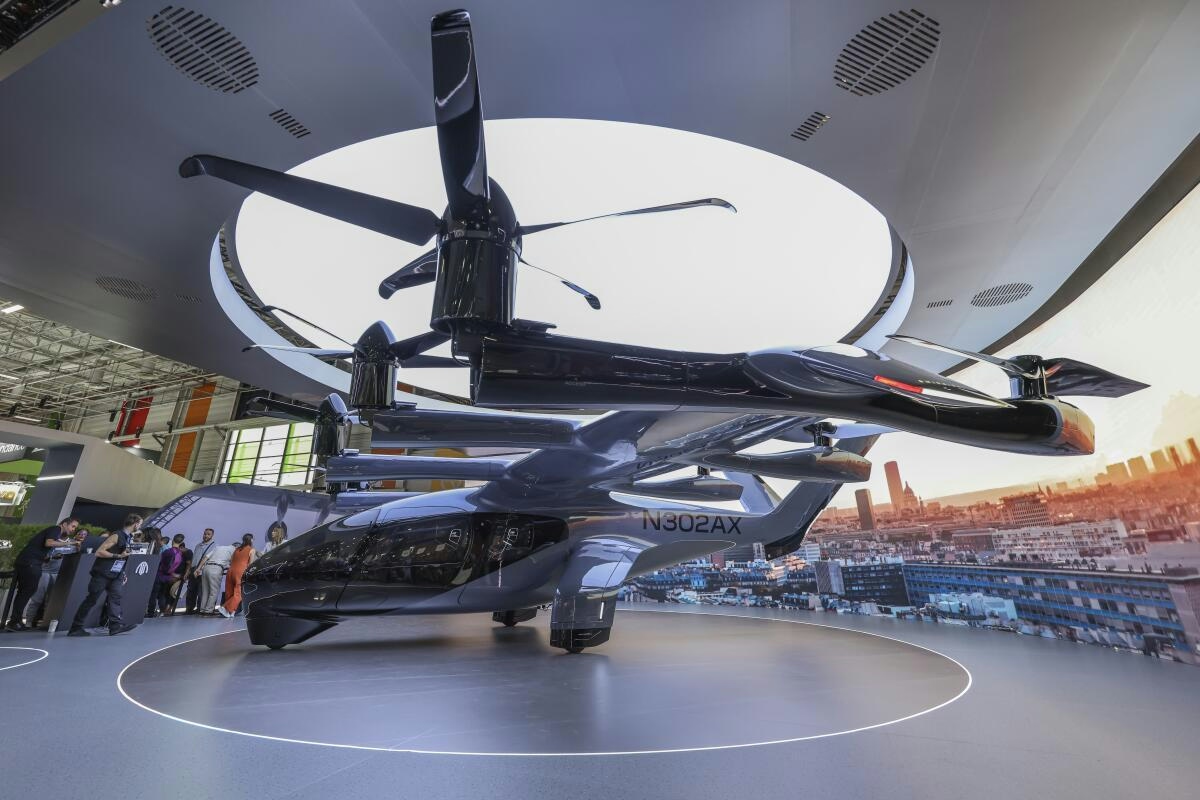
Flying taxis, once a staple of science fiction and futuristic visions, have taken a significant step toward becoming a tangible part of urban life. This week, Joby Aviation, a prominent player in the urban air mobility sector, conducted a series of piloted electric air taxi demonstration flights in New York City. These flights operated between John F. Kennedy International Airport and several heliports in Manhattan, utilizing actual city and airport infrastructure rather than isolated test sites. This milestone marks a crucial advancement for the industry, signaling a move from conceptual trials to real-world urban testing.

Progress and Potential

Although these flights are not yet available for commercial booking, they represent a critical phase in the development of flying taxis. Joby Aviation must still navigate regulatory approvals before it can offer paid passenger services in the United States. Nevertheless, the demonstrations highlight the potential benefits of this new mode of transport. The appeal is clear: travelers familiar with the often frustrating and time-consuming journey from major airports to city centers may soon have a faster alternative. Joby suggests that a trip from JFK to Manhattan could be completed in mere minutes, a stark contrast to the frequent traffic congestion and unpredictable delays currently experienced.

Public Concerns and Urban Impact

While the promise of convenience is compelling, the introduction of flying taxis raises important questions for urban residents. Most city dwellers may never ride in these vehicles, yet they will inevitably encounter them overhead. This reality shifts the discussion from technological feasibility to issues of public acceptance and quality of life. Safety remains a paramount concern—would residents feel secure with a new class of aircraft regularly flying above densely populated neighborhoods? Noise pollution is another critical factor, as the tolerance of frequent flights over homes, parks, and schools is uncertain. Additionally, questions of equity arise: will the benefits of aerial mobility be accessible only to a wealthy few, and how will cities reconcile increased aerial traffic with broader social and economic considerations?

These concerns are not merely hypothetical. As the technology advances, debates intensify over who stands to gain from flying taxis and who may bear the burden of their presence.

Industry Dynamics and Future Outlook

The rapid progress in urban air mobility has attracted significant attention beyond local communities. Investors have responded positively, viewing the sector as a potentially transformative force in transportation. Joby Aviation faces competition from several rivals, leading to legal disputes such as the ongoing court case against Archer Aviation, which involves allegations of misrepresentation and trade secret theft.

Despite these challenges, the market for flying taxis is expanding. Joby plans to initiate passenger flights in New York, Texas, and Florida as early as the latter half of this year, contingent on regulatory clearance. As these services approach operational reality, the fundamental question remains: are urban populations prepared to integrate flying taxis into their daily environment?

For now, Joby’s flights in New York serve as demonstrations, but the prospect of urban air travel is closer than ever—and accompanied by complex social and regulatory considerations. Would you be comfortable with flying taxis passing over your neighborhood?

More news
Breeze Airways Named One of TIME's 100 Most Influential Companies in 2026

Breeze Airways Named One of TIME's 100 Most Influential Companies in 2026

Breeze Airways Recognized Among TIME's 100 Most Influential Companies in 2026 Breeze Airways has been named one of TIME magazine’s 100 Most Influential Companies in 2026, marking a significant achievement for the rapidly expanding airline. This annual list, curated by TIME editors, celebrates organizations that demonstrate exceptional innovation, leadership, and global impact across various industries. Rapid Growth and Industry Impact Since its founding in 2021, Breeze Airways has quickly established itself as a notable player in the competitive airline industry. The company’s customer-focused strategy, competitive pricing, and targeted expansion into underserved markets have distinguished it from traditional carriers. Its inclusion on TIME’s prestigious list highlights the airline’s growing influence within the travel and tourism sector, reflecting its ability to reshape market dynamics through innovation and accessibility. Challenges Ahead Amid Rising Profile While the recognition affirms Breeze Airways’ success, it also introduces new challenges as the company embarks on its next phase of growth. To maintain its competitive advantage, the airline must continue to innovate and uphold operational excellence. Additionally, increased visibility will likely attract greater regulatory scrutiny, requiring the company to navigate evolving industry standards and government oversight carefully. Market volatility presents another significant challenge. The announcement is expected to boost investor interest, which could lead to fluctuations in Breeze Airways’ stock price. Although heightened attention may provide opportunities for capital infusion, it also intensifies the pressure on the airline to deliver consistent financial and operational results. Competitive Response and Industry Dynamics Breeze Airways’ elevated status is anticipated to provoke strategic responses from established competitors. Rival airlines may intensify marketing efforts, expand route networks, and pursue new partnerships to protect their market share. These developments could accelerate innovation and collaboration across the sector, further transforming the competitive landscape. As Breeze Airways celebrates its recognition among TIME’s 100 Most Influential Companies, the airline faces a critical juncture. Its capacity to adapt to emerging challenges and sustain its momentum will be closely monitored by investors, regulators, and industry peers alike.
Airbus Faces Challenges Meeting 2026 Delivery Targets Amid Rising Inventory

Airbus Faces Challenges Meeting 2026 Delivery Targets Amid Rising Inventory

Airbus Faces Challenges Meeting 2026 Delivery Targets Amid Rising Inventory Production-Delivery Discrepancy and Its Implications Airbus is encountering significant obstacles in meeting its 2026 delivery target of 870 aircraft, as recent data reveals a widening gap between production output and actual deliveries. Despite maintaining strong production rates, the European aerospace giant has struggled to convert completed aircraft into customer deliveries. To date this year, only 70.4% of produced aircraft have been delivered, a shortfall largely attributable to the A320neo family. This model, which constitutes the bulk of Airbus’s production, has seen a delivery conversion rate of just 70.2%. This nearly 30% discrepancy contrasts sharply with Boeing’s performance, which has delivered 93.2% of its produced aircraft across all programs, including a 94.6% conversion rate for the 737 MAX. Boeing’s superior delivery efficiency highlights a growing operational divide between the two manufacturers and raises concerns about Airbus’s ability to meet its annual guidance if the situation does not improve. Supply Chain Constraints and Financial Impact A critical factor contributing to Airbus’s delivery bottleneck is the limited supply of Pratt & Whitney engines, which has directly impeded A320neo production. This supply chain disruption has had a pronounced financial impact on the company. Airbus reported an 11% decline in first-quarter commercial aircraft revenues alongside an 84% drop in adjusted earnings for the division. The company has described the operating environment as “dynamic and complex,” grappling not only with engine shortages but also with broader supply chain and completion challenges. These issues have compounded the difficulty of converting produced aircraft into delivered units, resulting in a growing inventory of undelivered planes. Risks to Delivery Targets and Market Context The accumulation of undelivered aircraft poses a significant risk to Airbus’s ability to meet its 2026 delivery goals. If the current conversion rate persists, a portion of the expected deliveries for 2026 may be deferred into 2027, further exacerbating inventory build-up and making the annual target increasingly elusive. While Airbus remains committed to its forecast of 870 deliveries for the year, the company’s success hinges on resolving the delivery bottlenecks, particularly those related to engine availability and supply chain disruptions. Airbus is not alone in facing delivery challenges. Boeing, despite outperforming Airbus in delivery efficiency, and China’s C919 program, which is also experiencing delays, illustrate the broader difficulties confronting the global aerospace industry. Nonetheless, the gap between production capacity and delivery execution remains the central issue for Airbus as it strives to meet its ambitious targets in a competitive market environment.
Financing Nigeria’s Aviation Sector: Debt, Leasing, and Alternative Investment Structures

Financing Nigeria’s Aviation Sector: Debt, Leasing, and Alternative Investment Structures

Financing Nigeria’s Aviation Sector: Debt, Leasing, and Alternative Investment Structures Nigeria’s aviation industry is rapidly emerging as one of Africa’s most promising investment destinations. This growth is underpinned by significant advancements in airport infrastructure, the introduction of new indigenous airlines, and enhanced access to aircraft financing. Notably, Nigeria’s compliance with international aviation standards has improved markedly, with its Cape Town Convention compliance rating rising from 49% to over 75%. These developments have strengthened confidence among lenders and aircraft owners, fostering deeper collaboration between Nigerian operators and global aviation and financial institutions. Additionally, development finance institutions are demonstrating increased interest, signaling a transition from a sector focused on survival to one oriented towards long-term sustainability. Despite these positive trends, the sector continues to face considerable challenges. The persistent Jet A1 fuel shortage poses a serious threat to flight operations, prompting the federal government to explore debt relief options for struggling airlines. Market responses to these challenges are divided; while some investors view the situation as an opportunity for debt restructuring, others remain cautious about the long-term viability of domestic carriers. These difficulties are reflective of broader structural issues confronting African airlines. Meanwhile, global leasing companies such as TrueNoord are expanding their footprint across the continent. Recent industry developments, including the acquisition of Air Lease by SMBC Aviation Capital and its partners, highlight the intensifying competition within the global aviation leasing market—factors that are likely to influence investment strategies in Nigeria. Commercial and Investment Pathways Debt financing continues to be a principal mechanism for investment in Nigeria’s aviation sector. Local financial institutions have played a pivotal role in supporting fleet expansion for indigenous airlines. For instance, Access Bank Plc provided a naira-denominated loan facility to Green Africa, facilitating the acquisition of two fully owned aircraft. These loans are typically secured against the aircraft or other agreed collateral to mitigate risk for lenders. Depending on the scale and complexity of the transaction, funding may be sourced from a single lender or a syndicate. In the current environment, debt financing is also being considered as a strategic tool for restructuring, particularly as airlines contend with operational pressures such as fuel shortages. Aircraft leasing has become the dominant global model for fleet financing, with more than half of commercial aircraft worldwide operated under lease agreements. In Nigeria, leasing arrangements are increasingly prevalent, offering airlines operational flexibility without the financial burden of outright ownership. Leasing structures generally fall into two categories. A dry lease involves the lessor providing only the aircraft, while the airline assumes responsibility for crew, maintenance, insurance, and regulatory compliance. For example, Air Peace recently dry-leased a Boeing 737-700 NG from AerCap, one of the world’s largest lessors. This model is typically preferred by established operators with sufficient technical capacity. Conversely, a wet lease includes the provision of the aircraft along with crew, maintenance, and insurance, offering a more comprehensive solution for airlines lacking in-house resources. The competitive landscape of aircraft leasing is evolving rapidly, with global leasing giants consolidating and expanding their presence. This trend, combined with Nigeria’s regulatory improvements and ongoing operational challenges, is shaping a market where investment opportunities extend beyond emergency funding. Structured participation through debt, leasing, airport concessions, joint ventures, and public-private partnerships is increasingly attracting investor interest. As Nigeria’s aviation sector continues to navigate both opportunities and challenges, investors are seeking sustainable and well-structured pathways to engage with its growth trajectory.
Aircraft Battery Charger Market Projected to Reach $1.3 Billion by 2033

Aircraft Battery Charger Market Projected to Reach $1.3 Billion by 2033

Aircraft Battery Charger Market Projected to Reach $1.3 Billion by 2033 The global aircraft battery charger market is expected to experience substantial growth over the coming decade, with forecasts estimating its value will rise to US$ 1.3 billion by 2033, up from US$ 717 million in 2025. This growth corresponds to a compound annual growth rate (CAGR) of 7.9% between 2026 and 2033. The expansion is largely driven by the aviation sector’s increasing adoption of electric and hybrid aircraft technologies, which aim to reduce carbon emissions and improve operational efficiency. Growth Drivers: Electric Aviation and Smart Charging Technologies The advancement of electric aviation, including electric vertical takeoff and landing (eVTOL) aircraft and more-electric aircraft platforms, is a primary catalyst for the rising demand for sophisticated battery charging systems. Critical applications such as propulsion, auxiliary power units, avionics, emergency systems, and cabin comfort are attracting significant investment as airlines and manufacturers modernize their fleets and emphasize reliable onboard power management. The integration of lithium-ion and other advanced battery technologies, alongside the necessity for rapid, efficient, and intelligent charging solutions, is further accelerating market growth. Innovations in smart charging infrastructure, high-efficiency power conversion, predictive battery management, and integrated monitoring systems are enabling next-generation aviation platforms to operate with enhanced safety and reliability. Government initiatives promoting sustainable aviation and zero-emission technologies, particularly in regions such as North America and Asia-Pacific, are also playing a pivotal role in encouraging the widespread adoption of aircraft battery chargers. Competitive Landscape and Industry Innovation The competitive landscape is shaped by key industry players including Eaton, Electro.Aero, Concorde Battery Corporation, True Blue Power, AeroVironment, Lamar Technologies, Pilot John International, Securaplane Technologies, and MGM COMPRO. These companies provide a diverse array of solutions ranging from smart and high-voltage chargers to portable units and integrated charging infrastructure. Their offerings focus on improving charging efficiency, safety, battery lifecycle management, and operational reliability for both electric and conventional aircraft. Innovation remains a critical differentiator, with companies investing in high-efficiency charging systems, fast-charging technologies, intelligent battery management, digital monitoring integration, and stringent safety and regulatory compliance measures. Market Challenges and Industry Response Despite promising growth prospects, the aircraft battery charger market faces notable challenges. Safety concerns, particularly those related to lithium-ion battery fires, continue to attract regulatory scrutiny and drive demand for safer, more reliable charging solutions. Compliance with evolving regulations and the need for continuous technological advancement require substantial investment from market participants. In response, industry players are intensifying efforts to develop technologies that enhance battery safety and efficiency. Strategic partnerships and acquisitions are increasingly common as companies seek to strengthen their market positions and address the complex regulatory and technological landscape. Outlook As the aviation industry advances toward electrification and sustainability, aircraft battery chargers are poised to become indispensable components of modern aviation infrastructure. Their critical role in ensuring safe, efficient, and reliable energy delivery, while supporting battery health monitoring and operational continuity, will be essential in enabling the next generation of electric and hybrid aircraft worldwide.
AMETEK to Acquire First Aviation for Defense Aircraft Repairs

AMETEK to Acquire First Aviation for Defense Aircraft Repairs

AMETEK to Acquire First Aviation, Enhancing Defense Aircraft Repair Services AMETEK, Inc. (NYSE: AME) has announced a definitive agreement to acquire First Aviation Services, a leading provider of mission-critical maintenance, repair, and overhaul (MRO) services for defense and aviation sectors. First Aviation is also a manufacturer of proprietary components, specializing in advanced electronics, rotor blades, propellers, landing gear, and flight controls. The company designs and produces essential parts for a broad range of defense and aviation platforms, positioning it as a strategic addition to AMETEK’s existing MRO capabilities. David A. Zapico, AMETEK’s Chairman and Chief Executive Officer, emphasized the strategic alignment of the acquisition, noting that First Aviation’s offerings will expand AMETEK’s market reach and enhance its portfolio of component MRO services. He highlighted the complementary nature of the two companies’ products and services, which serve mission-critical applications, and expressed confidence in leveraging their combined operational, engineering, and distribution strengths to drive growth. First Aviation Services, which generates approximately $80 million in annual sales and operates six centers of excellence across the United States, will strengthen AMETEK’s position within the defense and aviation MRO market. The transaction is subject to customary closing conditions, including regulatory approvals. Competitive Landscape and Industry Context This acquisition occurs amid intensifying competition in the aerospace and defense maintenance sector. Competitors such as Talica have recently expanded through acquisitions like AeroDynamics Metal Finishing, while GE Aerospace is investing $1 billion to increase U.S. manufacturing capacity. These developments underscore the competitive pressures AMETEK faces as it seeks to broaden its market share. The broader aviation maintenance industry is also navigating challenges including elevated fuel prices, which may affect demand for MRO services, according to industry analysis from FlightGlobal. Additionally, heightened competitive vigilance is evident in recent disputes such as Archer Aviation’s complaint against Joby Aviation over alleged import violations, reflecting the strategic efforts companies are undertaking to protect and advance their market positions. About AMETEK AMETEK, with annual sales of approximately $7.5 billion, is a global provider of industrial technology solutions serving a diverse array of niche markets. The company’s growth strategy emphasizes operational excellence, technological innovation, global expansion, and strategic acquisitions, supported by disciplined cash generation and capital deployment. Founded in 1930 and publicly traded on the New York Stock Exchange for over 95 years, AMETEK is a component of the S&P 500 index. For further information, visit www.ametek.com.
Atlas Air Expands Aircraft Maintenance Division

Atlas Air Expands Aircraft Maintenance Division

Atlas Air Expands Aircraft Maintenance Division Atlas Air Service, headquartered in Bremen, Germany, has announced a significant expansion of its aircraft maintenance division, accompanied by a reinforced management structure aimed at driving strategic growth within the business jet maintenance sector. Leadership Restructuring and Strategic Focus In January 2026, the company appointed Florian Kohlmann to its executive board as head of aircraft maintenance. Kohlmann will be responsible for overseeing the strategic development, marketing, and sales activities across the entire Atlas Group in this segment. He will also maintain his role as managing director of Augsburg Air Service, facilitating close coordination among the group’s principal locations in Bremen, Augsburg, and Altenrhein, Switzerland. Complementing this leadership enhancement, Dennis Klose has been named director of Maintenance, Repair, and Overhaul (MRO) at the Bremen facility. Klose’s mandate centers on refining operational processes and increasing efficiency throughout the division. Operational Integration and Market Challenges The expanded management framework is designed to optimize processes across all sites and better align services with customer requirements. By fostering tighter collaboration between Bremen, Augsburg, and Altenrhein, Atlas Air Service aims to capitalize on synergies and elevate overall group performance. Nonetheless, the company faces several challenges as it broadens its maintenance capabilities. Ensuring regulatory compliance remains paramount, particularly as new services and technologies are integrated. The complexity of merging operations across multiple locations while upholding stringent safety and quality standards presents an ongoing challenge. Additionally, Atlas Air must contend with intense competition from established aircraft maintenance providers, who may respond by enhancing their own service offerings. Market Response and Future Outlook Despite these hurdles, the market has responded positively to Atlas Air’s expansion, with a noticeable increase in investor interest in its maintenance services. Industry analysts suggest that the company’s strategic initiatives could prompt competitors to accelerate their development efforts to preserve market share. Atlas Air Service’s leadership expresses confidence that the strengthened management team and integrated operational approach will position the group for sustained growth and improved service delivery in the evolving business jet maintenance landscape.
Trifork Acquires VION AI to Enhance Real-Time Operational Intelligence in Aviation

Trifork Acquires VION AI to Enhance Real-Time Operational Intelligence in Aviation

Trifork Acquires VION AI to Enhance Real-Time Operational Intelligence in Aviation **Switzerland, 30 April 2026** – Trifork Group AG has announced the acquisition of VION AI, a strategic move designed to accelerate the adoption of real-time operational intelligence within the aviation industry. This acquisition aims to strengthen Trifork’s aviation business by enhancing its capacity to deliver data-driven solutions that improve airline operations and customer service amid increasing cost pressures, operational complexities, and rising passenger expectations. Advancing Real-Time Data Capabilities in Aviation VION AI specializes in capturing and structuring real-time data from frontline operations, with a particular focus on aircraft turnaround processes. By leveraging artificial intelligence at the edge, VION AI’s technology reveals critical operational insights that have traditionally been delayed or remained unseen. This innovation offers airlines and airports a new level of situational awareness, enabling more informed and timely decision-making. Kristian Dollerup, Head of Aviation at Trifork, emphasized the transformative potential of this acquisition, stating, “By unlocking real-time insights from the frontline and providing actionable data and communication tools, we enable a fundamentally new way of managing turn operations—simpler, faster, and more intelligent wherever airlines fly. Together with VION AI, we aim to push the industry toward a more proactive and data-driven future.” The integration of VION AI’s capabilities with Trifork’s existing iFly4 App Suite and platform is expected to provide airlines with unprecedented, granular visibility into their operations. This enhanced real-time intelligence will facilitate immediate, data-driven actions that reduce operational complexity, lower costs, and significantly improve on-time performance. Strategic Fit and Industry Implications Michael Busch, CEO of VION AI, expressed enthusiasm about the partnership, noting, “We are incredibly excited to join forces with Trifork. From the outset, we shared a vision of making frontline operations visible and actionable in real time. Trifork’s robust platform, industry reach, and commitment to modern technology create the ideal environment to scale our solution and deliver meaningful impact globally.” Jørn Larsen, CEO of Trifork, highlighted the cultural and strategic alignment between the two companies. He remarked, “This acquisition is both a cultural and strategic fit. VION AI brings cutting-edge technology, innovative AI training methods, and deep aviation expertise. Combined with Trifork’s platforms and global reach, we anticipate strong synergies that will accelerate innovation and create immediate value for our customers.” Despite the promising outlook, integrating advanced AI technologies into existing aviation systems presents significant challenges. The process may encounter both cultural and technical hurdles as AI becomes increasingly central to enterprise infrastructure. The broader market is expected to respond with heightened interest in AI-driven operational solutions, prompting competitors to accelerate their own AI initiatives or pursue strategic partnerships to enhance their technological capabilities. This acquisition occurs amid volatility in the AI sector, with companies such as Oracle and CoreWeave facing investor concerns due to financial pressures on AI model providers, despite recent stock sell-offs. This context underscores the importance of robust integration and execution as AI technologies mature within critical industries like aviation. Trifork anticipates completing the core product integration with VION AI within approximately six weeks, enabling rapid deployment and early customer impact. The combined teams will collaborate closely to deliver measurable improvements in efficiency, operational reliability, and passenger experience for both existing and new clients. The acquisition is not expected to have a material impact on Trifork’s financial outlook in the near term.
Rolls-Royce Engine Flight Hours Recovering After Middle East Conflict

Rolls-Royce Engine Flight Hours Recovering After Middle East Conflict

Rolls-Royce Engine Flight Hours Recovering After Middle East Conflict Rolls-Royce has reported a robust recovery in engine flying hours following the recent Middle East conflict, with no lasting impact anticipated on its civil aerospace division. In its first-quarter trading update, the company confirmed that flying hours for Trent XWB engines, which power the Airbus A350, have fully returned to pre-conflict levels among regional customers. Impact on Aircraft Operations and Engine Performance The manufacturer highlighted that reductions in airline capacity have predominantly affected narrowbody aircraft, rather than the widebody jets typically equipped with Rolls-Royce engines. Consequently, the company does not expect any changes to the retirement schedule of Trent 700-powered Airbus A330s. Rolls-Royce maintains its forecast that overall large-engine flying hours will exceed 2019 levels by 15 to 20 percent this year, with first-quarter figures already reflecting a 5 to 15 percent increase. This resilience is attributed to strong growth in regions outside the Middle East, which have benefited from reallocated capacity and operational enhancements. Additionally, Rolls-Royce has upgraded more than one-third of the operational Boeing 787 fleet powered by Trent 1000 TEN engines, fitting them with improved high-pressure turbine blades designed to match the durability of the Trent 1000 XE powerplant. Orders and Market Position Recent orders for the Trent 1000 XE, including a notable agreement in April for three Boeing 787s with LATAM Airlines, have reinforced Rolls-Royce’s confidence. The company described these deals as clear evidence that its investment in durability improvements has positioned the XE engine as a competitive and order-winning product. Rolls-Royce has not revised its full-year guidance for large engine deliveries, which increased by 18 percent in the first quarter. It also does not anticipate any changes to its shop-visit profile for these engines this year or next as a result of the Middle East situation. Industry Context Within the broader aerospace industry, Safran remains optimistic despite the conflict, reporting a high volume of shop visits and a 63 percent increase in Leap engine deliveries during the first quarter. In contrast, GE Aviation has cautioned that the fallout from the Iran war could adversely affect its aftermarket business, forecasting a double-digit decline in Middle East flights and potentially reduced volumes in shop visits, spare parts, and engine sales. Nonetheless, GE is maintaining its full-year revenue and profit guidance. While the Middle East conflict has presented challenges for some aerospace manufacturers, the strong recoveries and continued growth reported by Rolls-Royce and Safran underscore the resilience of the civil aerospace sector.
SMBC Aviation Capital Increases Facility to $3.7 Billion

SMBC Aviation Capital Increases Facility to $3.7 Billion

SMBC Aviation Capital Expands Financing Facility to $3.7 Billion SMBC Aviation Capital has completed a significant upsizing of its syndicated financing facility, increasing it by US$1.7 billion to a total of US$3.7 billion. This expansion builds on the original US$2 billion facility announced in February, which was arranged to support the company’s acquisition of Sumisho Air Lease Corporation. The additional capital is intended for general corporate purposes, particularly to facilitate the integration of Air Lease’s extensive orderbook and fleet, which includes approximately 420 aircraft commitments with Airbus and Boeing. Broad Financial Support and Strategic Banking Relationships The upsized facility attracted considerable interest from the financial sector, with 33 institutions participating in the general syndication phase. This brings the total number of banks involved to 40, following the initial US$2 billion raised from seven banks during the senior syndication earlier this year. The participating banks span a wide geographic range, covering Asia, Europe, and the United States. Notably, the transaction has enabled SMBC Aviation Capital to establish 15 new banking relationships, further diversifying and strengthening its financial network. The revised facility structure increases the five-year tranche to US$2.28 billion and the seven-year tranche to US$1.42 billion, providing the company with long-term, competitively priced capital. This enhanced financial position is expected to underpin SMBC Aviation Capital’s expanded scale and growth prospects, particularly as it undertakes the complex task of integrating Air Lease’s fleet and orderbook into its operations. Navigating Industry Challenges Amid Expansion The expansion occurs within a highly competitive aircraft leasing market. The integration of Air Lease’s assets presents operational challenges, and industry observers anticipate intensified competition as other major lessors implement strategic measures to safeguard their market positions and capitalize on their own strengths. Despite these pressures, SMBC Aviation Capital’s move aligns with its strategic objective to establish itself as one of the most competitive and well-capitalized leasing platforms globally. Aisling Kenny, Chief Financial Officer of SMBC Aviation Capital, commented on the transaction, stating, “The upsizing of this facility provides long-term, competitively priced capital to support SMBC Aviation Capital’s increased scale and strong growth trajectory. This transaction also deepens our existing banking relationships, and we are pleased to welcome an additional fifteen new banking partners. The strong reception to this transaction, reflected in both its scale and the geographic diversity of participating banks, underlines the strength of our franchise and the global reach of our business.” As SMBC Aviation Capital continues to expand its global footprint, the increased facility is poised to play a crucial role in supporting its ambitions and managing the evolving dynamics of the aircraft leasing industry.
China Southern and Xiamen Airlines Order 137 Airbus Narrow-Body Jets

China Southern and Xiamen Airlines Order 137 Airbus Narrow-Body Jets

China Southern and Xiamen Airlines Place Landmark Order for 137 Airbus A320neo Jets Airbus has secured a substantial new order from China Southern Airlines, which announced on April 29 its intention to acquire 102 A320neo family aircraft for its own operations, alongside an additional 35 jets for its majority-owned subsidiary, Xiamen Airlines. This combined purchase of 137 narrow-body aircraft is valued at approximately $21.4 billion at list prices, although China Southern has negotiated undisclosed discounts. Delivery Schedule and Market Context The deliveries are slated to commence in 2028 and extend through 2032, following closely on the heels of a previous order for 96 aircraft placed in July 2022. This latest agreement arrives just weeks after China Eastern Airlines revealed an order for 101 A320neo family jets, underscoring intensifying competition among China’s leading carriers as they expand their Airbus narrow-body fleets. This surge in orders is particularly notable given Airbus’s current slowdown in A320neo deliveries, even as order activity remains robust. The extended delivery timeline for China Southern and Xiamen’s new aircraft may present challenges, especially if supply chain disruptions persist or if Airbus’s production delays continue. The evolving market dynamics suggest that airlines are prioritizing long-term fleet expansion despite potential near-term constraints. Fleet Composition and Strategic Objectives According to Airbus data, China Southern still has five unfilled A320neo orders out of 38 and 41 unfilled A321neo orders out of 99, with all nine A319neos already delivered. Xiamen Airlines maintains a backlog of 18 A320neos and 18 A321neos, totaling 22 and 20 orders respectively. Engine suppliers for the new aircraft have not yet been disclosed. Currently, China Southern operates A320neo family aircraft powered by both Pratt & Whitney Geared Turbofan and CFM LEAP-1A engines, while Xiamen’s fleet exclusively uses CFM engines. This order aligns with China Southern’s broader strategy to consolidate its presence in the Guangdong-Hong Kong-Macau Greater Bay Area, advance its footprint in the Beijing-Tianjin-Hebei region, and support China’s national “Belt and Road” initiative. The airline emphasized that the purchase “will help enhance the Group’s market competitiveness by increasing its flight capacity.” Industry Implications and Financial Performance Market analysts anticipate that this significant acquisition may trigger further orders from competitors seeking to maintain or expand their market share amid a rapidly evolving aviation landscape. Meanwhile, Boeing remains on the sidelines, reportedly awaiting potential deals as high-level negotiations between U.S. and Chinese officials continue to be postponed. Financially, China Southern reported a strong first quarter, posting a net profit of RMB 1.5 billion, a reversal from a RMB 747 million loss in the same period last year. Revenues increased by 10 percent to RMB 47.8 billion, with operating profit reaching RMB 2.5 billion. Other major Chinese carriers also demonstrated improved results: China Eastern returned to profitability with a RMB 1.6 billion net profit, and Air China reported a net profit of RMB 1.7 billion for the quarter. As Chinese airlines continue to expand their fleets and Airbus sustains strong order momentum despite delivery challenges, competition within the region’s aviation market is poised to intensify in the coming years.
line










