
Trasforma le intuizioni dell’IA in azioni concrete

Tendenze
Categories
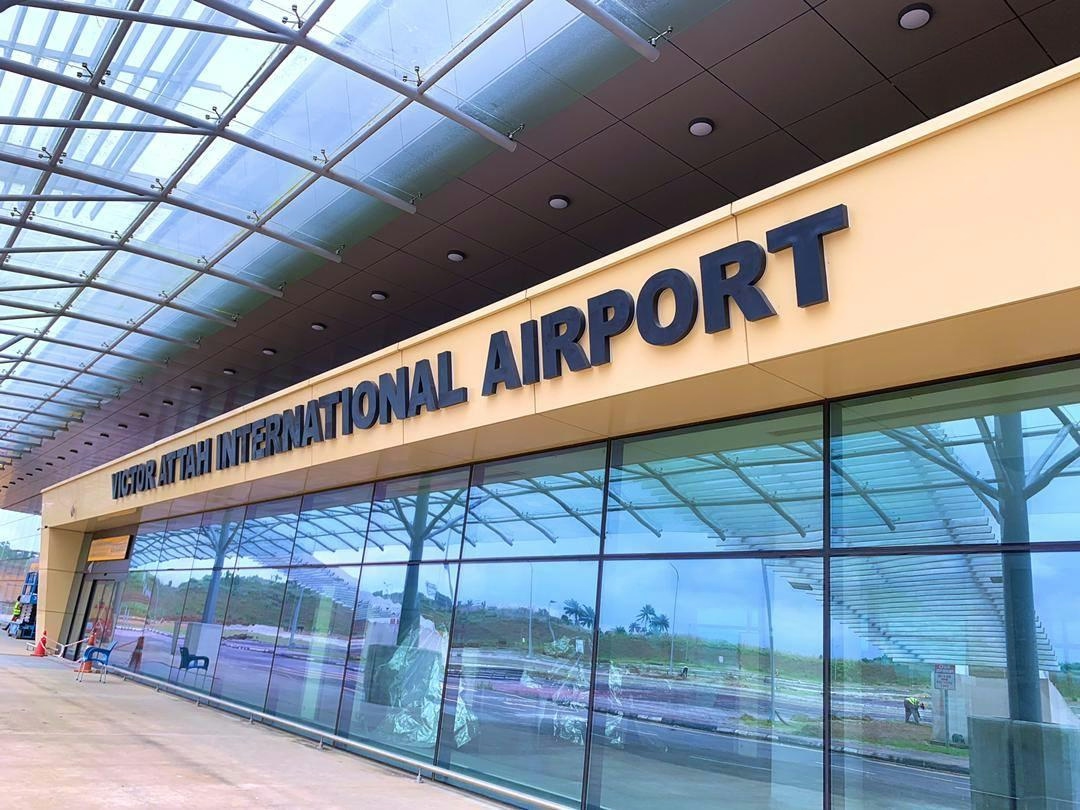
Four Governors Over 27 Years Develop Akwa Ibom’s Aviation Sector
Four Governors Over 27 Years Develop Akwa Ibom’s Aviation Sector
When a brand-new Airbus A220-300 received a traditional water cannon salute at Victor Attah International Airport in Uyo, it signified more than just the expansion of an airline fleet. The direct delivery from Airbus’s Mirabel facility in Canada marked the culmination of a rare 27-year experiment in policy continuity—an anomaly in Nigeria, where political transitions frequently disrupt infrastructure projects and long-term plans.
Since 1999, Akwa Ibom State has pursued a unified aviation strategy across four consecutive administrations, transforming what was once a contested vision into West Africa’s most integrated subnational aviation ecosystem. The arrival of Ibom Air’s latest jetliner—the third A220-300 in its fleet and the second of a ten-aircraft order—stands as tangible proof of this enduring commitment. Today, Akwa Ibom’s aviation framework includes a state-owned airline, a world-class international terminal, a commercial Maintenance, Repair, and Overhaul (MRO) facility, and a comprehensive pipeline for cultivating local aviation talent.
Origins and Early Challenges
The ambitious project traces its roots to the dawn of Nigeria’s Fourth Republic. At a recent reception, Senator Emmanuel Ibok Essien, a pivotal figure in the initiative’s inception, recalled the initial resistance encountered at the federal level. “In 1999, it was myself, Victor Attah, and Senator Udoma Udo Udoma who went to Houston, Texas, where we conceived the idea of this airport and the broader aviation strategy for Akwa Ibom,” Essien explained. Despite opposition from the federal government—then-President Olusegun Obasanjo argued that state funds should support federal airports in neighboring states—the Akwa Ibom team remained resolute. “Even on the day the President came to lay the foundation stone, there was immense pressure. Yet, Arc. Victor Attah stood his ground, laid the foundation, and established the vision that every governor after him has faithfully built upon,” Essien recounted.
A Four-Phase Relay of Leadership
The development of Akwa Ibom’s aviation sector has unfolded through a succession of leadership phases. Victor Attah (1999–2007) laid the groundwork by developing the master plan and securing the necessary land. His successor, Godswill Akpabio (2007–2015), oversaw the civil engineering works, constructed the main runway, and welcomed the first commercial charter flight. Under Udom Emmanuel (2015–2023), the state introduced a commercial strategy that distinguished Akwa Ibom, including the launch of Ibom Air. The current administration continues to expand the aviation ecosystem, with a focus on sustainability and integration.
Challenges and Regional Competition
Despite these achievements, Akwa Ibom’s aviation ambitions face significant challenges. The sector contends with competition from established regional players such as Dangote Refinery and Sonatrach, both of which are expanding their influence across West Africa. Market analysts are closely monitoring the financial viability and sustainability of Akwa Ibom’s aviation projects, particularly as competitors respond with strategic partnerships and investments—for instance, Sonatrach’s new Jet A1 supply route to Niger.
Furthermore, the broader investment climate remains uncertain. Recent setbacks, including the postponement of Electron’s inaugural flight due to funding difficulties, highlight the financial and operational hurdles confronting new aviation ventures in the region. These factors may affect Akwa Ibom’s capacity to attract investment and sustain its momentum.
Nonetheless, Akwa Ibom’s aviation sector stands as a rare example of sustained policy execution in Nigeria, offering a model for long-term infrastructure development amid a challenging and competitive environment.

Etihad Airways Suspends Airbus A380 Flights on Key Route

Aditya Birla Group Seeks Approval for Aircraft Leasing in GIFT City

Qatar Airways Highlights Innovation and Connectivity at Arabian Travel Market 2026

Hong Kong's Five-Year Plan Includes Andrew Fan's Aircraft Parts Processing Hub Proposal

ACIA Aero Leasing Delivers ATR72-600 to Air Nostrum

RTX Appoints Jill Albertelli as Head of Pratt & Whitney

TAT Technologies Joins Beyond Aero Hydrogen Aircraft Program

AURAK Study Highlights Barriers to Air Taxi Adoption in Emerging Economies

Xiamen Air Selects Altitude for 787 Maintenance at Heathrow

Etihad and Swissport Extend Global Partnership
