
Trasforma le intuizioni dell’IA in azioni concrete

Tendenze
Categories
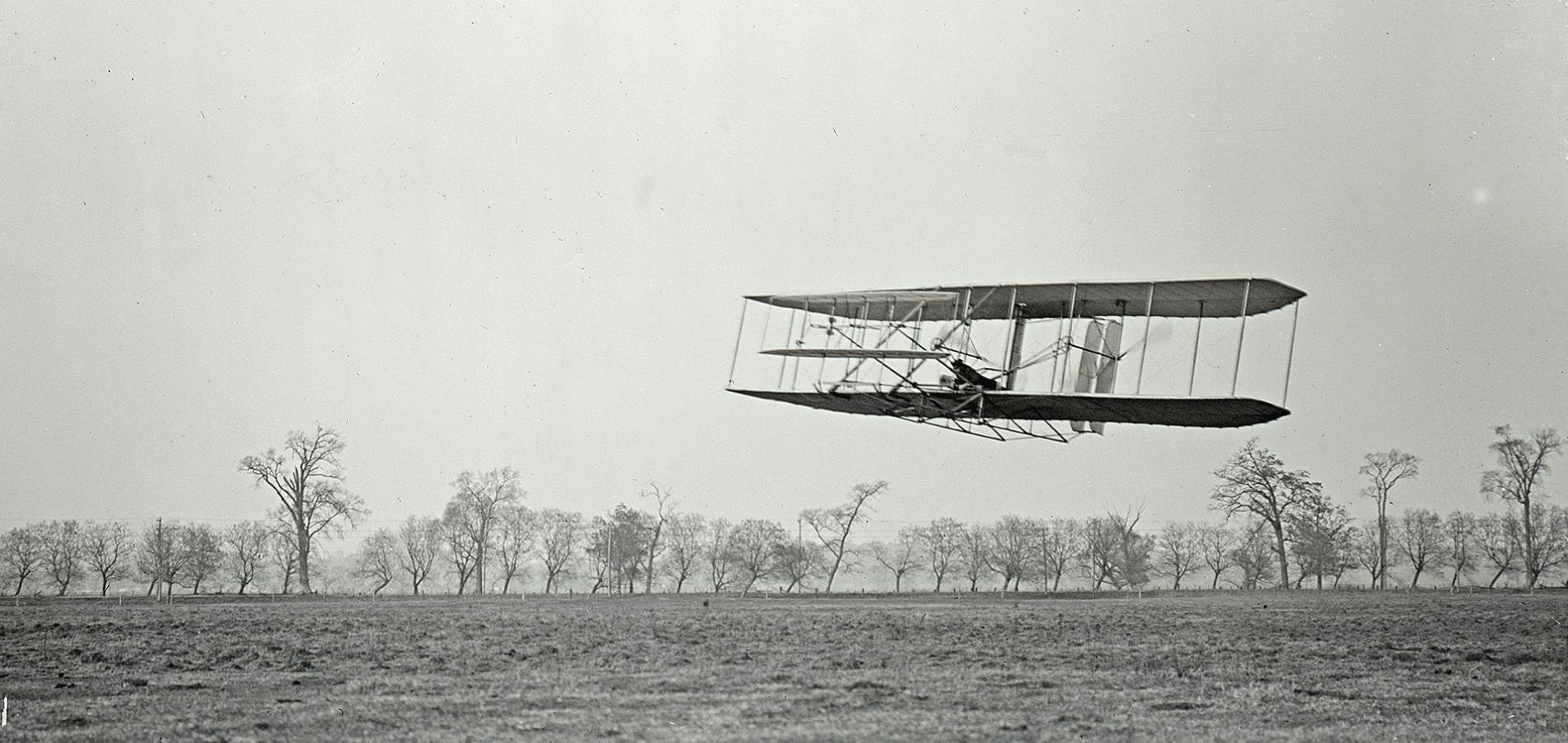
From Wright Brothers to AI: Aviation’s Tech Evolution for Safer Skies
From Wright Brothers to AI: Aviation’s Tech Evolution for Safer Skies
Early Innovations and the Rise of Digital Flight Control
In the earliest days of aviation, pioneers like the Wright brothers depended on mechanical ingenuity and pilot skill to keep their fragile aircraft aloft. The 1903 Flyer, constructed from wood and fabric, was controlled through wing warping and a simple elevator mechanism. This rudimentary approach contrasts sharply with today’s highly sophisticated cockpits, which function as digital command centers where computers oversee nearly every phase of flight, from takeoff to landing. This profound transformation has unfolded over more than a century of technological progress.
The transition from mechanical controls to digital systems began during World War II with the introduction of analog computers that assisted in bomb aiming and navigation. By the 1950s, devices such as the Bendix Central Air Data Computer employed mechanical components to calculate critical flight parameters like airspeed and altitude. These early systems laid the foundation for the integration of digital technology into flight management, gradually shifting computers from passive calculators to active controllers within the cockpit.
A significant breakthrough came in the 1970s with the advent of fly-by-wire technology. This innovation replaced traditional mechanical linkages with electronic signals, allowing pilot commands to be interpreted and executed by onboard computers in real time. Initially implemented in military aircraft such as the F-16 fighter jet, fly-by-wire systems entered commercial aviation with the Airbus A320 in 1988. This advancement not only reduced aircraft weight and improved fuel efficiency but also enhanced safety through envelope protection systems that prevent pilots from executing maneuvers that could jeopardize the aircraft.
Navigation, Design, and the AI Revolution
Digital technology has also revolutionized navigation. Inertial navigation systems developed in the 1960s evolved into GPS-integrated avionics by the 1990s, enabling precise and reliable positioning without dependence on ground-based aids. These improvements, documented by institutions such as Embry-Riddle Aeronautical University and the Centennial of Flight, have contributed significantly to the safety and efficiency of global air travel.
Beyond flight control and navigation, computer-aided design (CAD) software has transformed aircraft development. Engineers can now simulate aerodynamics and test designs virtually before constructing physical prototypes, accelerating innovation cycles, reducing costs, and streamlining manufacturing processes. This trend has been further propelled by manufacturers seeking global flexibility and simplified supply chains to facilitate the rapid adoption of emerging technologies.
Autopilot systems have undergone a parallel evolution. From their origins as simple gyroscopic devices in the early 20th century, modern autopilots now incorporate artificial intelligence capable of managing entire flights. Integrated with advanced flight management systems, these AI-driven autopilots reduce pilot workload and enhance safety by handling complex operational tasks with precision.
Challenges and the Future of Aviation Technology
Despite the remarkable advances, the integration of AI and digital systems into aviation presents significant challenges. Regulatory frameworks continue to evolve, particularly as the industry explores commercial supersonic travel and increasingly autonomous operations. Market responses to the promises of enhanced safety and efficiency are varied, with some competitors investing heavily in AI research and development to maintain technological leadership. However, there is growing caution against a reckless or “YOLO” approach to AI deployment, as unchecked innovation carries risks of unintended consequences or misuse.
As aviation advances further into the digital age, the interplay between innovation, safety, and regulation will be critical in shaping the future of flight. This ongoing evolution ensures that the pioneering spirit of the Wright brothers endures, now propelled by the power of artificial intelligence and computational technology.

Etihad Airways Suspends Airbus A380 Flights on Key Route

Aditya Birla Group Seeks Approval for Aircraft Leasing in GIFT City

Qatar Airways Highlights Innovation and Connectivity at Arabian Travel Market 2026

Hong Kong's Five-Year Plan Includes Andrew Fan's Aircraft Parts Processing Hub Proposal

ACIA Aero Leasing Delivers ATR72-600 to Air Nostrum

RTX Appoints Jill Albertelli as Head of Pratt & Whitney

TAT Technologies Joins Beyond Aero Hydrogen Aircraft Program

AURAK Study Highlights Barriers to Air Taxi Adoption in Emerging Economies

Xiamen Air Selects Altitude for 787 Maintenance at Heathrow

Etihad and Swissport Extend Global Partnership
