
Trasforma le intuizioni dell’IA in azioni concrete

Tendenze
Categories
GE Aerospace Develops Hypersonic Ramjet Using Generative AI
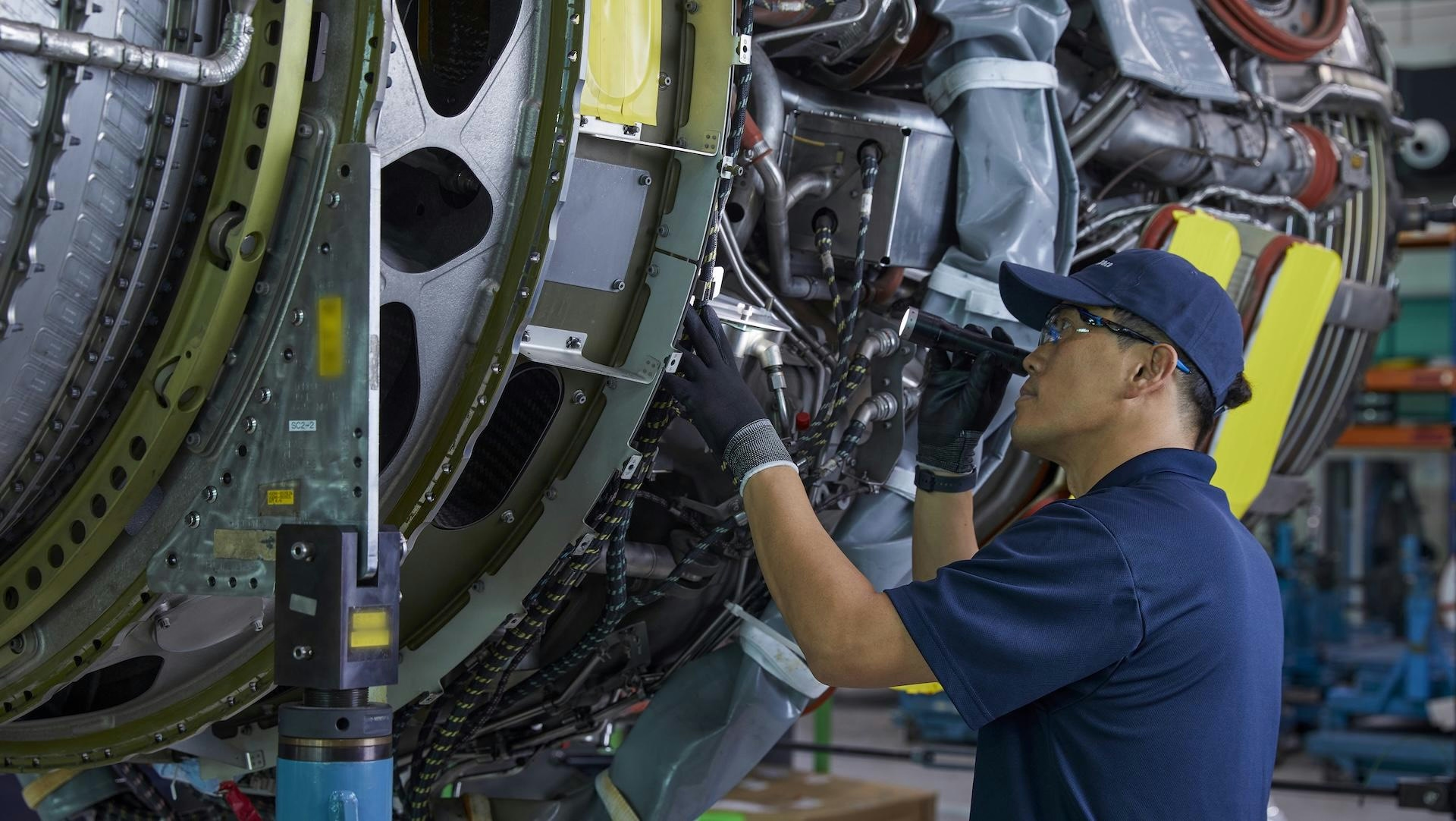
GE Aerospace Advances Hypersonic Ramjet Design with Generative AI
GE Aerospace has announced the successful completion of preliminary design studies for a hypersonic dual-mode ramjet, utilizing a bespoke generative artificial intelligence (AI) application to significantly expedite the engine design process. Unveiled on May 19, 2026, this initiative serves as a proof of concept, illustrating how generative AI can reduce design cycles from several months to mere seconds.
Accelerating Engine Development Through AI
At the company’s Research Center in Niskayuna, New York, engineers employed the AI tool to address a range of flight conditions and customer requirements typical of early ramjet development. The application generated hundreds of candidate engine configurations in a single session, each conforming to the specified constraints. While GE Aerospace has not disclosed detailed technical specifications or committed to advancing any particular design, the project was framed primarily as a demonstration of methodology rather than the initiation of a new hardware program.
Joe Vinciquerra, General Manager and Senior Executive Director at GE Aerospace Research, led the effort and highlighted the significance of the generative AI tool in streamlining the most time-intensive phase of engine development: the iterative process of refining requirements and producing a viable preliminary layout. “By using generative AI tools we can significantly reduce design cycle times,” Vinciquerra stated, emphasizing the potential to accelerate the progression toward testing and eventual commercialization.
The Niskayuna facility remains central to GE Aerospace’s hypersonic propulsion research. Recent achievements include a late 2023 demonstration of a dual-mode ramjet rig employing rotating detonation combustion in supersonic flow, a September 2025 flight of a solid-fuel ramjet aboard a Starfighters Aerospace F-104 as part of the ATLAS program, and January 2026 ground tests of a liquid-fueled rotating detonation ramjet developed in collaboration with Lockheed Martin for missile applications.
Strategic Context and Industry Challenges
The urgency for rapid innovation in propulsion technology is underscored by the U.S. Department of Defense’s prioritization of air-breathing hypersonic concepts, particularly as China and Russia have already deployed operational systems. Historically, U.S. efforts have encountered difficulties transitioning from research to deployment, making accelerated development a critical competitive advantage.
Nonetheless, the integration of generative AI into aerospace design presents challenges beyond technical execution. Broader market skepticism toward AI-generated content, as evidenced in the music industry—where a Luminate report revealed negative consumer attitudes toward AI-created music that imitates existing artists—may signal cautious reception within aerospace circles. Competitors might leverage consumer trust in traditional engineering methods to differentiate their technologies from AI-driven solutions. For GE Aerospace, cultivating trust among stakeholders and the broader audience will be essential as AI tools become increasingly integral to their development processes.
Vinciquerra also noted that the same generative AI technology is being applied to the CFM International RISE program, a joint venture with Safran Aircraft Engines aimed at developing open fan propulsion for next-generation single-aisle aircraft. The RISE initiative targets a fuel-burn reduction exceeding 20 percent compared to current narrowbody engines, with plans for CFM and Airbus to utilize an A380 as a flight demonstrator later this decade.
As GE Aerospace continues to advance its AI-driven design capabilities, the company navigates the dual imperatives of harnessing accelerated innovation and securing confidence in a rapidly evolving technological landscape.

Etihad Airways Suspends Airbus A380 Flights on Key Route

Aditya Birla Group Seeks Approval for Aircraft Leasing in GIFT City

Qatar Airways Highlights Innovation and Connectivity at Arabian Travel Market 2026

Hong Kong's Five-Year Plan Includes Andrew Fan's Aircraft Parts Processing Hub Proposal

ACIA Aero Leasing Delivers ATR72-600 to Air Nostrum

RTX Appoints Jill Albertelli as Head of Pratt & Whitney

TAT Technologies Joins Beyond Aero Hydrogen Aircraft Program

AURAK Study Highlights Barriers to Air Taxi Adoption in Emerging Economies

Xiamen Air Selects Altitude for 787 Maintenance at Heathrow

Etihad and Swissport Extend Global Partnership
