
Trasforma le intuizioni dell’IA in azioni concrete

Tendenze
Categories
German Researchers Conduct Flight Tests of AI-Controlled Morphing Wings
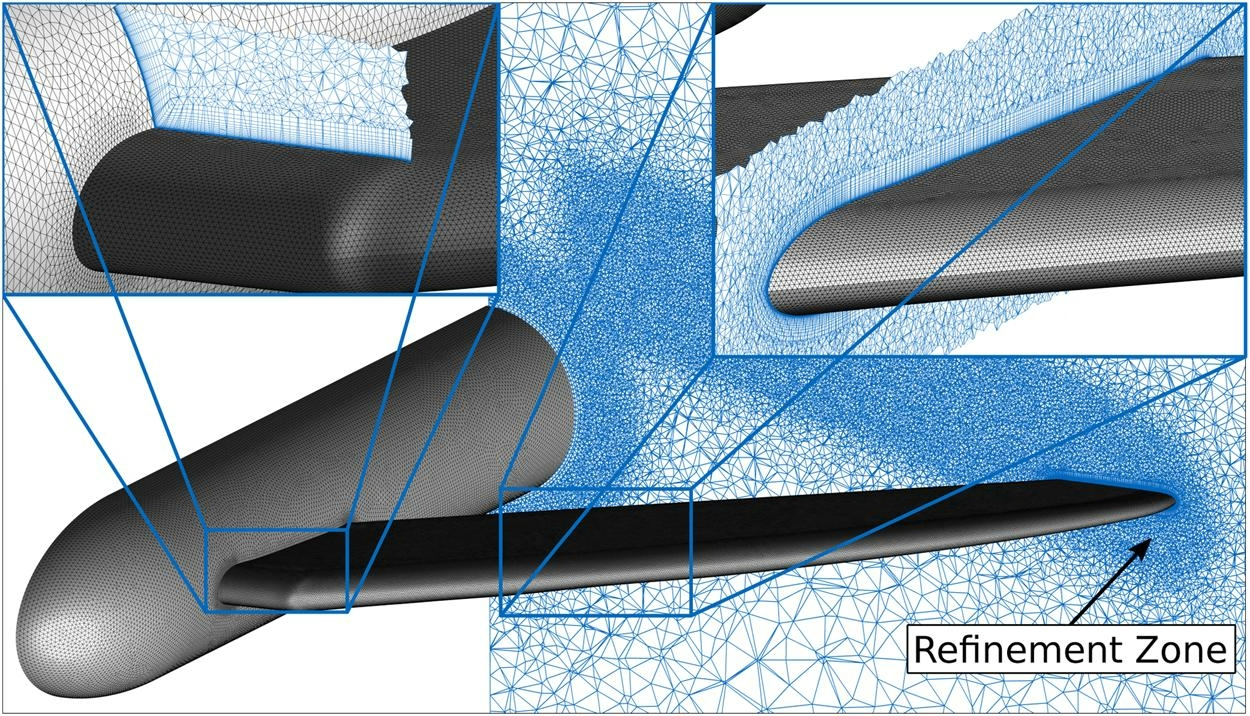
German Researchers Conduct Flight Tests of AI-Controlled Morphing Wings
Breakthrough in Adaptive Wing Technology
Researchers at the German Aerospace Center (DLR) have successfully completed pioneering flight tests of aircraft wings capable of dynamically changing shape during flight, controlled by an advanced artificial intelligence system. These trials, conducted under the Morphing Technologies and Artificial Intelligence Research Group (morphAIR) project, represent a significant advancement toward developing more efficient, controllable, and safer fixed-wing aircraft.
The morphAIR initiative seeks to replace conventional flaps and ailerons with innovative, shape-shifting wing structures. For the tests, DLR’s uncrewed experimental aircraft, Proteus, was alternately equipped with traditional wings and morphing wings. Both wing types were fabricated from fiber-reinforced composites; however, the morphing wings incorporated the Hyperelastic Trailing Edge Morphing system (HyTEM). This system employs ten small actuators distributed along the wingspan, enabling the trailing edge to deform smoothly and continuously rather than in discrete increments.
Martin Radestock, project leader at the DLR Institute of Lightweight Systems, explained that the morphing wing’s ability to alter its shape mid-flight allows it to adapt optimally to varying flight conditions. This seamless adaptability reduces aerodynamic drag and facilitates precise control over lift and induced drag. Moreover, distributing control functions across the wing enhances fault tolerance, a critical factor for future aircraft safety.
AI-Driven Flight Control and Aerodynamic Monitoring
A central component of the project is an AI-assisted flight control system developed by the DLR Institute of Flight Systems. This adaptive algorithm continuously monitors deviations from its trained model and updates itself in real time. It can compensate for simulated damage or actuator failures by reallocating control to unaffected surfaces, thereby maintaining flight stability. Additionally, the system integrates a pressure-reconstruction technique from the DLR Institute of Aerodynamics and Flow Technology, which estimates surface pressure distribution from limited sensor inputs. This capability enables the aircraft to detect and respond autonomously to local aerodynamic disturbances.
The initial flight tests took place at DLR’s National Experimental Test Center for Unmanned Aircraft Systems in Cochstedt, eastern Germany. These trials primarily demonstrated the airworthiness and integration of the new morphing wing and AI control systems. The aircraft, with a top speed of 186 mph (300 km/h) and a wing loading of 14.3 lb/ft² (70 kg/m²), was tested in a scaled configuration relevant to light aircraft. A subsequent test campaign is scheduled for 2026, involving a Proteus model with a total mass of approximately 154 lb (70 kg) to assess scalability. Findings from these experiments will contribute to the forthcoming Unmanned Aircraft Wing Adaption (UAdapt) project.
Challenges and Industry Response
Despite the promising outcomes, the widespread adoption of AI-controlled morphing wings faces considerable challenges. Regulatory approval processes, integration with existing aviation infrastructure, and the necessity to demonstrate consistent safety and reliability remain significant obstacles. The aviation industry has exhibited a mixture of interest and skepticism, particularly among traditional manufacturers cautious of rapid technological change. Competitors may respond by pursuing collaborative research or accelerating their own development efforts to remain competitive with DLR’s advancements in morphing wing technology.
As the morphAIR project advances, its results have the potential to transform aircraft design. However, broad implementation will depend on overcoming technical, regulatory, and industry acceptance barriers.

Etihad Airways Suspends Airbus A380 Flights on Key Route

Aditya Birla Group Seeks Approval for Aircraft Leasing in GIFT City

Qatar Airways Highlights Innovation and Connectivity at Arabian Travel Market 2026

Hong Kong's Five-Year Plan Includes Andrew Fan's Aircraft Parts Processing Hub Proposal

ACIA Aero Leasing Delivers ATR72-600 to Air Nostrum

RTX Appoints Jill Albertelli as Head of Pratt & Whitney

TAT Technologies Joins Beyond Aero Hydrogen Aircraft Program

AURAK Study Highlights Barriers to Air Taxi Adoption in Emerging Economies

Xiamen Air Selects Altitude for 787 Maintenance at Heathrow

Etihad and Swissport Extend Global Partnership
