
Trasforma le intuizioni dell’IA in azioni concrete

Tendenze
Categories
How Aircraft Engines Use Reverse Thrust During Landing
How Aircraft Engines Use Reverse Thrust During Landing
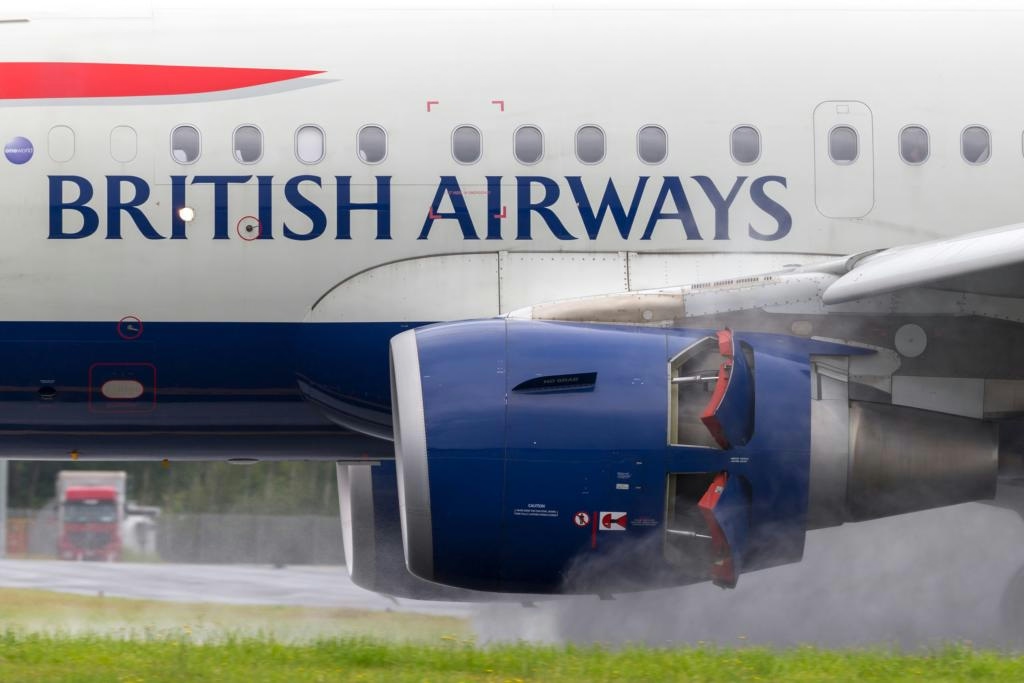
From the moment an aircraft’s wheels touch down, passengers often witness a distinctive change: engine nacelles slide open, and the engines emit a deeper roar as the plane decelerates rapidly. This marks the activation of thrust reversers, a crucial system that enhances safety and efficiency during landing.
The Role of Reverse Thrust in Safe Deceleration
Jet engines are designed to deliver optimal power and efficiency throughout all flight phases, including the critical moments after touchdown. At landing speeds typically ranging from 125 to 145 knots, aircraft rely on multiple systems to slow down. While spoilers deploy and wheel brakes engage, reverse thrust provides a significant portion of the deceleration force in the initial seconds after landing. At higher speeds, thrust reversers can contribute up to 40% of the total braking effort, which helps conserve runway length and reduces brake wear. Pilots generally disengage reverse thrust once the aircraft slows to around 60 to 70 knots, although in emergency situations or rejected takeoffs, full reverse thrust is essential to prevent runway overruns.
Mechanisms Behind Thrust Reversers
The visible opening of engine panels during landing is more than a dramatic spectacle. Most modern jet engines employ a cascade thrust reverser system. In this design, the outer engine cowl slides backward to reveal cascade vanes, while blocker doors pivot into the bypass duct to redirect airflow forward. This process channels the cool bypass air in the opposite direction of travel, generating a powerful braking force. Importantly, only the bypass airflow is reversed; the hot core exhaust continues to flow rearward. This characteristic makes high-bypass engines—those with bypass ratios between 5:1 and 12:1—particularly effective at producing reverse thrust without risking engine damage.
Different aircraft utilize alternative systems. Turboprop planes, such as the ATR series, reverse thrust by twisting their propeller blades to redirect airflow, providing strong braking without moving engine nacelles. Older jet models sometimes use clamshell doors at the rear of the engine to redirect exhaust forward, though this method has largely been supplanted by more efficient cascade systems.
Technological Challenges and Industry Innovations
The use of reverse thrust demands precise control to avoid structural damage and passenger discomfort. This requirement has driven significant advancements in engine design and thrust reverser technology. Leading manufacturers like Honeywell and GE Aerospace have introduced innovative systems that enhance both safety and operational efficiency.
The positive reception of these innovations has intensified competition within the aerospace industry. Rolls-Royce is advancing its AE 110F engine for the U.S. Future Long-Range Assault Aircraft (FLRAA) program, while Pratt & Whitney is developing new engine designs focused on improved performance and sustainability. As the global commercial fleet grows and the industry increasingly prioritizes greener propulsion technologies, reverse thrust systems continue to evolve, balancing operational demands with environmental considerations.
Importance in Challenging Landing Conditions
Reverse thrust is particularly valuable in demanding environments, such as the United Kingdom’s frequently damp, short, and crosswind-affected runways. Depending on the aircraft type, the use of reverse thrust can reduce landing distances by 300 to 700 meters, a critical advantage at airports like London City where runway length and weather conditions pose operational challenges.
Reverse thrust remains a sophisticated and evolving technology that plays an indispensable role in modern aviation, ensuring safe landings, enhancing operational efficiency, and driving continuous innovation in aircraft engine design.

Etihad Airways Suspends Airbus A380 Flights on Key Route

Aditya Birla Group Seeks Approval for Aircraft Leasing in GIFT City

Qatar Airways Highlights Innovation and Connectivity at Arabian Travel Market 2026

Hong Kong's Five-Year Plan Includes Andrew Fan's Aircraft Parts Processing Hub Proposal

ACIA Aero Leasing Delivers ATR72-600 to Air Nostrum

RTX Appoints Jill Albertelli as Head of Pratt & Whitney

TAT Technologies Joins Beyond Aero Hydrogen Aircraft Program

AURAK Study Highlights Barriers to Air Taxi Adoption in Emerging Economies

Xiamen Air Selects Altitude for 787 Maintenance at Heathrow

Etihad and Swissport Extend Global Partnership
