
Trasforma le intuizioni dell’IA in azioni concrete

Tendenze
Categories
Intelligent Energy Unveils 150kW Aerospace Fuel Cell for FIA 2026
Intelligent Energy Unveils 150kW Aerospace Fuel Cell for FIA 2026
At the Farnborough International Airshow 2026, fuel cell manufacturer Intelligent Energy revealed its latest aerospace fuel cell hardware, marking a significant advancement within the UK’s £54 million H2GEAR research initiative. The new demonstrator unit, designed to propel hydrogen-electric aviation technology forward, was presented by Martin Goodwin, head of aerospace programmes, who detailed the system’s innovative design and recent performance milestones.
A Breakthrough in Hydrogen-Electric Propulsion
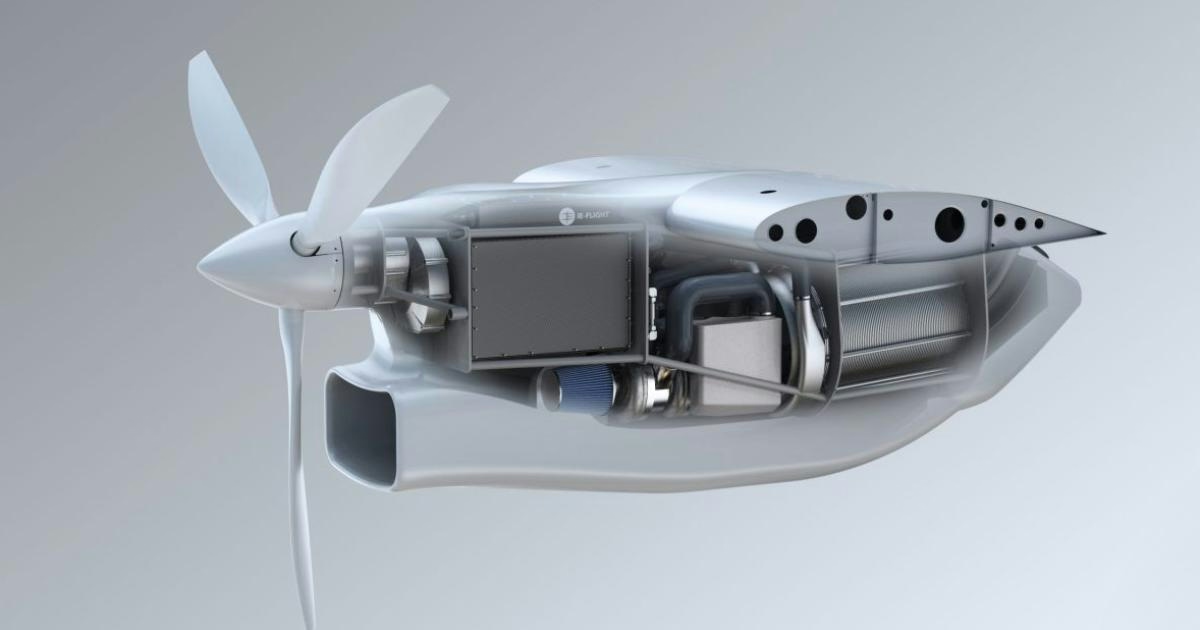
The demonstrator unit has achieved a power output exceeding 150 kW during testing, positioning it as a leading candidate for next-generation regional aircraft and urban air mobility platforms. The system is housed within a carbon-fibre enclosure engineered to reduce overall mass. The main fuel cell stack and end plate are located in the lower section, while an upper module contains high-voltage systems and primary electrical outputs. At the front, an integrated exhaust and water management circuit efficiently extracts exhaust air, separates water, and recycles the recovered liquid back into the stack to support thermal regulation and humidification.
This development is part of the H2GEAR programme, led by GKN Aerospace and supported by the Aerospace Technology Institute (ATI). The 150kW demonstrator serves as a foundational step toward scalable hydrogen-electric propulsion architectures. These advancements are expected to inform Intelligent Energy’s forthcoming commercial IE-FLIGHT series and contribute to the £17 million ATI-backed HEIGHTS programme, which aims to deliver a 300kW modular aviation fuel cell system.
Challenges and Industry Implications
Despite the technological progress, significant challenges remain on the path to commercial adoption. The high cost and complexity of fuel cell stacks and hydrogen storage systems, combined with the limited availability of hydrogen refueling infrastructure, pose substantial barriers to widespread deployment. Nevertheless, the unveiling has attracted growing interest from regional aircraft manufacturers and urban air mobility developers seeking sustainable propulsion alternatives.
The competitive landscape is intensifying as startups such as ZeroAvia advance their own hydrogen-electric engine technologies. Industry analysts expect Intelligent Energy’s progress to stimulate further innovation, encouraging competitors to accelerate the development of propulsion systems and the necessary hydrogen infrastructure for aviation applications.
As the aerospace sector increasingly focuses on decarbonization, Intelligent Energy’s 150kW demonstrator highlights both the potential and the complexities involved in integrating hydrogen fuel cells into commercial flight. This milestone sets the stage for ongoing technological evolution and heightened market competition in the years ahead.

Hong Kong's Five-Year Plan Includes Andrew Fan's Aircraft Parts Processing Hub Proposal

ACIA Aero Leasing Delivers ATR72-600 to Air Nostrum

RTX Appoints Jill Albertelli as Head of Pratt & Whitney

TAT Technologies Joins Beyond Aero Hydrogen Aircraft Program

AURAK Study Highlights Barriers to Air Taxi Adoption in Emerging Economies

Xiamen Air Selects Altitude for 787 Maintenance at Heathrow

Etihad and Swissport Extend Global Partnership

Sepehran Airlines B737 Returns to Mashhad After Tyre and Engine Issues

Etihad Deploys Widebody Fleet to Meet Strong Demand

Korean Air Finalizes $36.2 Billion Deal with Boeing
