
Trasforma le intuizioni dell’IA in azioni concrete

Tendenze
Categories
Kazakhstan Implements New Regulations for Air Taxis and Drones
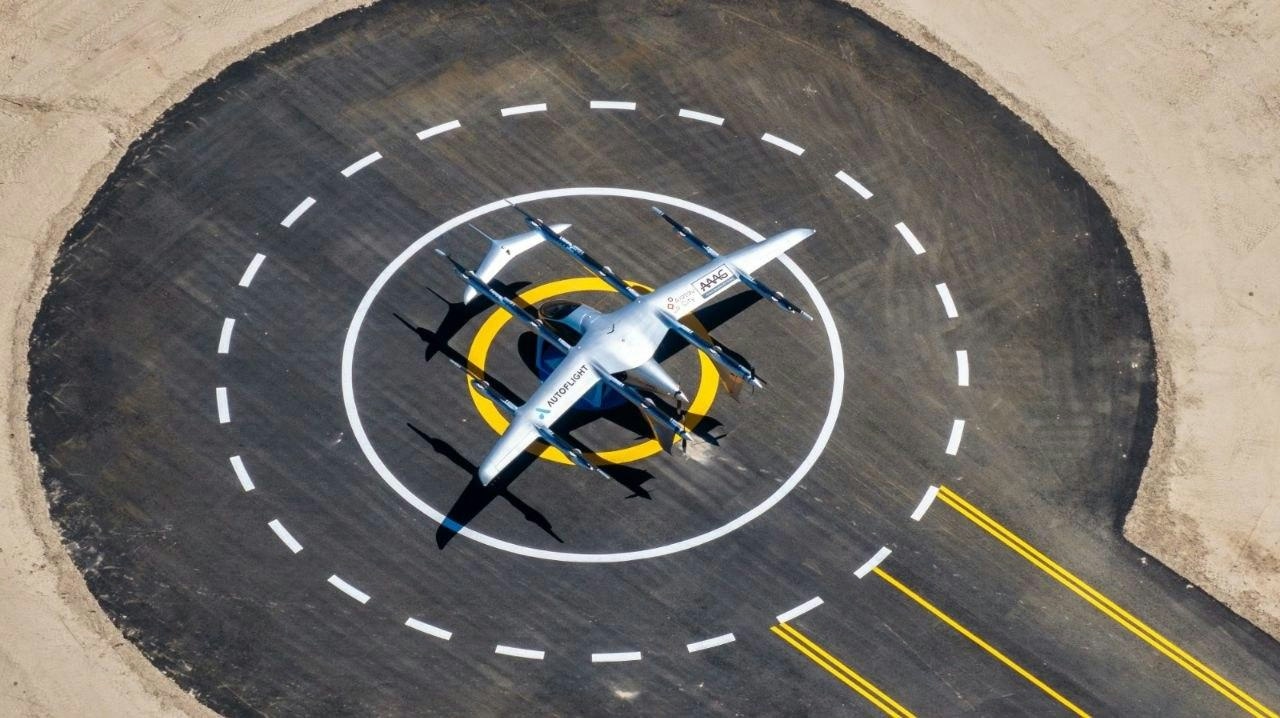
Kazakhstan Implements New Regulations for Air Taxis and Drones
On June 24, 2026, President Kassym-Jomart Tokayev enacted significant amendments to Kazakhstan’s aviation laws, introducing a comprehensive regulatory framework for air taxis, drones, and other emerging transport technologies. These changes update the Law on the Use of the Airspace of the Republic of Kazakhstan and Aviation Activities, reflecting the country’s commitment to modernizing its approach to digitalization, personal data protection, road traffic management, and the integration of innovative aviation technologies.
Establishing a Legal Framework for Advanced Air Mobility
The Civil Aviation Committee has highlighted that the new legislation formally establishes the legal foundation for Kazakhstan’s urban air mobility (UAM) market. This move aligns Kazakhstan with global leaders such as the United States, the European Union, South Korea, and China, all of which have developed regulations for electric vertical takeoff and landing (eVTOL) aircraft. Central to the amendments is the introduction of the Advanced Air Mobility (AAM) concept, which categorizes both urban and regional air mobility.
The law provides a clear legal framework for the operation of eVTOL aircraft and other vehicles approved for advanced air mobility. For the first time, vertiports—essential infrastructure for air taxi operations—are granted legal status, with detailed operational requirements outlined. New certification procedures have been established for aircraft developers, manufacturers, urban air mobility operators, and civil remotely piloted aircraft systems. Furthermore, the legislation introduces a framework for an Unmanned Traffic Management (UTM) system, enabling digital oversight of unmanned aircraft flights, including remote identification, routing, and airspace coordination.
To ensure the safety and security of unmanned operations, enhanced cybersecurity and digital infrastructure standards have been incorporated. The amendments also strengthen government oversight of civil drone activities by updating rules on registration, certification, operation, and flight management. These measures aim to transition innovative aviation technologies from experimental stages into a fully regulated environment, fostering transparency, attracting investment, and accelerating technological advancement within Kazakhstan’s high-tech aviation sector.
Navigating Challenges and Market Implications
While these regulatory changes position Kazakhstan at the forefront of advanced aviation, they also introduce complex challenges. The evolving legal landscape will require careful navigation, as illustrated by ongoing international disputes such as the court battle between Archer and Joby, two prominent eVTOL developers. The new framework is expected to stimulate competition and innovation within Kazakhstan’s air taxi sector, while also influencing the rapidly growing precision agriculture drone market.
Industry stakeholders are already adapting to the emerging opportunities and regulatory requirements. National carrier Air Astana is likely to adjust its growth strategies to leverage the expanding air mobility market. Meanwhile, technology firms such as Tytan Technologies are anticipated to broaden their counter-drone solutions to address increasing demands for security and airspace management.
The Civil Aviation Committee has emphasized that these legislative reforms create transparent and predictable conditions conducive to industry growth. As Kazakhstan advances its regulatory support for advanced aviation, it aims to attract investment and establish itself as a regional leader in innovative air transport. Notably, Qazinform has reported that the first air taxi tests have commenced in Alatau City, marking the beginning of a new chapter in Kazakhstan’s aviation industry.

Etihad Airways Suspends Airbus A380 Flights on Key Route

Aditya Birla Group Seeks Approval for Aircraft Leasing in GIFT City

Qatar Airways Highlights Innovation and Connectivity at Arabian Travel Market 2026

Hong Kong's Five-Year Plan Includes Andrew Fan's Aircraft Parts Processing Hub Proposal

ACIA Aero Leasing Delivers ATR72-600 to Air Nostrum

RTX Appoints Jill Albertelli as Head of Pratt & Whitney

TAT Technologies Joins Beyond Aero Hydrogen Aircraft Program

AURAK Study Highlights Barriers to Air Taxi Adoption in Emerging Economies

Xiamen Air Selects Altitude for 787 Maintenance at Heathrow

Etihad and Swissport Extend Global Partnership
