
Trasforma le intuizioni dell’IA in azioni concrete

Tendenze
Categories
Lufthansa Invests in Both Boeing 777X and Airbus A350
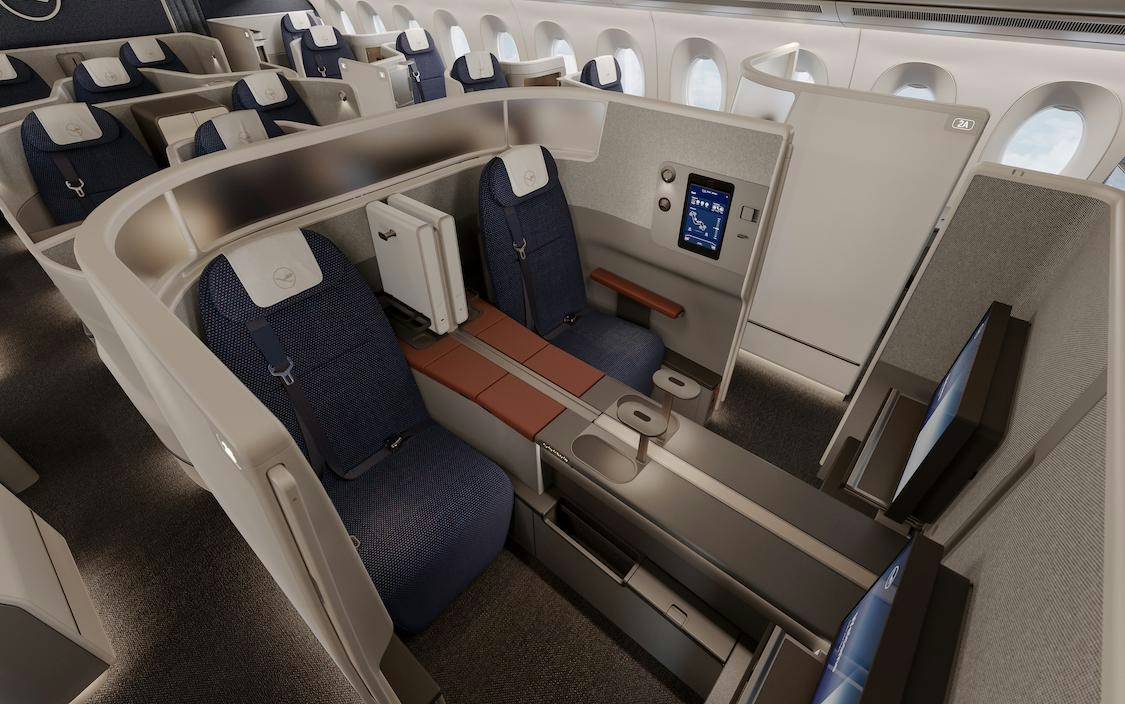
Lufthansa Invests in Both Boeing 777X and Airbus A350
Lufthansa, the German flag carrier, has long been known for operating a diverse fleet, currently comprising ten different aircraft types according to Planespotters.net. Historically, the airline has flown as many as 25 different models, including aircraft from manufacturers such as Fokker, McDonnell Douglas, Embraer, Bombardier, Boeing, and Airbus. Today, its fleet is predominantly composed of Boeing and Airbus jets, with Bombardier aircraft primarily serving short-haul routes.
While Lufthansa has expressed intentions to streamline its fleet in order to reduce operating costs, the airline continues to embrace variety. This is evident in its substantial orders for both the Airbus A350 and Boeing 777X, two next-generation long-haul aircraft positioned as flagships by their respective manufacturers.
Competing Flagships: Airbus A350 and Boeing 777X
The Airbus A350 and Boeing 777X represent distinct design philosophies but share the objective of enhancing the economics of long-haul travel through advanced aerodynamics and more efficient engines. The A350, which features a composite airframe and entered service in 2018, has established itself as a reliable and efficient aircraft. In contrast, the Boeing 777X has experienced over six years of delays, with first deliveries now anticipated in 2027 due to supply chain disruptions and an extended certification process. Although Boeing has produced 26 777X aircraft, none have yet entered commercial service.
The two aircraft differ in several key specifications. The 777-9 measures 76.73 meters in length with a wingspan of 235 feet 5 inches, while the A350-1000 is slightly shorter at 73.79 meters and has a wingspan of 212 feet 5 inches. The A350 offers a longer range of 8,900 nautical miles compared to the 7,285 nautical miles of the 777-9. The 777X is powered by two GE9X engines delivering 110,000 pounds of thrust each, whereas the A350 uses two Rolls-Royce Trent XWB-97 engines with 97,000 pounds of thrust. In terms of passenger capacity in a three-class configuration, the 777-9 accommodates 426 passengers, slightly more than the A350-1000’s 410. The maximum takeoff weight is also higher for the 777-9 at 351.5 tonnes compared to 322 tonnes for the A350-1000.
Lufthansa is poised to become the launch operator of the 777-9, having placed orders for 20 passenger variants and seven 777-8 freighters. The airline currently operates 30 A350s and has 29 additional aircraft on order, including both A350-900 and A350-1000 models.
Strategic Diversification Amid Industry Challenges
Lufthansa’s decision to invest in both the Airbus A350 and Boeing 777X carries inherent risks. The airline is contending with ongoing labor disputes and financial underperformance within its mainline operations, which place additional strain on its ambitious fleet renewal strategy. Furthermore, Boeing’s 777X program has recently encountered engine reliability issues, raising concerns about potential further delays and operational challenges.
Market analysts remain divided on Lufthansa’s approach. Some interpret the dual investment as a strategic hedge, providing the airline with flexibility and enhanced negotiating leverage with both manufacturers. Others question the prudence of committing to the 777X, given its troubled development and the A350’s proven track record. Competitors are closely monitoring the situation, with Airbus likely to emphasize the A350’s reliability and performance, while Boeing continues to highlight the 777X’s technological innovations and anticipated market demand.
Despite these uncertainties, Lufthansa’s commitment to both aircraft underscores its strategy of maintaining a versatile and modern fleet. The airline aims to balance innovation, capacity, and operational resilience as it navigates a complex and evolving aviation landscape.

Etihad Airways Suspends Airbus A380 Flights on Key Route

Aditya Birla Group Seeks Approval for Aircraft Leasing in GIFT City

Qatar Airways Highlights Innovation and Connectivity at Arabian Travel Market 2026

Hong Kong's Five-Year Plan Includes Andrew Fan's Aircraft Parts Processing Hub Proposal

ACIA Aero Leasing Delivers ATR72-600 to Air Nostrum

RTX Appoints Jill Albertelli as Head of Pratt & Whitney

TAT Technologies Joins Beyond Aero Hydrogen Aircraft Program

AURAK Study Highlights Barriers to Air Taxi Adoption in Emerging Economies

Xiamen Air Selects Altitude for 787 Maintenance at Heathrow

Etihad and Swissport Extend Global Partnership
