
Trasforma le intuizioni dell’IA in azioni concrete

Tendenze
Categories
Lufthansa Technik Employs 3D-Printed Titanium Latch in Aircraft Maintenance
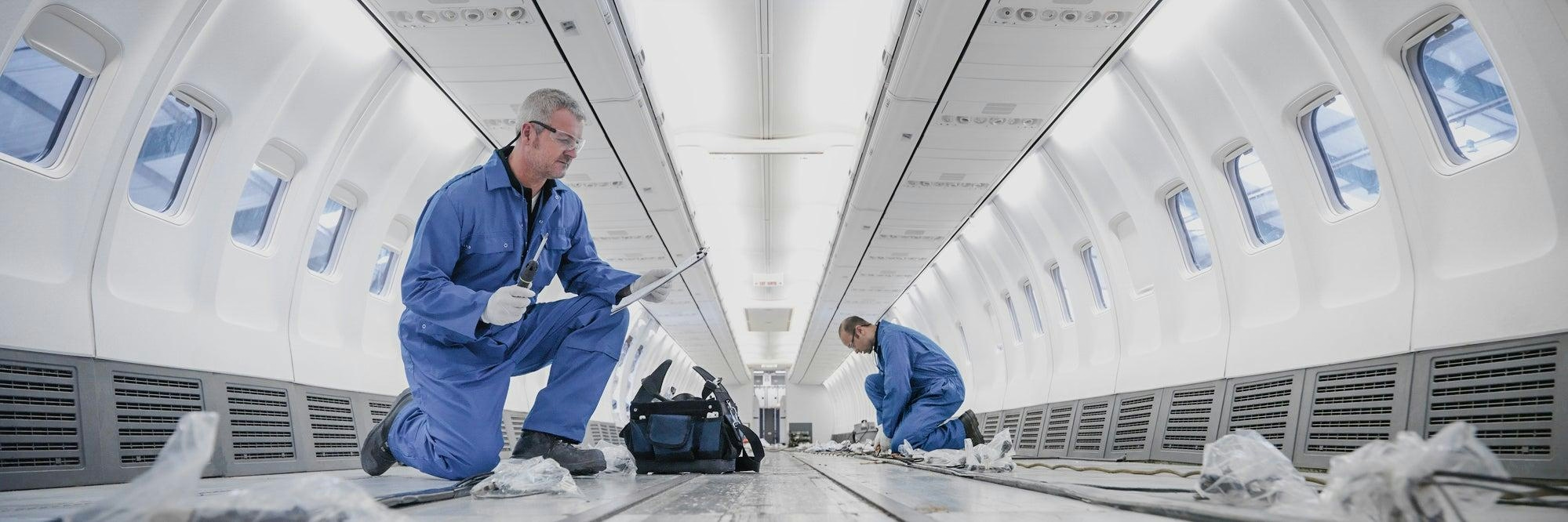
Lufthansa Technik Advances Aircraft Maintenance with 3D-Printed Titanium Latch
Lufthansa Technik, a prominent leader in aircraft maintenance and interiors, has expanded its application of 3D printing technology to improve reliability and operational efficiency for its airline clients. The company’s engineering team recently developed a titanium latch using laser powder bed fusion (LPBF) to replace a polymer component that had been prone to frequent failure. This latch, integral to the roller shutters on Airbus A330, A340, and A380 aircraft, had long been a source of maintenance challenges due to repeated breakages.
Addressing Durability Challenges with Advanced Materials
Historically, maintenance, repair, and overhaul (MRO) operations have utilized 3D printing primarily to replace heavier metal parts with lighter, cost-effective polymer alternatives. Lufthansa Technik’s decision to reverse this trend by substituting the original polymer latch with a titanium counterpart reflects a strategic response to durability concerns. The polymer component’s repeated failures not only led to costly repairs and potential flight delays but also posed risks to safety and passenger experience. Compounding the issue, the original supplier did not offer the latch as a standalone replacement, compelling operators to replace the entire roller shutter assembly—a process both time-consuming and expensive.
By manufacturing the replacement latch from Ti6Al4V titanium alloy through an EN 9100-certified process and under EASA Part 21.G and 21.J certification, Lufthansa Technik has significantly extended the service life of the roller shutter. This innovation allows for rapid replacement of the latch itself if it fails, eliminating the need to procure a full assembly. The result is a marked reduction in aircraft downtime and considerable cost savings over the long term.
Implications for the MRO Industry and Future Adoption
While the integration of 3D printing for critical components entails substantial initial investment and necessitates comprehensive training for maintenance personnel in new production and quality assurance protocols, the advantages are substantial. Airlines stand to benefit from lower operational costs, reduced lead times for difficult-to-source parts, and enhanced fleet availability.
Industry analysts suggest that Lufthansa Technik’s pioneering use of additive manufacturing for such essential parts may encourage competitors to accelerate their own adoption of similar technologies. This shift could herald a broader transformation within the MRO sector toward on-demand production of certified, high-performance components that are otherwise challenging to obtain through conventional supply chains.
By leveraging its capacity for self-certification, Lufthansa Technik not only resolves a persistent maintenance issue but also establishes a benchmark for innovation in aircraft support. Project Engineer David Rudolz emphasized that the company’s approach prioritizes safety and customer experience while simultaneously driving operational efficiencies that benefit both airlines and passengers.

Etihad Airways Suspends Airbus A380 Flights on Key Route

Aditya Birla Group Seeks Approval for Aircraft Leasing in GIFT City

Qatar Airways Highlights Innovation and Connectivity at Arabian Travel Market 2026

Hong Kong's Five-Year Plan Includes Andrew Fan's Aircraft Parts Processing Hub Proposal

ACIA Aero Leasing Delivers ATR72-600 to Air Nostrum

RTX Appoints Jill Albertelli as Head of Pratt & Whitney

TAT Technologies Joins Beyond Aero Hydrogen Aircraft Program

AURAK Study Highlights Barriers to Air Taxi Adoption in Emerging Economies

Xiamen Air Selects Altitude for 787 Maintenance at Heathrow

Etihad and Swissport Extend Global Partnership
