
Trasforma le intuizioni dell’IA in azioni concrete

Tendenze
Categories
Number of Airbus A380 Flights Scheduled for March
Number of Airbus A380 Flights Scheduled for March
Despite Airbus ceasing production of the A380 in 2021, the world’s largest passenger aircraft continues to hold a significant position in global long-haul travel. Although now operated by a limited number of airlines, the superjumbo remains essential on routes characterized by high passenger demand, premium cabin services, and airport slot restrictions, where its vast capacity proves economically advantageous. The flight schedule for March illustrates the concentrated nature of the A380 market, with a small group of carriers responsible for all scheduled operations, and Emirates overwhelmingly dominating the sector.
The Enduring Role and Current Operations of the A380
Introduced in 2007, the Airbus A380 was designed to alleviate congestion at major international hubs through its full-length double-deck design and four-engine configuration. Its ability to transport hundreds of passengers, complemented by spacious premium cabins featuring onboard lounges and shower suites, established it as a flagship aircraft for several global airlines. However, the aviation industry’s shift toward more fuel-efficient twin-engine widebodies such as the Boeing 787 and Airbus A350 has narrowed the A380’s future prospects. While production has ended, the aircraft remains a specialized asset on select high-demand routes.
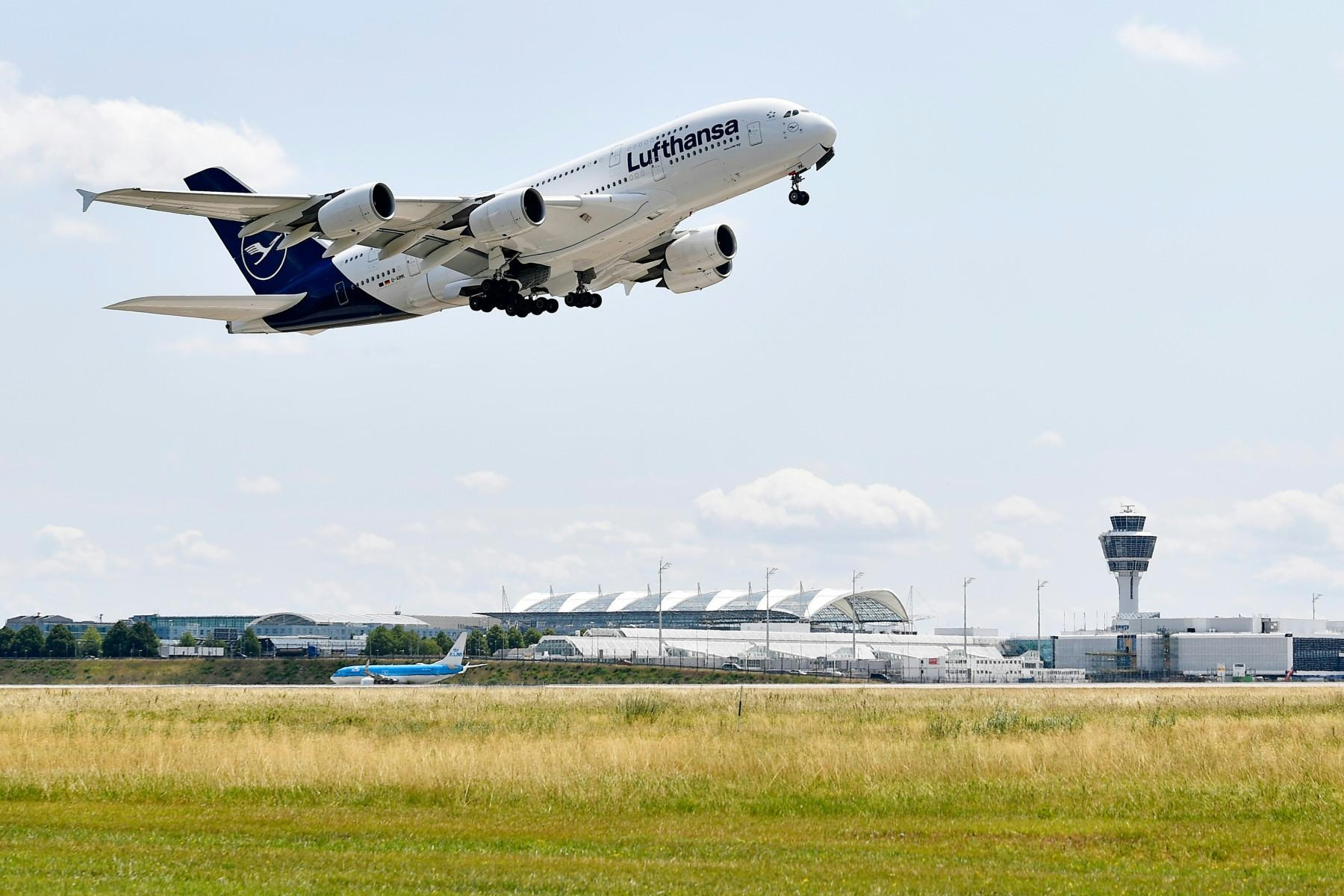
Data from March 2026 reveals that the A380 is scheduled to operate 7,701 flights worldwide, offering nearly 3.9 million seats and generating approximately 15.7 billion available seat miles (ASMs). These figures highlight the aircraft’s sustained relevance on routes where airlines can reliably fill its large capacity, despite the reduction in the number of operators. Emirates emerges as the dominant operator, maintaining a substantial share of global A380 flights. Meanwhile, Qantas is planning to increase its A380 services in response to evolving market conditions. Other carriers have scaled back or retired their A380 fleets entirely; Lufthansa, for instance, has withdrawn its A380s from service and repurposed them as parts donors rather than returning them to active flight.
Market Challenges and Strategic Adjustments
The operation of A380 flights in March faces several challenges. Geopolitical tensions, particularly the ongoing U.S.-Israeli conflict involving Iran, have resulted in widespread airspace closures and the cancellation of over 37,000 flights to and from the Middle East. These disruptions have contributed to rising oil prices and heightened concerns over a potential downturn in global travel, complicating long-haul scheduling and capacity planning.
Despite these obstacles, Emirates continues to maintain a robust A380 schedule, while other airlines adapt their strategies in response to fluctuating market demand and operational constraints. Although the superjumbo’s presence has diminished from its peak, it remains a key indicator of where high-capacity, premium-focused long-haul travel continues to be viable.

Etihad Airways Suspends Airbus A380 Flights on Key Route

Aditya Birla Group Seeks Approval for Aircraft Leasing in GIFT City

Qatar Airways Highlights Innovation and Connectivity at Arabian Travel Market 2026

Hong Kong's Five-Year Plan Includes Andrew Fan's Aircraft Parts Processing Hub Proposal

ACIA Aero Leasing Delivers ATR72-600 to Air Nostrum

RTX Appoints Jill Albertelli as Head of Pratt & Whitney

TAT Technologies Joins Beyond Aero Hydrogen Aircraft Program

AURAK Study Highlights Barriers to Air Taxi Adoption in Emerging Economies

Xiamen Air Selects Altitude for 787 Maintenance at Heathrow

Etihad and Swissport Extend Global Partnership
