
Trasforma le intuizioni dell’IA in azioni concrete

Tendenze
Categories
Saab Innovation Unit Outlines 2026 Flight-Test Plan for Ruby
Saab Innovation Unit Details 2026 Flight-Test Plan for Ruby
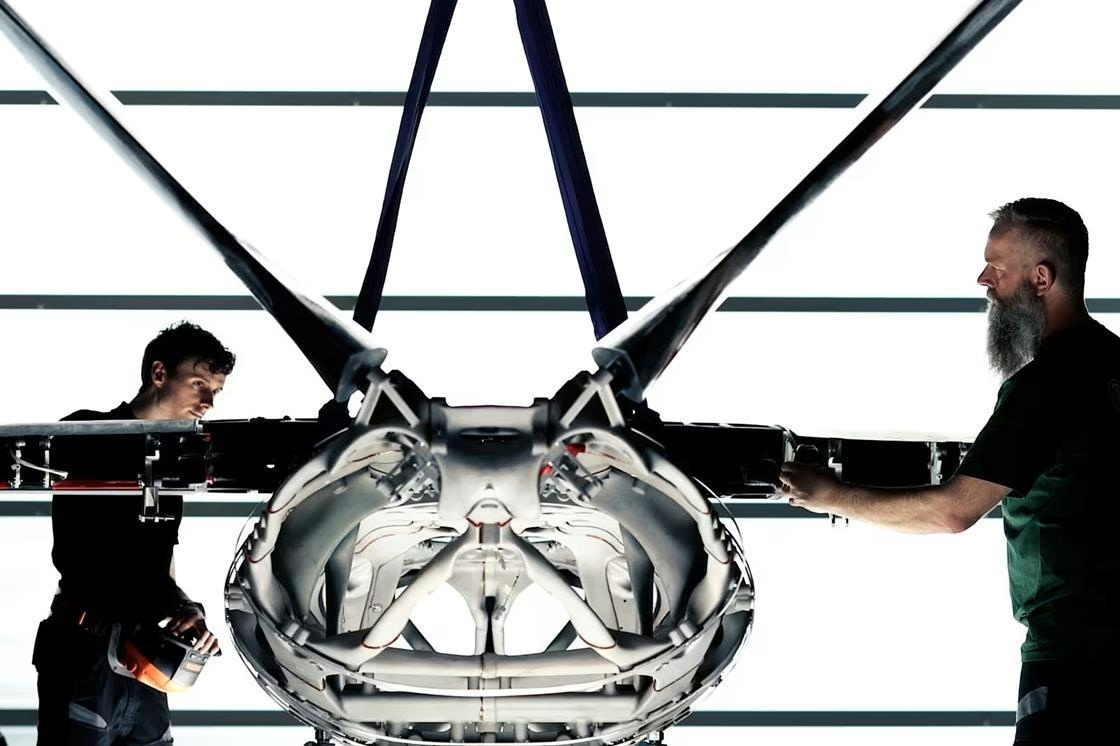
Saab’s internal innovation start-up, The Rainforest, is preparing for a significant milestone in 2026 with the planned flight test of Ruby, an unmanned aerial platform featuring what the company describes as “the world’s first software-defined aircraft fuselage.” This fuselage, measuring over five meters in length and composed of 26 uniquely printed metal parts, is poised to become one of the largest additively manufactured metal structures to achieve powered flight. The Swedish aerospace firm highlights the innovative nature of this design, which challenges traditional manufacturing constraints.
Advanced Manufacturing and Design Innovation
Ruby is powered by a GE Aerospace J85 engine and fitted with a composite wing spanning six to seven meters. The project is a collaboration between Saab and Divergent Technologies, with the core fuselage structure having already passed structural proof-loading tests. The development process leverages Divergent’s software-defined manufacturing approach, which eliminates the need for specialized tooling or fixtures. Instead, it employs industrial-scale laser powder fusion additive manufacturing combined with universal robotic assembly.
Axel Baathe, head of The Rainforest, explains that additive manufacturing allows load-bearing structures to move beyond conventional straight lines and right angles, enabling organic forms that follow optimal load paths. This innovation, supported by artificial intelligence-driven design optimization, has dramatically reduced the number of fuselage parts by at least a factor of 100. Traditional riveted assemblies have been replaced with interwoven, organic structures, enhancing both strength and efficiency.
The manufacturing technique also offers significant advantages in weight optimization and functional integration. Critical systems such as wiring, thermal management, and hydraulics can be embedded directly into the fuselage during printing, simplifying assembly and potentially improving overall performance. Baathe envisions a future where the manufacturing process matches the speed and flexibility of design iterations, suggesting a scenario where “CAD in the morning, fly in the afternoon” could become a reality. The facility itself is designed to reconfigure instantly to produce any digital twin design without the delays and costs associated with new tooling.
Challenges and Industry Implications
Despite the promise of this technology, Saab faces considerable challenges as it approaches the 2026 flight test. Ensuring the structural integrity and reliable in-flight performance of the software-defined fuselage remains critical, especially given the novel materials and manufacturing methods involved. Industry experts are closely monitoring how additive manufacturing combined with AI-driven design could transform defense technology, potentially impacting cost structures, production speed, and adaptability in aircraft manufacturing.
Saab’s competitors may respond by accelerating their own additive manufacturing initiatives or pursuing strategic measures to counter Saab’s emerging technological lead. Furthermore, Saab’s ongoing contract to deliver 17 Gripen E/F fighter jets to Colombia could strain resources and management focus, potentially affecting the Ruby program’s development timeline and overall success.
As Saab advances the Ruby project, it stands as a pioneering example of the future of aerospace manufacturing—one that could fundamentally redefine the processes by which aircraft are designed, constructed, and flown.

Etihad Airways Suspends Airbus A380 Flights on Key Route

Aditya Birla Group Seeks Approval for Aircraft Leasing in GIFT City

Qatar Airways Highlights Innovation and Connectivity at Arabian Travel Market 2026

Hong Kong's Five-Year Plan Includes Andrew Fan's Aircraft Parts Processing Hub Proposal

ACIA Aero Leasing Delivers ATR72-600 to Air Nostrum

RTX Appoints Jill Albertelli as Head of Pratt & Whitney

TAT Technologies Joins Beyond Aero Hydrogen Aircraft Program

AURAK Study Highlights Barriers to Air Taxi Adoption in Emerging Economies

Xiamen Air Selects Altitude for 787 Maintenance at Heathrow

Etihad and Swissport Extend Global Partnership
