
Trasforma le intuizioni dell’IA in azioni concrete

Tendenze
Categories
Skypuzzler Challenges Use of AI in Managing Increasing Drone Traffic
Skypuzzler Challenges Use of AI in Managing Increasing Drone Traffic
As the Federal Aviation Administration (FAA) prepares to address the expected rise in low-altitude drone and advanced aviation vehicle traffic, Danish company Skypuzzler proposes an alternative to conventional artificial intelligence (AI) models. Rather than relying on AI, Skypuzzler employs mathematical algorithms to manage airspace more effectively.
Innovative Algorithmic Approach to Air Traffic Management
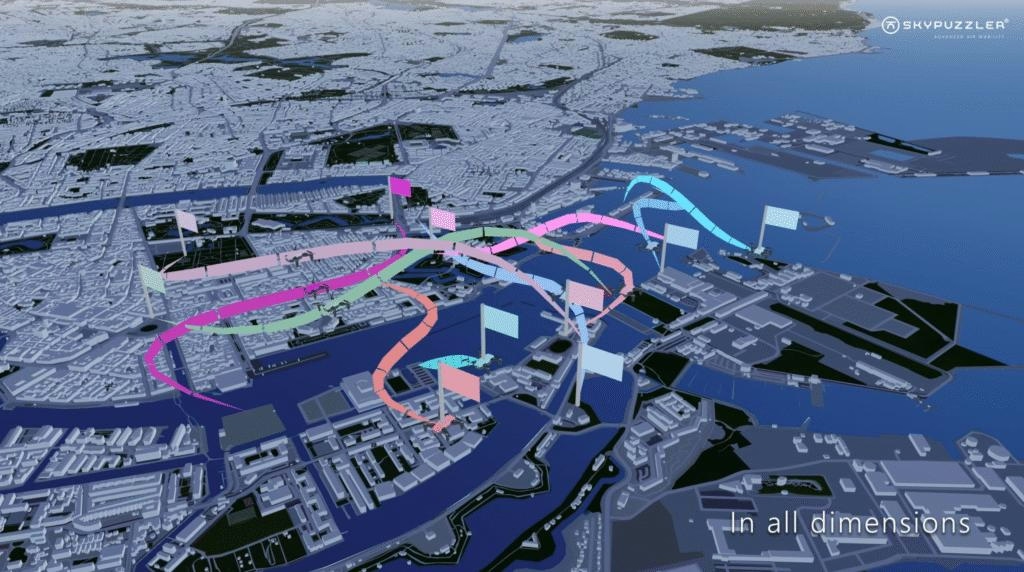
Founded by former air traffic controllers and a computer scientist, Copenhagen-based Skypuzzler has developed a comprehensive air traffic management system that combines strategic pre-departure planning with tactical in-flight deconfliction. This dual approach is designed to prevent airspace conflicts before they arise while allowing real-time management of drone operations. According to CEO Jesper Skou, the system’s advantage lies in its ability to function without requiring additional hardware installations on drones. Instead, it utilizes data already transmitted by drones to UAS traffic management (UTM) systems or infrastructure.
Skypuzzler’s platform is currently being integrated with prominent European aerospace and logistics companies, including Thales Group and DSV, the world’s largest logistics provider. The technology is undergoing trials in complex operational settings such as the Port of Rotterdam, where nearly 100 drone operators conduct a variety of missions ranging from cargo transport to oil leak inspections. Skou described the challenge as a “logistic puzzle” to coordinate diverse drone types and missions within shared airspace safely and efficiently.
Expansion and Market Dynamics
The company recently attracted investment from United Airlines Ventures, the venture capital arm of United Airlines Holdings, signaling growing interest in the U.S. market. Skypuzzler is targeting expansion into key regions like Dallas-Fort Worth, a major hub for drone delivery services and UTM system development. The FAA has already authorized drone deliveries by operators such as Wing, Zipline, and Flytrex, with the first joint implementation of the U.S. UTM Strategic Coordination standard occurring last year between Flytrex and Wing.
Despite these advances, Skou warns that current U.S. airspace deconfliction models—which involve limited coordination among a small number of UAV operators before departure—may prove inadequate as drone and manned aircraft traffic intensifies. The complexity of managing this growing traffic demands sophisticated algorithms capable of collision prediction and avoidance, adherence to evolving aviation regulations, and robust cybersecurity measures to mitigate risks associated with AI-driven systems.
Industry Perspectives and Future Outlook
Reactions to AI-based airspace management have been mixed. Some stakeholders express skepticism, raising concerns about transparency and control over AI-generated data. In response, competitors are either developing their own AI solutions or collaborating with Skypuzzler to establish industry-wide standards for drone traffic management.
As drone traffic continues to increase, the debate over the optimal technological approach—whether algorithmic or AI-driven—remains central to shaping the future of airspace management in both Europe and the United States.

Etihad and Swissport Extend Global Partnership

Sepehran Airlines B737 Returns to Mashhad After Tyre and Engine Issues

Etihad Deploys Widebody Fleet to Meet Strong Demand

Korean Air Finalizes $36.2 Billion Deal with Boeing

Australia’s RFDS Queensland Section Orders Six King Air 260Cs

Korean Air Finalizes Order for 103 Boeing Jets and Engines

Embraer E195-E2 Features Distinctive Engine Placement Among Regional Jets

What Passengers Can Expect on Boeing’s New 777X Jet

How Ethiopian Airlines Became Africa’s Leading Carrier Amid Gulf Competition

Joby Aviation Extends Autonomous Flight Capabilities with Cross-Country Tour
