
Trasforma le intuizioni dell’IA in azioni concrete

Tendenze
Categories
Spirit AeroSystems Profitability Delayed to 2020 Amid Boeing Acquisition Impact
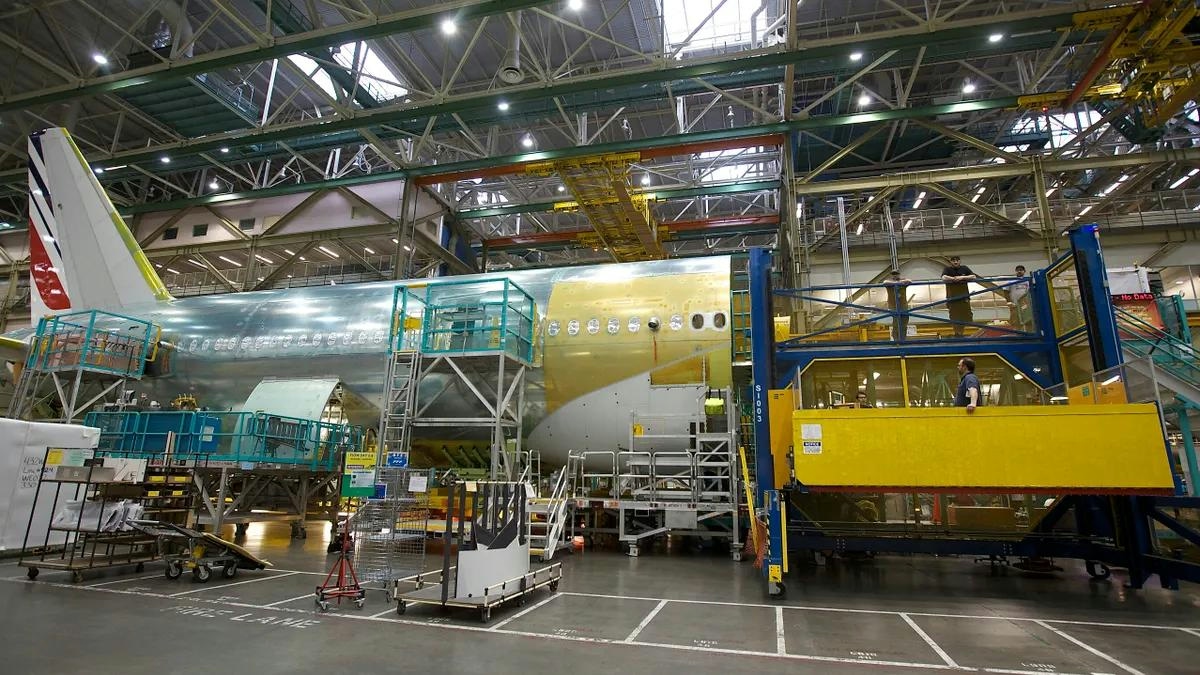
Spirit AeroSystems Profitability Postponed to 2027 Amid Boeing Acquisition Challenges
Spirit AeroSystems is confronting significant delays in achieving profitability following its $4.7 billion acquisition by Boeing, completed in December 2025. Recent updates from Boeing in March 2026 reveal that integration expenses have exceeded initial projections, pushing the expected profitability timeline for Boeing’s Commercial Airplanes division to 2027. This revision has elicited cautious responses from investors, who are closely scrutinizing Boeing’s financial stability and the broader ramifications for the aerospace supply chain.
Integration Challenges and Margin Pressures
Boeing’s disclosures highlight substantial near-term margin pressures directly linked to the integration of Spirit AeroSystems. The Commercial Airplanes unit now anticipates operating margins between -7.5% and -8% in early 2026, a marked deterioration from earlier forecasts that predicted flat or positive margins. Audits conducted at Spirit’s production facilities uncovered deeper operational difficulties, including quality control issues necessitating rework on 25 Boeing 737 aircraft, each requiring approximately three days of corrective work. These findings have led Boeing to designate 2026 as a pivotal year focused on stabilizing production processes rather than generating profits.
For shareholders of Spirit AeroSystems, the acquisition has introduced uncertainty as the company undergoes delisting and Boeing consolidates its operations. European investors, particularly those with exposure to aerospace through Boeing shares traded on Xetra, must now recalibrate expectations regarding cash flow recovery from this critical supplier.
Production and Delivery Adjustments
The production rate for the Boeing 737 MAX remains constrained at 42 aircraft per month due to Federal Aviation Administration (FAA) restrictions, with an aspirational target of 53 units by the end of 2026. However, delays associated with Spirit AeroSystems have shifted some deliveries from the first to the second quarter of the year, dampening near-term revenue growth prospects. Boeing aims to deliver a total of 500 aircraft in 2026, a key benchmark for scaling output following the integration.
Strategic Implications and Industry Context
The acquisition represents a strategic reversal of Boeing’s two-decade-long outsourcing approach, bringing fuselage production in-house to address persistent quality issues that have affected the company since the 2024 safety crises. Spirit AeroSystems, formerly Boeing’s primary supplier for the 737, 777, and 787 fuselages, had been grappling with recurring defects traced back to its manufacturing sites. Boeing’s management regards the current integration costs as temporary, anticipating a return to positive margins and operational normalization by 2027.
A reported 40% reduction in manufacturing defects over the past year indicates progress, yet ongoing audits suggest that some challenges will require additional time to resolve fully. This shift toward vertical integration aligns with a broader industry trend favoring resilient, sovereign supply chains that emphasize quality assurance over just-in-time efficiency.
Investor Outlook
For investors in Europe and globally, Boeing’s consolidation raises important questions about component pricing and competitive dynamics within a less fragmented supplier market. With Airbus maintaining its dominance in Europe, Boeing’s supply chain restructuring could indirectly benefit regional carriers through improved quality and delivery reliability.
As the aerospace sector observes Boeing’s efforts to manage integration costs and sustain its market position, competitor responses remain uncertain. The delayed timeline for profitability underscores the execution risks inherent in large-scale aerospace consolidations and highlights the ongoing challenges confronting the industry’s recovery.

Etihad Airways Suspends Airbus A380 Flights on Key Route

Aditya Birla Group Seeks Approval for Aircraft Leasing in GIFT City

Qatar Airways Highlights Innovation and Connectivity at Arabian Travel Market 2026

Hong Kong's Five-Year Plan Includes Andrew Fan's Aircraft Parts Processing Hub Proposal

ACIA Aero Leasing Delivers ATR72-600 to Air Nostrum

RTX Appoints Jill Albertelli as Head of Pratt & Whitney

TAT Technologies Joins Beyond Aero Hydrogen Aircraft Program

AURAK Study Highlights Barriers to Air Taxi Adoption in Emerging Economies

Xiamen Air Selects Altitude for 787 Maintenance at Heathrow

Etihad and Swissport Extend Global Partnership
