
Trasforma le intuizioni dell’IA in azioni concrete

Tendenze
Categories
U.S. Announces Plan to Develop Engine for Future Hypersonic Aircraft
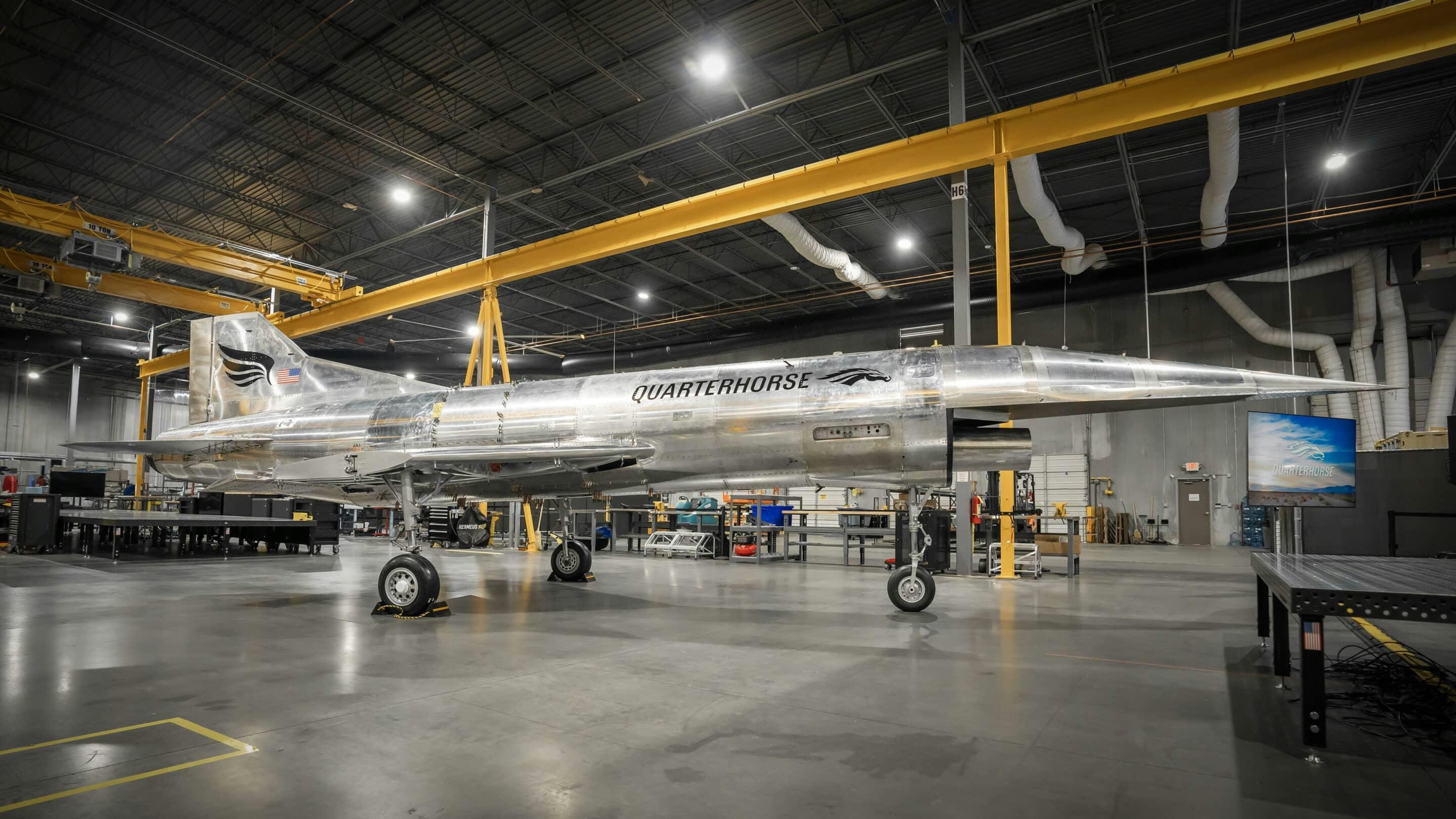
U.S. Announces Initiative to Develop High Mach Gas Turbine Engine for Hypersonic Flight
The U.S. Department of Defense, through the Defense Advanced Research Projects Agency (DARPA), has launched a new program to design and develop a High Mach Gas Turbine (HMGT) engine aimed at powering future reusable hypersonic aircraft. This initiative, undertaken in collaboration with the Air Force Research Laboratory (AFRL) and the Air Force Life Cycle Management Center’s Propulsion Directorate (AFLCMC/LP), seeks to accelerate the development of propulsion systems capable of sustained flight at speeds exceeding Mach 4.
Program Objectives and Development Phases
The initial phase of the HMGT program, as outlined in a solicitation released on September 24, will concentrate on conceptual and preliminary design work. This includes defining the engine’s core architecture, identifying key subsystems, and establishing a technology roadmap to mature each component. Early testing of subsystems and components will be conducted to validate design concepts and approaches.
DARPA highlights that the HMGT effort is focused on enabling airbreathing propulsion at hypersonic speeds, which promises enhanced reusability, responsiveness, and cost-effectiveness compared to traditional rocket-based systems. This represents a strategic departure from previous Pentagon hypersonic projects that have predominantly relied on expendable rocket boosters or dual-mode scramjet demonstrators. The development of a reusable turbine-based engine could allow aircraft to operate repeatedly at hypersonic speeds, thereby reducing launch costs and turnaround times.
The program is structured in multiple phases, with Phase 1A funded at approximately $10 million and Phase 1B anticipated to receive an additional $30 million. DARPA expects to issue multiple awards and requires companies to submit abstracts to qualify for subsequent proposal stages. Importantly, only complete airbreathing turbine-based propulsion system concepts will be considered; partial subsystems and non-turbine architectures are excluded from consideration.
Testing, Collaboration, and Industry Implications
The solicitation specifies that ground test facilities will be made available to evaluate full-scale HMGT engines across their operational speed and altitude envelopes. However, flight testing using experimental X-plane platforms is not included in the current program scope. Coordination with other U.S. hypersonic technology efforts, such as the Air Force’s Combined-Cycle Rocket-Based Propulsion (CoRSAir) initiative, is planned to ensure complementary development and avoid duplication.
Developing a next-generation hypersonic engine presents formidable technological and financial challenges. Achieving the required speeds and efficiencies will demand overcoming complex engineering obstacles, while the high costs associated with research and development remain a significant concern. The announcement is expected to intensify competition among major engine manufacturers, including Honeywell, GE Aerospace, Pratt & Whitney, and Beehive Industries, all vying to establish a presence in the emerging hypersonic propulsion market.
Industry responses are likely to include accelerated development timelines and the pursuit of innovative propulsion technologies. For instance, GE Aerospace is advancing rotating detonation ramjets, Beehive Industries is developing its Frenzy engine, and Honeywell is exploring adaptations of its existing engines for new platforms such as the Collaborative Combat Aircraft (CCA).
The HMGT program forms part of DARPA’s broader effort to expedite propulsion innovation through its Advanced Propulsion Office (APO). This initiative aims to integrate breakthrough technologies into operational platforms more rapidly and efficiently than traditional acquisition processes. As the Pentagon seeks to address critical capability gaps in high-speed flight, the HMGT program represents a significant step toward enabling reusable, long-range hypersonic aircraft for future military missions.

Etihad Airways Suspends Airbus A380 Flights on Key Route

Aditya Birla Group Seeks Approval for Aircraft Leasing in GIFT City

Qatar Airways Highlights Innovation and Connectivity at Arabian Travel Market 2026

Hong Kong's Five-Year Plan Includes Andrew Fan's Aircraft Parts Processing Hub Proposal

ACIA Aero Leasing Delivers ATR72-600 to Air Nostrum

RTX Appoints Jill Albertelli as Head of Pratt & Whitney

TAT Technologies Joins Beyond Aero Hydrogen Aircraft Program

AURAK Study Highlights Barriers to Air Taxi Adoption in Emerging Economies

Xiamen Air Selects Altitude for 787 Maintenance at Heathrow

Etihad and Swissport Extend Global Partnership
