
Trasforma le intuizioni dell’IA in azioni concrete

Tendenze
Categories
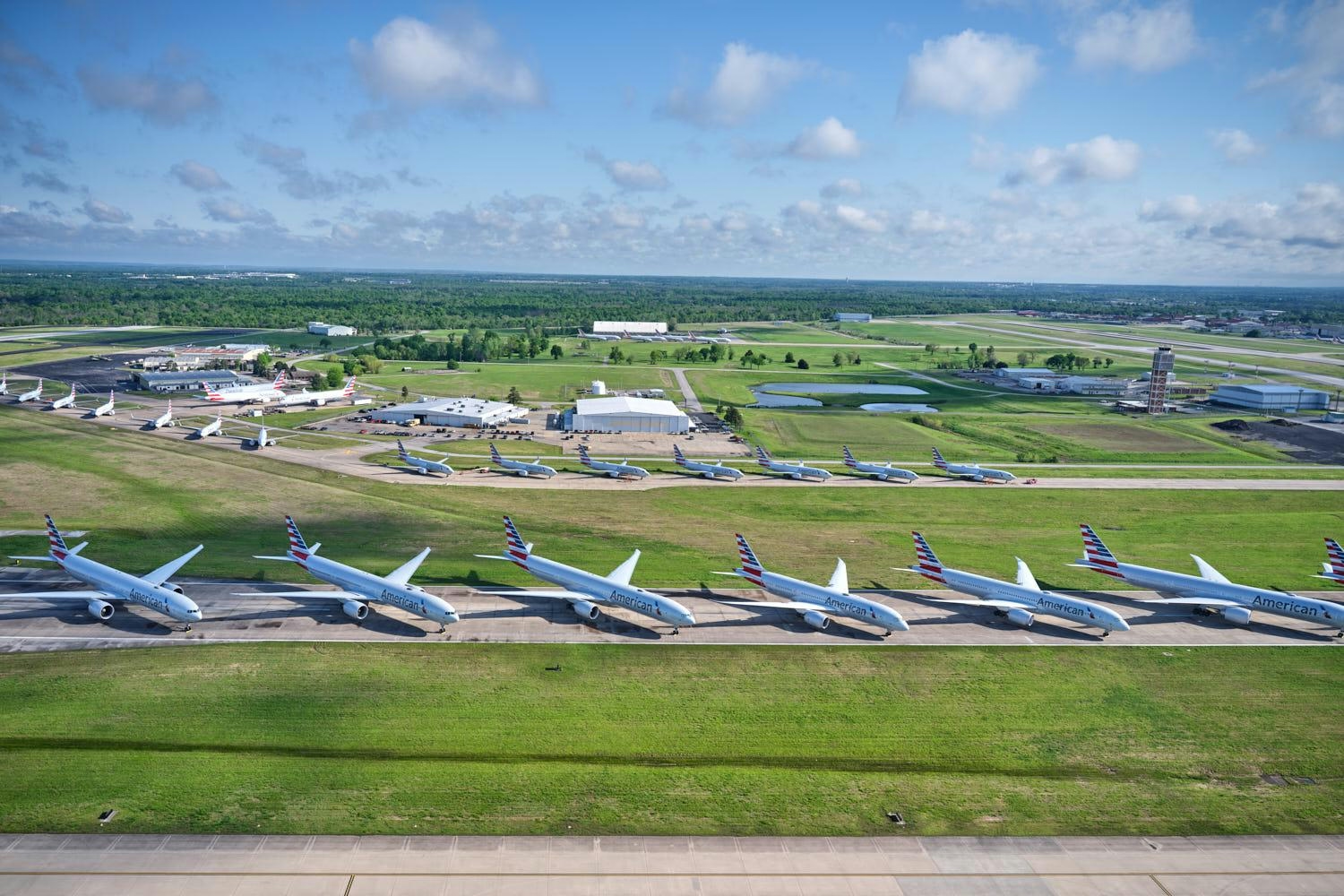
Why American Airlines’ Widebody Jets Sat Idle in Roswell for Five Years Before Vietnam Redeployment
Why American Airlines’ Widebody Jets Sat Idle in Roswell for Five Years Before Vietnam Redeployment
American Airlines, long associated with the iconic Boeing 747, has not operated the type for several decades. The airline retired its last standard 747 in 1985, followed by the final two 747SPs in 1992. During the COVID-19 pandemic, as airlines worldwide grounded aircraft in desert storage facilities, many observers assumed that American’s jets sent to Roswell International Air Center were 747s. In fact, the airline stored Boeing 767s and Airbus A330s, not the much larger 747s.
Factors Behind Extended Storage in Roswell
The prolonged idling of these widebody jets in Roswell, some for as long as five years, resulted from a combination of global and industry-specific challenges. The onset of the pandemic caused a sharp decline in international travel demand, but this was further exacerbated by broader market volatility and geopolitical tensions, including conflicts in the Middle East. These factors collectively suppressed global travel and diminished the immediate need for large, long-haul aircraft. Confronted with financial pressures and an uncertain recovery timeline, American Airlines made the strategic decision to streamline its fleet and reduce operational costs by placing several widebody aircraft into long-term storage.
While some of these aircraft have since been repurposed—several Boeing 767s have been converted into freighters—others are preparing for redeployment abroad. Notably, eight former American Airlines Airbus A330s are slated to join Vietnam’s Sun PhuQuoc airline in 2026. This move reflects a resurgence in demand for widebody jets in select markets and aligns with Boeing’s forecast for 2026 to 2045, which anticipates steady demand for widebody aircraft despite recent disruptions.
The narrative of pandemic-era 747 retirements is more relevant to carriers such as KLM, Qantas, and British Airways, whose jumbos entered a saturated secondhand market. These aircraft, preserved by desert climates, are unlikely to return to passenger service. For American Airlines, the pressing question remains which of its pandemic-retired widebodies will be reactivated and which will remain grounded indefinitely.
American Airlines’ Fleet Evolution and Current Strategy
American Airlines operates one of the world’s largest commercial fleets. In the 1970s and early 1980s, the airline flew Boeing 747s but shifted focus to twin- and tri-engine widebodies for long-haul routes after retiring the type. Throughout the 2000s, American maintained an all-Boeing mainline fleet until a significant Airbus A320-family order in 2011 diversified its lineup.
Today, American’s mainline fleet centers on the Airbus A319, A320, A321, and Boeing 737 aircraft, while its widebody fleet consists exclusively of Boeing 777 and 787 Dreamliner variants. With approximately 1,029 aircraft in service and an average fleet age of 13.9 years, the airline continues to modernize and adapt to evolving market conditions.
The five-year period during which American’s widebodies remained idle in Roswell highlights the complex interplay of global events, economic factors, and strategic fleet management decisions. As international travel recovers and new markets develop, these aircraft are positioned for renewed roles, underscoring the resilience and adaptability of both American Airlines and the broader aviation industry.

Etihad and Swissport Extend Global Partnership

Sepehran Airlines B737 Returns to Mashhad After Tyre and Engine Issues

Etihad Deploys Widebody Fleet to Meet Strong Demand

Korean Air Finalizes $36.2 Billion Deal with Boeing

Australia’s RFDS Queensland Section Orders Six King Air 260Cs

Korean Air Finalizes Order for 103 Boeing Jets and Engines

Embraer E195-E2 Features Distinctive Engine Placement Among Regional Jets

What Passengers Can Expect on Boeing’s New 777X Jet

How Ethiopian Airlines Became Africa’s Leading Carrier Amid Gulf Competition

Joby Aviation Extends Autonomous Flight Capabilities with Cross-Country Tour
