AeroGenie — あなたのインテリジェントな副操縦士。

現在のトレンド
Categories
Inside Vietjet’s 32-Hour Emergency Response to Keep Airbus Fleet Operational
Inside Vietjet’s 32-Hour Emergency Response to Keep Airbus Fleet Operational
In late November, the global aviation industry faced an urgent crisis when Airbus issued a critical technical alert at 11:00 p.m. on November 28. The alert identified a serious software glitch affecting over 6,000 Airbus A319, A320, and A321 aircraft. The European Union Aviation Safety Agency (EASA) swiftly responded with a mandatory Emergency Airworthiness Directive (EAD), requiring all operators to update or replace the ELAC flight-control software by 6:59 a.m. on November 30. This directive addressed a rare but significant risk: under certain conditions, solar radiation could interfere with the software, potentially causing uncommanded nose-down inputs, posing a safety hazard.
In Vietnam, the directive impacted 81 aircraft, with Vietjet operating 69 of them. The airline confronted an unprecedented 32-hour technical challenge to keep its fleet operational and minimize disruption. This effort was part of a broader industry-wide scramble as airlines worldwide dealt with grounded flights and complex logistical hurdles. The incident also triggered notable market reactions, including a sharp decline in Airbus shares and a public apology from the manufacturer for the inconvenience caused.
Rapid Mobilization and Emergency Operations
Upon receiving the alert, Vietjet immediately activated its Emergency Response Committee, mobilizing teams across engineering, flight operations, scheduling, and technology. Utilizing its AMOS maintenance management system, which integrates big data and artificial intelligence, the airline conducted a real-time assessment of its fleet. This enabled the identification of aircraft configurations, locations, and operational constraints. Contingency plans were swiftly developed to maintain network stability, including aircraft redeployment and schedule optimization aimed at minimizing passenger disruption.
The operation faced significant logistical challenges. Airbus estimated that each software update would require two to three hours per aircraft, specialized equipment was limited, and the affected aircraft were dispersed across multiple countries. Airlines worldwide adopted an “all hands on deck” approach, with some competitors collaborating and pooling resources to address the issue promptly.
Breakthrough on the Hangar Floor
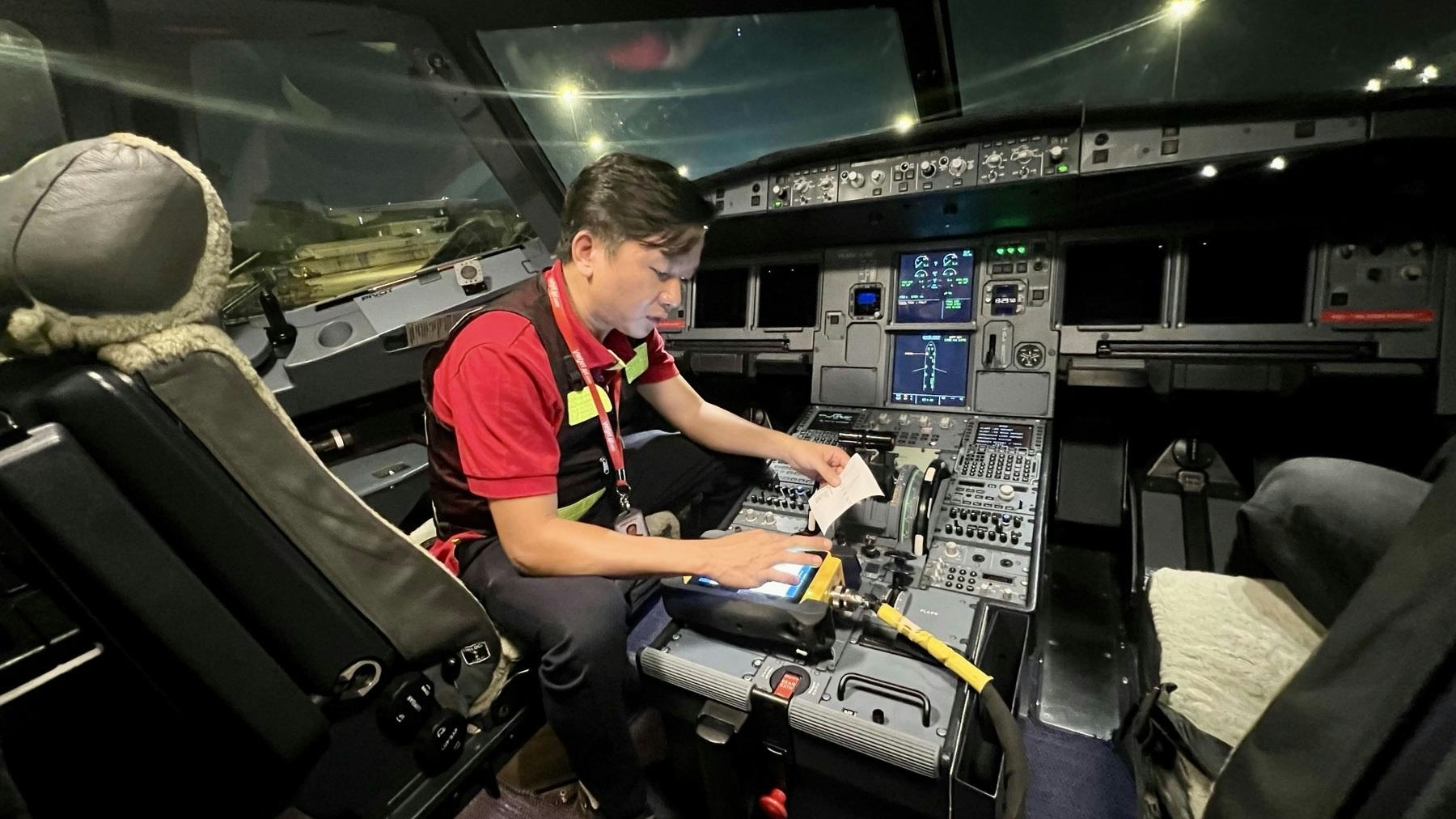
A pivotal moment occurred in Da Nang, where Vietjet engineer Nguyen Van Trung, leveraging over 15 years of experience, completed a full ELAC software update in just 45 minutes without omitting any mandatory safety procedures. The software update process is inherently complex, involving verification, standardization, testing, and cross-checking for each aircraft’s unique configuration. Trung emphasized, “Nothing can be skipped. But experience allows you to know exactly where time can be optimized—and where it absolutely cannot.”
The first aircraft to complete the update, VN-A644, represented a decisive breakthrough. The optimized 45-minute procedure was immediately standardized and disseminated to engineering teams at Noi Bai, Tan Son Nhat, Da Nang, and international stations, significantly accelerating progress across the fleet.
Technology, Teamwork, and Industry Collaboration
In addition to software updates, Vietjet prepared hardware contingency measures by pre-positioning ELAC units from grounded aircraft for immediate replacement if necessary. The airline also received support from Vietjet Thailand and other carriers, including Vietnam Airlines and Bamboo Airways, which provided additional equipment to scale the operation.
Digitalized technical documentation accessible on iPads, standardized software libraries, and real-time fleet visibility enabled Vietjet to compress administrative timelines while maintaining full compliance with Airbus and EASA safety requirements. Through rapid mobilization, technological innovation, and industry collaboration, Vietjet successfully navigated one of the most challenging operational crises in its history, ensuring passenger safety and network continuity amid a global aviation emergency.

PCC Approves Acquisition of Global Aircraft Leasing Firm
Frontier Airlines Airbus A321neo Returns to Cleveland After Engine Fire
Why the Boeing 777X Is Limited to a Single Engine Type
Malaysia Aviation Group Announces Long-Term Business Plan

TrueNoord Expands Executive Team
Hartzell Launches Sky-Tec Starter Line
Boeing 777 Engine Failure Reported at Dulles Airport
Austrian Airlines Transfers Embraer Fleet to Air Dolomiti
Airbus and Ingenium Open Aerospace Innovation Lab in Ottawa