
AIによるインサイトを行動へとつなげる

現在のトレンド
Categories
Malaysia Aviation Group Announces Long-Term Business Plan
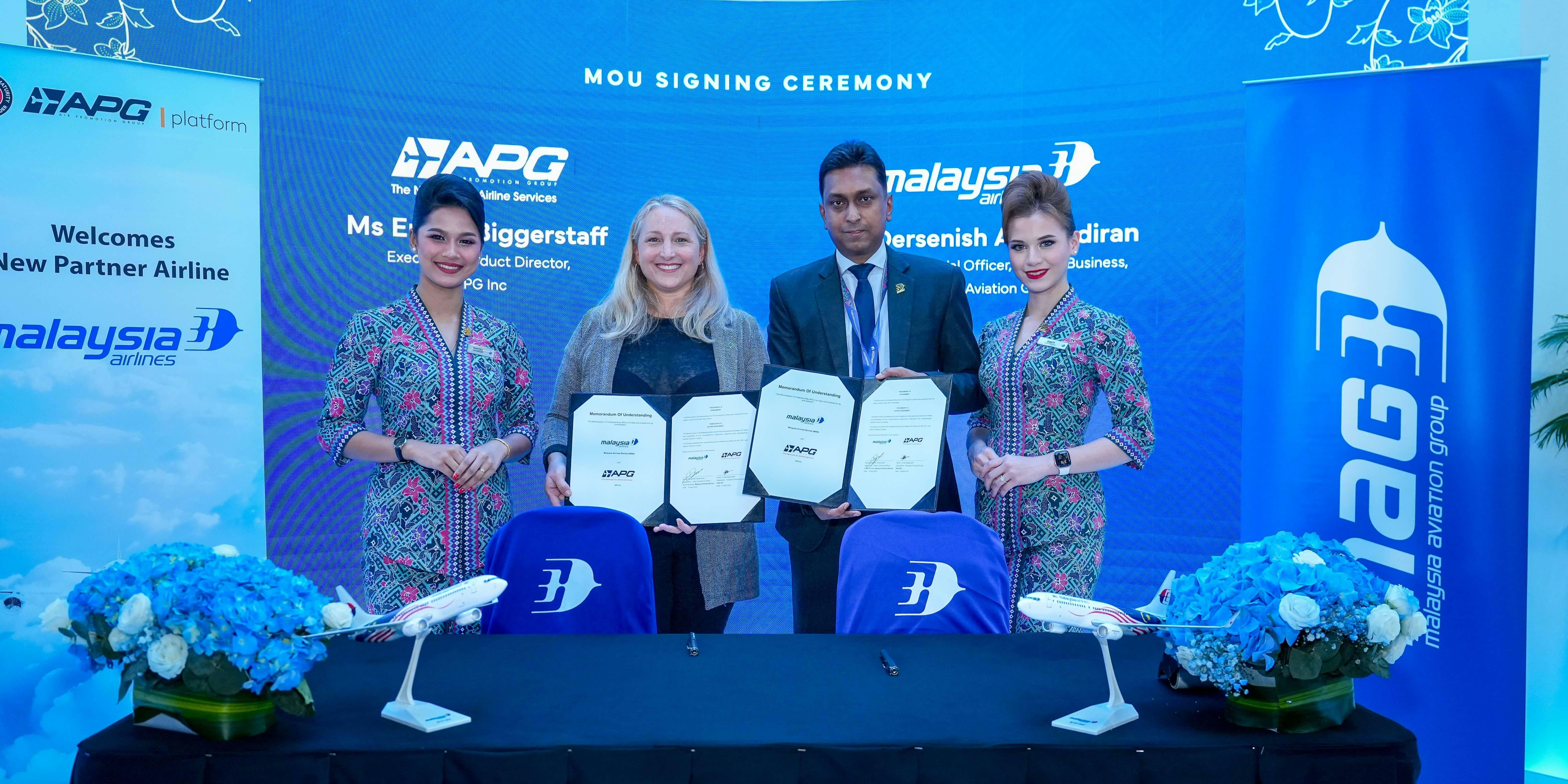
Malaysia Aviation Group Announces Ambitious Five-Year Growth Strategy
Malaysia Aviation Group (MAG) has unveiled its Long-Term Business Plan 3.0 (LTBP3.0), a comprehensive five-year roadmap spanning 2026 to 2030. The plan is designed to enhance the group’s competitive standing and foster sustainable growth across its aviation ecosystem. This new strategy builds upon the successes of LTBP2.0, introduced in 2020 during MAG’s financial restructuring, which notably reduced liabilities by over RM15 billion and eliminated RM10 billion in legacy debt. Since then, the group has recorded its strongest performance in more than a decade.
Progress and Achievements Under LTBP2.0
Since the implementation of LTBP2.0, MAG has achieved three consecutive years of operating profit and two years of positive net income after tax. The group’s Customer Satisfaction Index (CSI) has improved to 84% year-to-date, up from 80% in 2024. Fleet modernization has been a key focus, with the acquisition of 22 next-generation aircraft, alongside route expansion and enhanced customer experience initiatives. Regional connectivity has been strengthened, particularly through Firefly’s jet operations realigned to KLIA Terminal 1 and the introduction of new ASEAN routes.
MAG has also diversified its revenue streams, with non-air revenue now accounting for 18% of total group revenue. This growth is supported by strategic initiatives such as leasing Hangar 4 at Subang Airport to expand maintenance, repair, and overhaul (MRO) capacity. Digital innovation has played a significant role, with the development of an in-house middleware system and AI-powered customer support contributing to a 91% contact centre CSI, the highest among the group’s customer touchpoints.
Datuk Captain Izham Ismail, Group Managing Director of MAG, emphasized the group’s resilience and ambition, stating, “The progress we have made under LTBP2.0 reflects the capability and resilience of our people across the Group, and it gives us the confidence to move into our next chapter with greater ambition. LTBP3.0 marks a shift from stabilisation to scaled and disciplined growth. It sharpens our premium position and deepens the value we create across our broader aviation ecosystem.”
Strategic Objectives and Challenges Ahead
Central to LTBP3.0 is a focused network and fleet strategy aimed at elevating Malaysia Airlines into Skytrax’s Top 10 Global Airlines by 2030, a significant leap from its current ranking of 27. The group targets doubling its topline revenue to over RM24 billion and achieving more than 60% growth in third-party revenue across its aviation services businesses. These ambitious goals are intended to strengthen MAG’s long-term financial resilience and enhance Malaysia’s global connectivity.
However, the group faces critical decisions, particularly regarding the renewal of its widebody fleet, with a final determination expected by early 2026. This decision carries substantial financial and strategic implications and has elicited mixed reactions from the market. Competitors such as AirAsia are simultaneously advancing their fleet expansion plans, including the anticipated delivery of the A321LR in 2026, which may intensify regional competition.
Compounding these challenges is an impending leadership transition, as Datuk Captain Izham Ismail prepares to step down. This change raises questions about operational continuity and investor confidence during the crucial implementation phase of LTBP3.0.
Despite these uncertainties, MAG remains steadfast in its commitment to its long-term vision. Izham remarked, “It is a bold aspiration, perhaps a distant dream to some, but one we are fully committed to realising by building on what we have achieved, accelerating where we are strongest and investing strategically to secure long-term, sustainable value for our customers, partners and the wider nation.”
With LTBP3.0, Malaysia Aviation Group aims to consolidate its position as a leading regional aviation player, navigating industry challenges while capitalizing on emerging opportunities for growth.

Etihad Airways Suspends Airbus A380 Flights on Key Route

Aditya Birla Group Seeks Approval for Aircraft Leasing in GIFT City

Qatar Airways Highlights Innovation and Connectivity at Arabian Travel Market 2026

Hong Kong's Five-Year Plan Includes Andrew Fan's Aircraft Parts Processing Hub Proposal

ACIA Aero Leasing Delivers ATR72-600 to Air Nostrum

RTX Appoints Jill Albertelli as Head of Pratt & Whitney

TAT Technologies Joins Beyond Aero Hydrogen Aircraft Program

AURAK Study Highlights Barriers to Air Taxi Adoption in Emerging Economies

Xiamen Air Selects Altitude for 787 Maintenance at Heathrow

Etihad and Swissport Extend Global Partnership
