
Zet AI‑inzichten om in gerichte actie

Trending
Categories
AI Analyzes Nationwide Air Traffic Risks After Reagan Airport Crash, Duffy Says
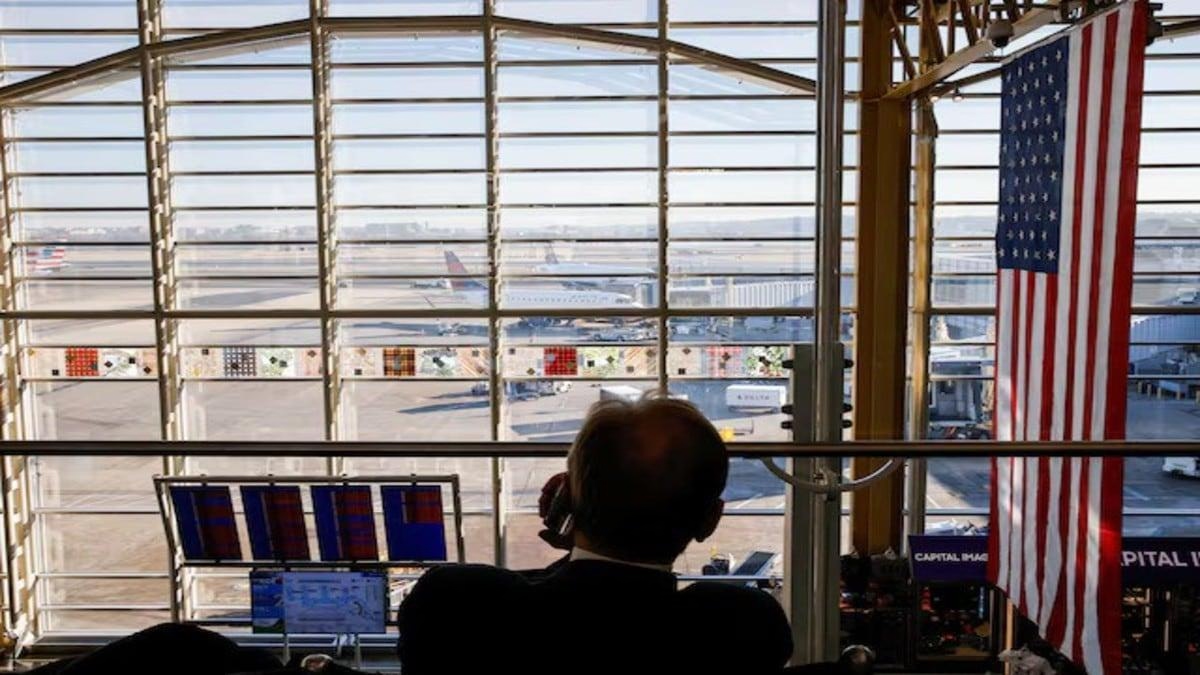
AI Analyzes Nationwide Air Traffic Risks After Reagan Airport Crash
In response to the fatal midair collision at Washington’s Ronald Reagan National Airport earlier this year, federal officials have turned to artificial intelligence to enhance air traffic safety across the United States. Transportation Secretary Sean Duffy revealed that AI is now being employed to identify potential hazards in the nation’s airspace, with the goal of preventing incidents similar to the January crash that resulted in 67 fatalities.
Enhancing Airspace Safety Post-Crash
The tragic collision on January 29 involved an American Airlines passenger jet and a U.S. Army Black Hawk helicopter, prompting immediate action from aviation authorities. Measures were swiftly implemented to segregate airspace for helicopters and fixed-wing aircraft over Washington, D.C. Secretary Duffy explained that the area near Runway 33, previously a zone of overlapping traffic routes, has been effectively separated to eliminate cross traffic. This overlap had been identified as a contributing factor to the disaster.
The crash, which claimed all lives aboard the American Airlines flight, triggered a comprehensive nationwide review of air traffic protocols. Investigations attributed the accident to pilot error on the part of the Black Hawk operator and insufficient separation between different types of aircraft operating in the same airspace.
Nationwide Deployment of AI for Risk Identification
Acknowledging prior lapses in oversight that allowed for numerous close calls, Secretary Duffy emphasized the urgency of proactive measures. AI technology is now being utilized to scan airports across the country for similar risk “hot spots.” Officials are employing AI to analyze extensive flight data, detect patterns, and flag potential dangers more efficiently than traditional methods. Duffy noted that investigators questioned whether other areas with similar risk profiles existed nationwide and are using AI to address these concerns before another tragedy occurs.
Despite the promise of AI, integrating this technology into existing air traffic control systems presents significant challenges. Ensuring data accuracy and achieving seamless compatibility with legacy infrastructure remain critical hurdles to effective implementation.
Industry Response and Future Outlook
The aviation sector has responded with cautious optimism to the introduction of AI-driven safety initiatives. While there is widespread support for efforts aimed at accident prevention, industry stakeholders are closely monitoring how AI integration will impact current operations. Concurrently, competitors within the aviation technology market are accelerating their own AI development programs to remain competitive with federal advancements.
Officials remain hopeful that AI will become a vital tool in improving air traffic safety nationwide. The ongoing refinement of protocols, combined with the adoption of advanced technologies, is viewed as an essential strategy to mitigate risks and safeguard lives in the future.

Etihad Airways Suspends Airbus A380 Flights on Key Route

Aditya Birla Group Seeks Approval for Aircraft Leasing in GIFT City

Qatar Airways Highlights Innovation and Connectivity at Arabian Travel Market 2026

Hong Kong's Five-Year Plan Includes Andrew Fan's Aircraft Parts Processing Hub Proposal

ACIA Aero Leasing Delivers ATR72-600 to Air Nostrum

RTX Appoints Jill Albertelli as Head of Pratt & Whitney

TAT Technologies Joins Beyond Aero Hydrogen Aircraft Program

AURAK Study Highlights Barriers to Air Taxi Adoption in Emerging Economies

Xiamen Air Selects Altitude for 787 Maintenance at Heathrow

Etihad and Swissport Extend Global Partnership
