
Zet AI‑inzichten om in gerichte actie

Trending
Categories
Airlines Focused on Human Customers, Not AI Agents
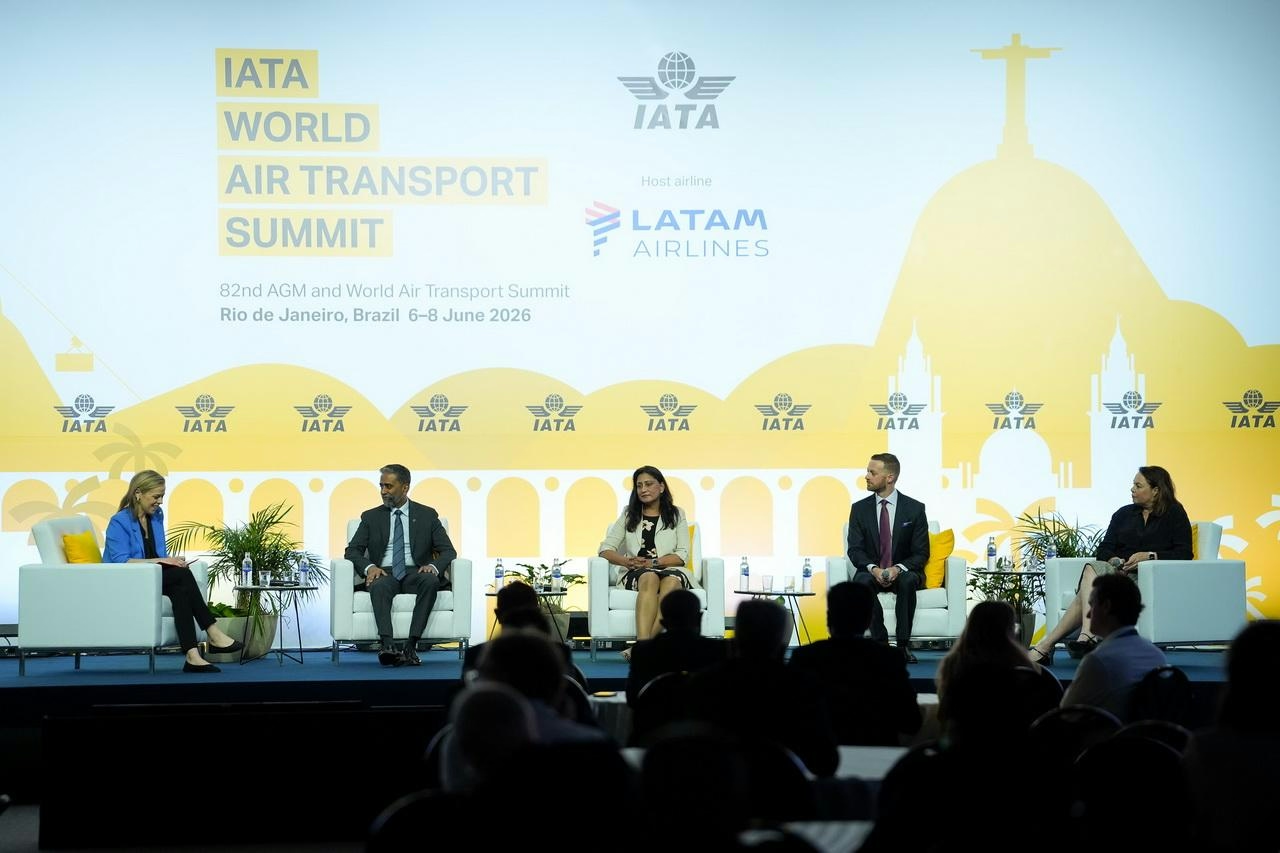
Airlines Prioritize Human Customers Amid AI Integration Challenges
As artificial intelligence continues to transform the aviation sector, airline executives are confronting a critical question: should their focus remain on human passengers, or should they optimize operations for AI-driven agents? This issue took center stage at the International Air Transport Association’s (IATA) 2026 Annual General Meeting, reflecting ongoing debates from the recent Skift Data + AI Summit.
Nikhil Ravi Shankar, CEO of Air New Zealand, encapsulated the industry's dilemma with a striking analogy, stating, “The aviation industry has built a tractor, and it’s using it to haul shovels.” His remarks underscored the need for airlines to fully leverage AI’s capabilities rather than confining it to marginal roles. The panel, comprising airline leaders and AI experts, examined the delicate balance between harnessing AI for operational efficiency and preserving authentic customer relationships.
The Complexities of Dynamic Pricing
Dynamic pricing emerged as a particularly contentious topic, generating both passenger unease and industry scrutiny. Megan O’Keeffe, Vice President for Airline Solutions at Amadeus, differentiated traditional revenue management—which adjusts fares based on historical trends—from contemporary AI-driven models capable of setting individualized prices in real time. Andrew Sellers, Vice President of Technology Strategy at Confluent, drew comparisons to the hotel industry, where AI systems have exploited corporate travel policies by pricing rooms just below reimbursement thresholds.
Sellers highlighted a fundamental challenge in AI deployment: interpretability. Unlike earlier models that could explain their decision-making processes, modern deep learning systems operate with considerable opacity. “We’re extremely poor at understanding why they make certain decisions. These systems are inherently stochastic—probabilistic. We simply don’t always know what they’ll do,” he explained, emphasizing the unpredictability embedded in current AI technologies.
Ethical Considerations and Maintaining Customer Trust
Ravi Shankar stressed a non-negotiable principle for the industry: pricing must remain fair and non-discriminatory, irrespective of technological advances. This concern is far from theoretical. Abha Dogra, Chief Product Officer at IBS Software, cautioned that hyper-personalization could breach ethical boundaries. She illustrated this with the example of AI systems accessing loyalty and travel data to identify passengers traveling for sensitive reasons, such as funerals or medical emergencies, and adjusting prices accordingly. “If the offer is dynamically formed, hyper-personalization can work against the customer at their most vulnerable moments,” Dogra warned. The industry has yet to establish clear regulations or standards to govern such practices.
Navigating Innovation While Preserving Human Connection
As AI adoption accelerates in areas like predictive maintenance, disruption management, and customer service, airlines face increasing pressure to integrate these technologies to remain competitive. Panelists acknowledged that AI already provides measurable benefits, particularly in managing disruptions such as rerouting passengers during adverse weather conditions. Nonetheless, skepticism persists among consumers regarding AI-driven services, and airlines that fully embrace AI may gain advantages in efficiency and customer experience.
The discussions at IATA and the Skift Data + AI Summit highlighted a fundamental tension within the industry: the need to innovate while safeguarding customer trust and service quality. Prioritizing human customers can strengthen loyalty and relationships but may risk ceding ground to competitors who aggressively deploy AI. The evolving challenge lies in responsibly governing AI’s application to ensure that technology serves people, rather than the reverse.

Etihad Airways Suspends Airbus A380 Flights on Key Route

Aditya Birla Group Seeks Approval for Aircraft Leasing in GIFT City

Qatar Airways Highlights Innovation and Connectivity at Arabian Travel Market 2026

Hong Kong's Five-Year Plan Includes Andrew Fan's Aircraft Parts Processing Hub Proposal

ACIA Aero Leasing Delivers ATR72-600 to Air Nostrum

RTX Appoints Jill Albertelli as Head of Pratt & Whitney

TAT Technologies Joins Beyond Aero Hydrogen Aircraft Program

AURAK Study Highlights Barriers to Air Taxi Adoption in Emerging Economies

Xiamen Air Selects Altitude for 787 Maintenance at Heathrow

Etihad and Swissport Extend Global Partnership
