
Zet AI‑inzichten om in gerichte actie

Trending
Categories
China Develops Mach 4 ‘ACE’ Turbojet Engine with Record Performance
China Develops Mach 4 ‘ACE’ Turbojet Engine with Record Performance
Breakthrough in Adaptive Cycle Engine Technology
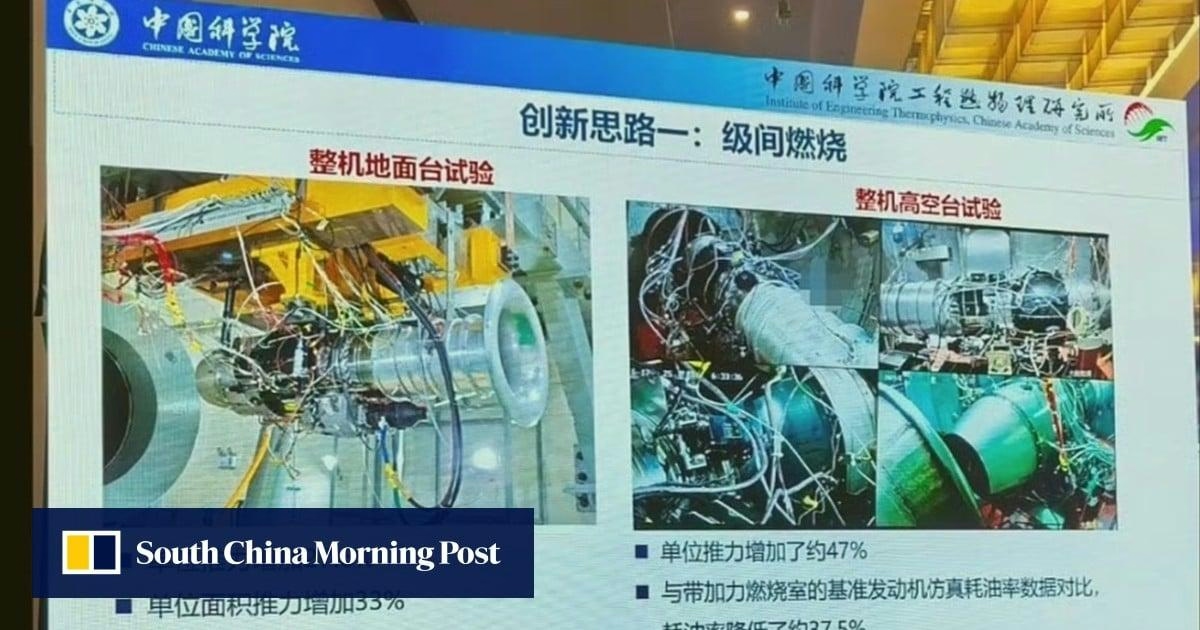
China has announced a significant advancement in jet engine technology with the unveiling of a prototype adaptive cycle engine (ACE) capable of achieving speeds up to Mach 4. This new engine demonstrates remarkable improvements in thrust, fuel efficiency, and operational range, marking a milestone in aerospace propulsion. The development was presented at the Chinese Society of Engineering Thermophysics annual conference in Beijing by Xu Gang, deputy director of the Institute of Engineering Thermophysics at the Chinese Academy of Sciences, who shared the results of recent ground and altitude testing.
The ACE engine incorporates innovative “bypass combustion and inter-stage mixing variable-mode engine” technology, which represents a substantial evolution beyond conventional turbine designs. This approach effectively mitigates the significant thrust loss that traditional engines experience at high altitudes and supersonic speeds, enabling sustained high-speed cruise capabilities. Furthermore, the engine is engineered to function as the high-speed turbine component within combined-cycle propulsion systems, addressing the persistent “thrust trap” issue that has historically constrained such systems’ performance.
Distinctive Design and Strategic Implications
China’s ACE engine distinguishes itself from its American counterparts through a unique three-stream architecture, diverging from the dual-bypass designs favored by U.S. manufacturers. This novel configuration enhances the engine’s versatility and efficiency, positioning China as a serious competitor in the development of next-generation fighter aircraft and future supersonic commercial transports.
The announcement comes amid a complex geopolitical and economic backdrop. Ongoing trade tensions between the United States and China have already affected China’s broader aviation sector, notably causing delays in the delivery of the domestically produced C919 jetliner, which competes directly with Boeing’s 737 and Airbus’s A320. These setbacks have contributed to market uncertainty, despite robust financial performances from leading technology firms such as Palantir.
Meanwhile, the global aerospace market is witnessing intensified competition. Airbus has increased production of its A320 single-aisle jets in China, while India’s Hindustan Aeronautics Limited has entered a partnership with Russia to manufacture SJ-100 aircraft, introducing new challenges for established players like Boeing and Airbus.
China’s progress with the ACE turbojet engine represents a pivotal advancement in propulsion technology. Should the engine be successfully integrated into future aircraft, it has the potential to alter the competitive dynamics of both military and commercial aviation, further intensifying the global race for aerospace dominance.

Etihad Airways Suspends Airbus A380 Flights on Key Route

Aditya Birla Group Seeks Approval for Aircraft Leasing in GIFT City

Qatar Airways Highlights Innovation and Connectivity at Arabian Travel Market 2026

Hong Kong's Five-Year Plan Includes Andrew Fan's Aircraft Parts Processing Hub Proposal

ACIA Aero Leasing Delivers ATR72-600 to Air Nostrum

RTX Appoints Jill Albertelli as Head of Pratt & Whitney

TAT Technologies Joins Beyond Aero Hydrogen Aircraft Program

AURAK Study Highlights Barriers to Air Taxi Adoption in Emerging Economies

Xiamen Air Selects Altitude for 787 Maintenance at Heathrow

Etihad and Swissport Extend Global Partnership
