
Zet AI‑inzichten om in gerichte actie

Trending
Categories
Defense Innovation Unit says Honeywell quantum navigation system improved aircraft position accuracy by 89% in GPS-free Pacific test flight
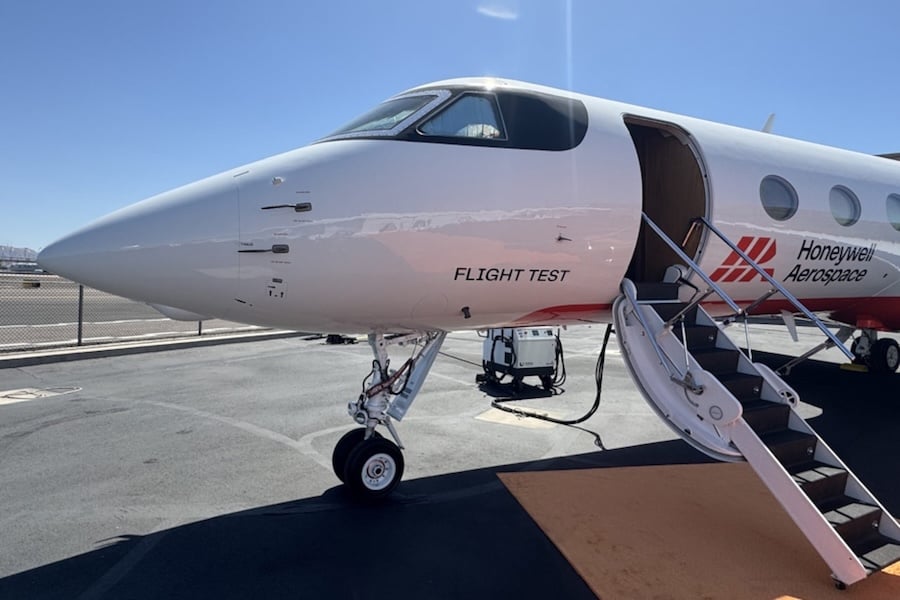
Honeywell’s Quantum Navigation System Achieves 89% Improvement in Aircraft Position Accuracy During GPS-Denied Pacific Test
A prototype quantum navigation system developed by Honeywell Aerospace has demonstrated a remarkable 89% enhancement in aircraft position accuracy compared to traditional backup methods during a GPS-denied test flight over the Pacific Ocean, the Defense Innovation Unit (DIU) reported. The system, known as MagNav, utilizes advanced quantum sensors to measure the Earth’s magnetic field and operated continuously for four hours and 23 minutes aboard an Embraer 170 flying between Seattle’s Puget Sound and southern Alaska.
Advancing Quantum Navigation from Lab to Flight
This test represented a critical milestone for MagNav, transitioning the technology from controlled laboratory environments to real-world aviation conditions where conventional visual navigation aids were largely unavailable. The navigation data was transmitted directly to pilots in real time via standard tablets, demonstrating the system’s potential for seamless integration into existing cockpit configurations without requiring extensive modifications.
MagNav’s quantum sensors function by comparing real-time magnetic field measurements with the Earth’s crustal magnetic signatures, providing a continuous and reliable navigation reference. Unlike GPS signals, which can be disrupted or spoofed, the Earth’s magnetic field is inherently resistant to interference, offering a resilient alternative for navigation when satellite signals are compromised. DIU highlighted this advantage, emphasizing the system’s robustness in contested or degraded environments.
Kyle Norman, deputy director of DIU’s Kill Web portfolio, described the achievement as a significant advancement for the department’s quantum sensing initiatives. He noted the rapid progression from problem identification to prototype development, underscoring the efficiency of the “Transition of Quantum Sensing” program launched in spring 2024. Honeywell was selected for prototype development from a competitive pool of 72 companies.
Implications and Future Prospects
Traditional backup navigation systems often depend on radar mapping, visible landmarks, or inertial sensors, which can accumulate errors over time, especially during extended flights over featureless terrain or open ocean. The Pacific test, conducted in a visually sparse and dynamically changing environment, provided a rigorous evaluation of MagNav’s capabilities where conventional methods typically falter.
Looking ahead, Honeywell and DIU plan to further validate MagNav by installing it aboard a U.S. military C-17 Globemaster III transport aircraft later this year. This next phase aims to assess the system’s performance as a robust backup navigation solution for both military and commercial aircraft operating without reliance on satellite-based positioning.
Despite the promising results, the widespread adoption of Honeywell’s quantum navigation system may encounter challenges. Resistance from entrenched legacy systems, along with the need for substantial investment in training and infrastructure, could slow deployment. Nevertheless, the market response is expected to be favorable, driven by increasing demand from defense and commercial sectors for enhanced navigation accuracy and resilience against GPS interference or jamming. The success of MagNav may also prompt competitors to accelerate development of their own quantum or alternative navigation technologies to maintain competitiveness in this evolving field.
The successful Pacific test underscores the transformative potential of quantum navigation technology in enabling reliable aircraft operations in GPS-denied environments, positioning MagNav as a leading candidate for next-generation navigation solutions.

Etihad Airways Suspends Airbus A380 Flights on Key Route

Aditya Birla Group Seeks Approval for Aircraft Leasing in GIFT City

Qatar Airways Highlights Innovation and Connectivity at Arabian Travel Market 2026

Hong Kong's Five-Year Plan Includes Andrew Fan's Aircraft Parts Processing Hub Proposal

ACIA Aero Leasing Delivers ATR72-600 to Air Nostrum

RTX Appoints Jill Albertelli as Head of Pratt & Whitney

TAT Technologies Joins Beyond Aero Hydrogen Aircraft Program

AURAK Study Highlights Barriers to Air Taxi Adoption in Emerging Economies

Xiamen Air Selects Altitude for 787 Maintenance at Heathrow

Etihad and Swissport Extend Global Partnership
