
Zet AI‑inzichten om in gerichte actie

Trending
Categories
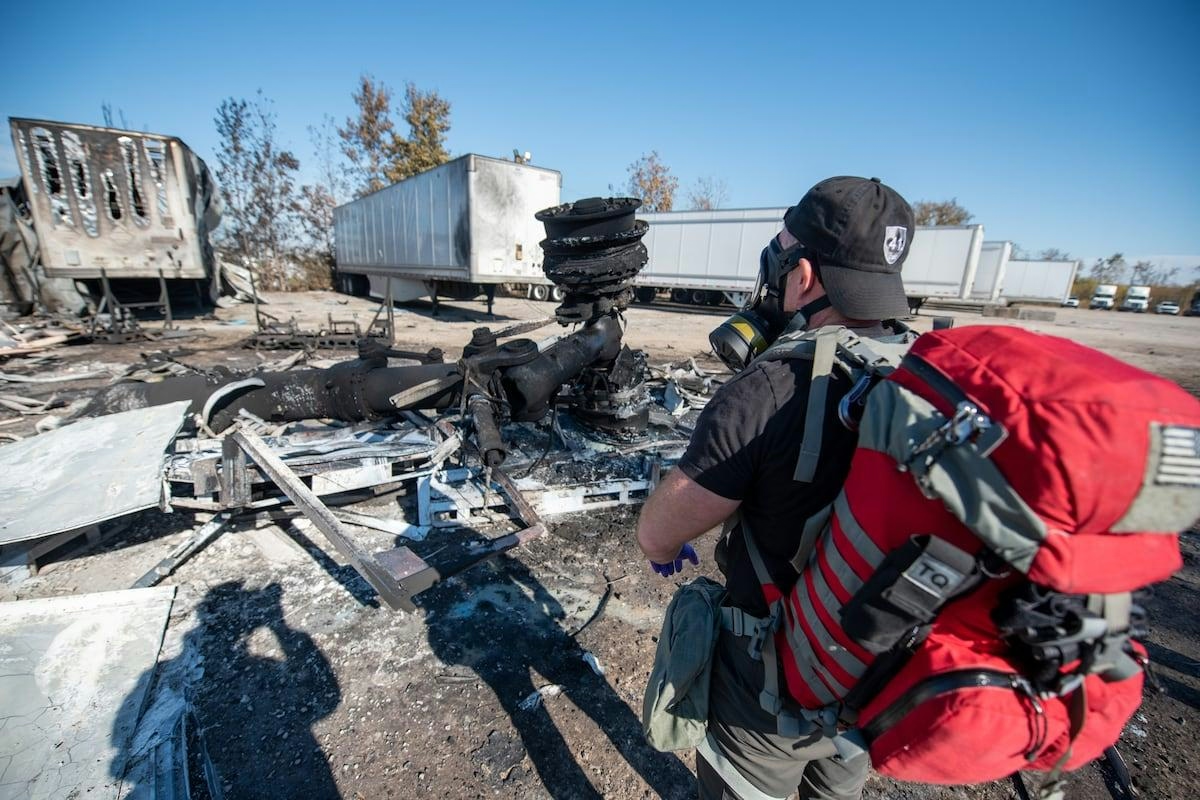
Engine Detachment in Louisville Highlights Longstanding Aviation Safety Concern
Engine Detachment in Louisville Highlights Longstanding Aviation Safety Concern
Catastrophic Incident During Takeoff
On the evening of November 4, 2025, a UPS-operated MD-11 freighter commenced its takeoff roll on runway 17R at Louisville Muhammad Ali International Airport. The initial taxi and acceleration phases proceeded without incident. However, at the moment of rotation, the aircraft’s left engine and its pylon detached from the wing, trailing flames as they arced overhead. The 34-year-old trijet, heavily fueled for a flight to Honolulu and nearing retirement, briefly lifted off before rolling left and crashing into a petroleum-recycling yard and an adjacent warehouse. The ensuing fire and thick black smoke quickly engulfed the area.
The crash resulted in the deaths of all three crew members aboard the aircraft. The US National Transportation Safety Board (NTSB) later confirmed that 11 individuals on the ground also perished, with an additional victim succumbing to injuries weeks after the accident. The cockpit voice recorder captured a continuous alarm sounding for 25 seconds following rotation, though it failed to provide a definitive diagnosis. Given the minimal altitude and the catastrophic damage sustained, the crew had no opportunity to regain control.
Preliminary Findings and Systemic Safety Issues
While the NTSB’s investigation remains ongoing, preliminary findings and a public hearing held in May have identified the immediate cause as the failure of a single spherical bearing in the pylon’s aft mount. Metallurgical analysis revealed fatigue cracks in the bearing’s race, which ultimately led to overstress during takeoff—a classic example of a single point of failure. Surveillance footage from the airport vividly documented the sequence of events: the engine detaching from its mount, fire erupting at the wing root, and the aircraft’s final descent.
Beyond the immediate mechanical failure, the investigation has uncovered deeper systemic concerns. A Boeing service letter issued in February 2011 had previously warned of this exact failure mode—fatigue cracking in bearing races at a specific machined groove—on other aircraft. Although Boeing recommended a redesigned bearing that eliminated the problematic groove, this modification was not mandated, allowing the older, vulnerable part to remain in service. Since 2002, the NTSB has recorded at least ten similar bearing failures across the MD-11 fleet, including four incidents involving FedEx aircraft between 2017 and 2022. Reporting of these failures has been inconsistent: only seven of the ten incidents were reported to Boeing, four to the Federal Aviation Administration (FAA), and just two to both agencies. Notably, the most recent failure in December 2022 was not reported to any authority, underscoring a fragmented and inadequate safety reporting system.
Broader Implications for Aviation Safety and Industry Response
The ramifications of the Louisville crash extend well beyond technical findings. The incident has prompted intense scrutiny from aviation safety regulators, raising critical questions about oversight mechanisms and the efficacy of voluntary compliance with safety recommendations. UPS and Boeing now face potential litigation from the families of victims, alongside significant reputational damage. The event has also unsettled the aviation market, with insurers contemplating increased premiums and investors voicing renewed concerns regarding aviation safety standards.
In response, competitors within the industry have emphasized their own safety protocols, issuing public commitments to enhanced safety measures in an effort to reassure customers and distinguish themselves amid a shaken market. As the investigation continues, the Louisville tragedy serves as a stark reminder of the vital importance of robust safety systems, transparent incident reporting, and proactive risk management in commercial aviation.

Etihad Airways Suspends Airbus A380 Flights on Key Route

Aditya Birla Group Seeks Approval for Aircraft Leasing in GIFT City

Qatar Airways Highlights Innovation and Connectivity at Arabian Travel Market 2026

Hong Kong's Five-Year Plan Includes Andrew Fan's Aircraft Parts Processing Hub Proposal

ACIA Aero Leasing Delivers ATR72-600 to Air Nostrum

RTX Appoints Jill Albertelli as Head of Pratt & Whitney

TAT Technologies Joins Beyond Aero Hydrogen Aircraft Program

AURAK Study Highlights Barriers to Air Taxi Adoption in Emerging Economies

Xiamen Air Selects Altitude for 787 Maintenance at Heathrow

Etihad and Swissport Extend Global Partnership
