
Zet AI‑inzichten om in gerichte actie

Trending
Categories
Five Engine Failures Raise Safety Concerns for Russian Airlines in One Week
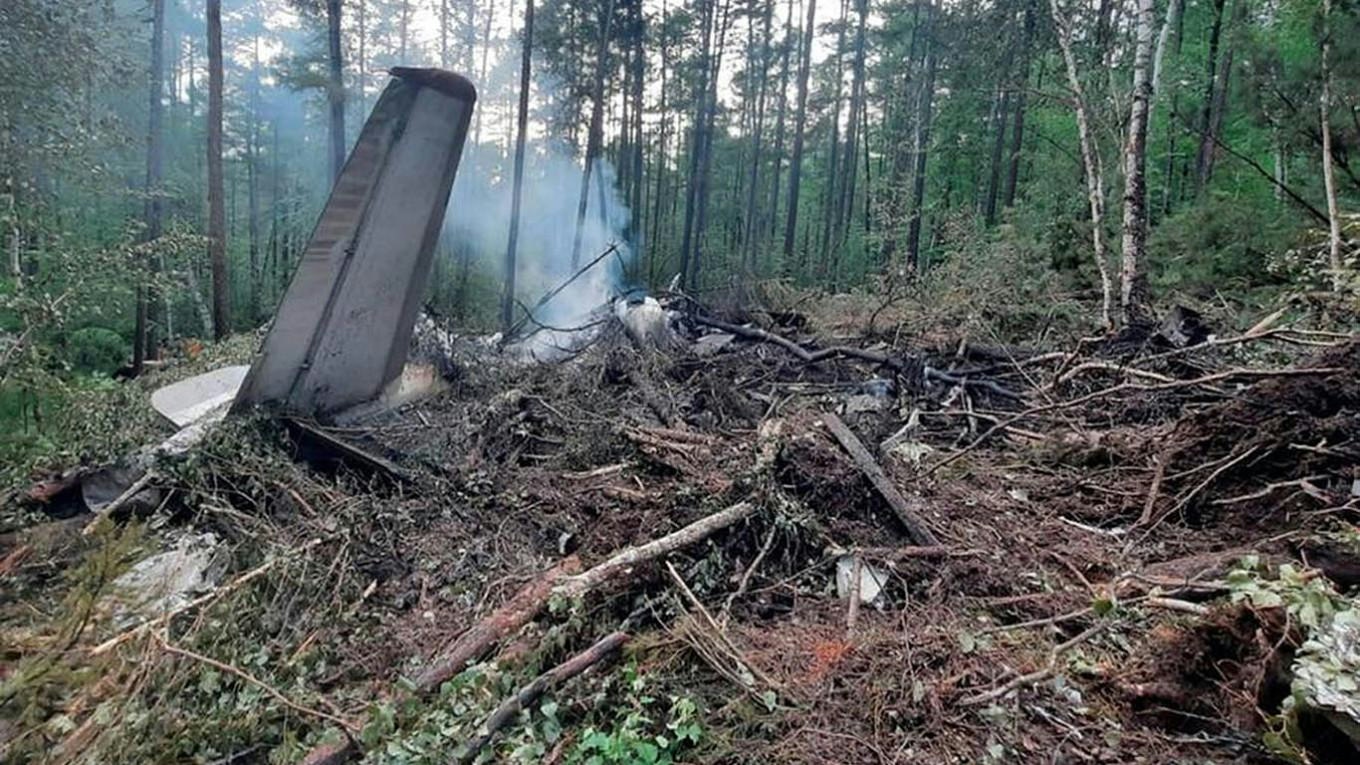
Five Engine Failures Raise Safety Concerns for Russian Airlines in One Week
A Surge in Mid-Flight Engine Failures
Within a single week, five Russian passenger aircraft experienced mid-flight engine failures, intensifying scrutiny over the safety of the nation’s civil aviation sector. These incidents, reported by The Moscow Times on March 20, underscore the growing operational challenges faced by Russian airlines amid stringent Western sanctions imposed following Russia’s full-scale invasion of Ukraine.
Between March 10 and March 16, a series of alarming technical malfunctions occurred across multiple carriers. On March 16, a Sukhoi Superjet 100 operated by Rossiya Airlines was forced to return to Sheremetyevo Airport after detecting high vibrations in its second engine during a flight from Moscow to Saint Petersburg. Earlier, on March 13, a Rossiya Airlines Boeing 737-800 on the Sochi-Novosibirsk route triggered an oil circulation system alarm in its first engine. On March 15, an Aeroflot Airbus A330 flying from Yekaterinburg to Bangkok returned to its departure airport due to a faulty air bleed valve in the second engine. Additionally, on March 12, Ural Airlines’ A320neo experienced a failure of its second engine thrust reverser during landing in Khabarovsk, while on March 10, an S7 Airlines Airbus A320 suffered a similar malfunction at Irkutsk airport.
These incidents highlight a broader crisis confronting Russian airlines, which are struggling to maintain their predominantly foreign-made fleets amid severe restrictions on spare parts and technical support.
Maintenance Challenges Amid Sanctions
The imposition of Western sanctions has drastically curtailed access to essential parts and maintenance services for Boeing and Airbus aircraft, which constitute a significant portion of Russia’s long-haul fleet. According to Kommersant, fewer than 60 of the 93 remaining wide-body jets are currently operational, with the remainder grounded or undergoing extended maintenance due to a shortage of spare parts. Attempts to establish repair facilities abroad, including in Iran, have thus far been unsuccessful.
The Ministry of Transport had forecasted in 2022 that the fleet would contract to 52 aircraft by 2030; however, current operational numbers are already nearing this threshold. In a reflection of the urgency, Russia formally requested the International Civil Aviation Organization (ICAO) in September 2025 to ease airworthiness restrictions on Boeing and Airbus aircraft.
The crisis affects all major Russian carriers. Aeroflot Group, for instance, has 17 of its 59 wide-body aircraft in maintenance, some grounded for over a year. Azur Air operates only six of its 11 planes, while Northern Wind flies just two of nine. The inability to replace foreign aircraft with domestic models exacerbates the situation. Reuters reports that only one of the 15 planned Russian-made aircraft for 2025 has been delivered to date.
Industry-Wide Implications and Safety Concerns
Russian aviation authorities have expressed deep concern over the deteriorating safety standards. Vladimir Kovalsky, head of Gosaviandzor, described the situation as a “systemic problem,” citing issues such as falsified maintenance records, unauthorized repairs, and a general lowering of safety protocols. Between 2023 and 2025, more than 480 aircraft—nearly half of the fleet—were prohibited from operation due to regulatory violations.
The crisis has also triggered market repercussions, including rising insurance premiums and increased scrutiny from both passengers and regulators. The reputational damage risks driving travelers toward competitors with higher safety standards, potentially reshaping market dynamics. Meanwhile, the Asia-Pacific region’s engine maintenance, repair, and overhaul (MRO) market is projected to exceed $30 billion by 2035, signaling a shift in maintenance focus that could further elevate operational costs for Russian airlines.
In response to these challenges, carriers have resorted to unconventional measures. Ural Airlines announced plans to extend the service life of its Airbus A320s beyond 96,000 flight hours at an uncertified maintenance center. Aviation journalist Andrey Menshenin warned that such practices further distance Russian aviation from international safety norms. Expert Vadim Lukashevich acknowledged that Russian airlines have gained “invaluable practical experience” in dismantling aircraft after emergency landings but cautioned, “One can only hope that this ‘great step forward’ will happen without human casualties.”

Etihad Airways Suspends Airbus A380 Flights on Key Route

Aditya Birla Group Seeks Approval for Aircraft Leasing in GIFT City

Qatar Airways Highlights Innovation and Connectivity at Arabian Travel Market 2026

Hong Kong's Five-Year Plan Includes Andrew Fan's Aircraft Parts Processing Hub Proposal

ACIA Aero Leasing Delivers ATR72-600 to Air Nostrum

RTX Appoints Jill Albertelli as Head of Pratt & Whitney

TAT Technologies Joins Beyond Aero Hydrogen Aircraft Program

AURAK Study Highlights Barriers to Air Taxi Adoption in Emerging Economies

Xiamen Air Selects Altitude for 787 Maintenance at Heathrow

Etihad and Swissport Extend Global Partnership
