
Zet AI‑inzichten om in gerichte actie

Trending
Categories
France Orders Airbus VSR700 Uncrewed Aerial Vehicle
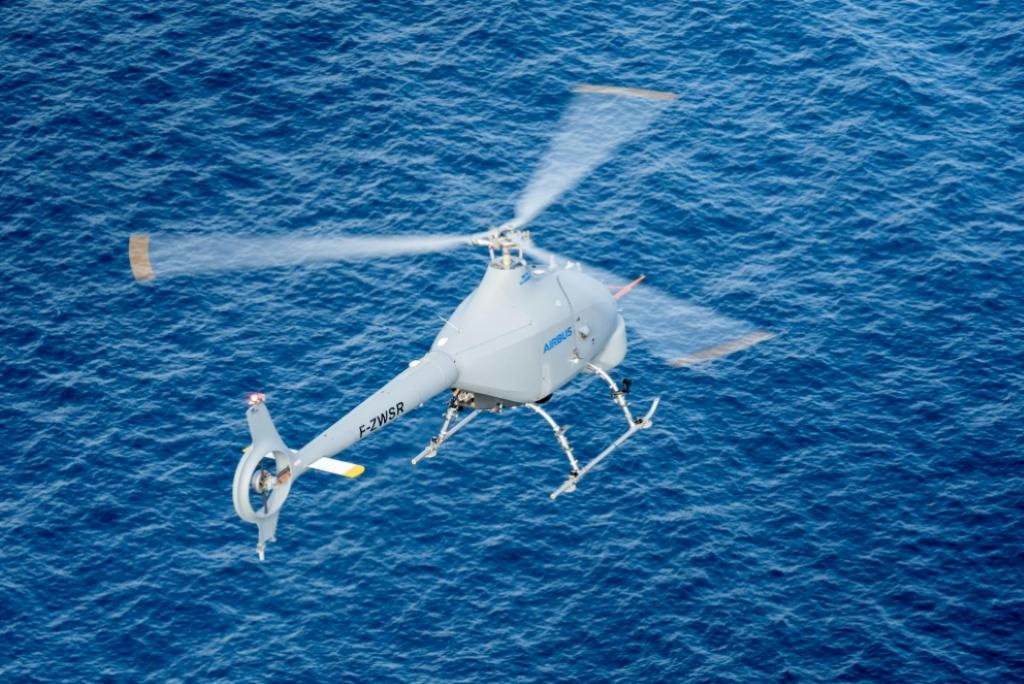
France Commits to Airbus VSR700 Uncrewed Aerial Vehicles for Naval Modernization
Contract Award and Strategic Significance
On 14 January 2026, the French Armament General Directorate (DGA) officially awarded a contract to Airbus Helicopters and Naval Group for the production of six VSR700 uncrewed aerial systems. These drones are slated for deployment by the French Navy beginning in 2028, representing a pivotal advancement in France’s naval modernization efforts through the integration of cutting-edge unmanned technologies.
Bruno Even, CEO of Airbus Helicopters, expressed the company’s commitment to delivering a reliable and high-performance platform that will enhance the French Navy’s operational sovereignty and mission effectiveness. He highlighted the establishment of a dedicated industrial framework designed to support serial production while upholding stringent aeronautical safety and performance standards.
Capabilities and Integration
The VSR700 will be configured primarily for Intelligence, Surveillance, and Reconnaissance (ISR) missions. It will be equipped with a suite of advanced sensors, including a surveillance radar, an electro-optical system, and an Automatic Identification System (AIS) receiver. Naval Group will manage the integration of the VSR700 into the naval vessels’ architecture, ensuring seamless connectivity with existing combat systems through the Steeris® Mission System.
Derived from the crewed Cabri G2 helicopter developed by Hélicoptères Guimbal, the VSR700 serves as a dual-use platform. Its naval military variant was developed under the French Navy and DGA’s SDAM (Système de drone aérien de la Marine) programme in collaboration with Naval Group. The system has undergone rigorous testing both on land and at sea, designed to augment crewed helicopters by extending a vessel’s intelligence-gathering and surveillance reach. While initially focused on ISR roles, the VSR700’s versatility allows it to support logistics, armed reconnaissance, and even civil applications such as firefighting and disaster relief.
Challenges and Market Implications
The integration of the VSR700 into existing French naval systems may encounter technical challenges, potentially affecting delivery timelines as the new technology is assimilated into operational fleets. This development is anticipated to have broader implications for the defense sector, stimulating increased interest in uncrewed aerial vehicles for surveillance and reconnaissance missions.
Competitors, including Leonardo Helicopters—which has developed autonomous rotorcraft for the UK Royal Navy—may accelerate their own UAV programs in response. As global defense priorities shift towards unmanned systems, the market is expected to witness intensified innovation and competition in this domain.
Airbus has also showcased the VSR700’s capability to operate collaboratively with crewed helicopters through its HTeaming solution, further enhancing operational flexibility for the French Navy.
Comments

Etihad Airways Suspends Airbus A380 Flights on Key Route

Aditya Birla Group Seeks Approval for Aircraft Leasing in GIFT City

Qatar Airways Highlights Innovation and Connectivity at Arabian Travel Market 2026

Hong Kong's Five-Year Plan Includes Andrew Fan's Aircraft Parts Processing Hub Proposal

ACIA Aero Leasing Delivers ATR72-600 to Air Nostrum

RTX Appoints Jill Albertelli as Head of Pratt & Whitney

TAT Technologies Joins Beyond Aero Hydrogen Aircraft Program

AURAK Study Highlights Barriers to Air Taxi Adoption in Emerging Economies

Xiamen Air Selects Altitude for 787 Maintenance at Heathrow

Etihad and Swissport Extend Global Partnership
