
Zet AI‑inzichten om in gerichte actie

Trending
Categories
Fw 187 Falke: A Faster but Overlooked Fighter Than the Bf 109
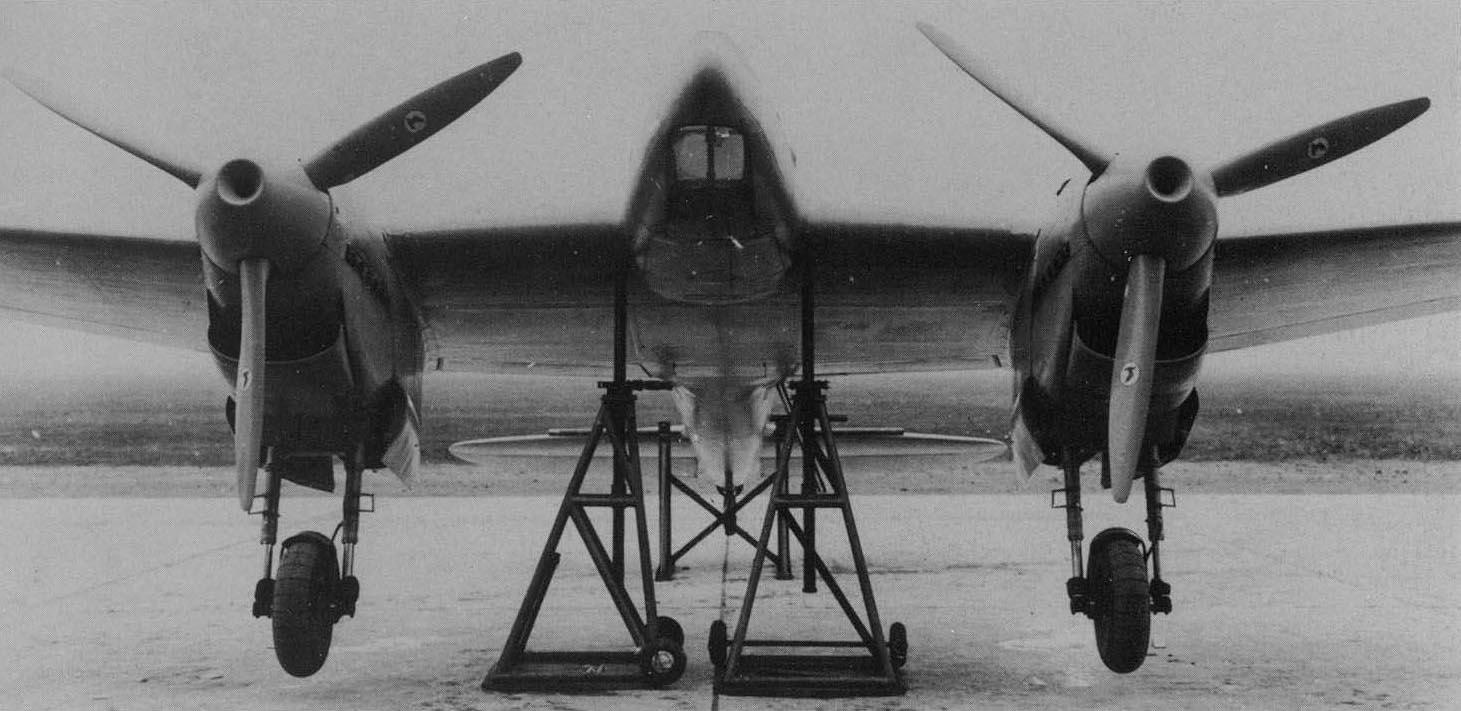
Fw 187 Falke: A Faster but Overlooked Fighter Than the Bf 109
Development and Performance
In 1937, Focke-Wulf introduced the Fw 187 Falke, a fighter aircraft that outpaced the Messerschmitt Bf 109, which was then the Luftwaffe’s frontline fighter. Remarkably, the Falke achieved this despite utilizing the same Junkers Jumo 210 engines as the Bf 109. It was approximately 80 km/h faster, had double the operational range, and weighed nearly twice as much, yet still managed to surpass the speed of its single-engine rival. Despite these impressive attributes, only nine Fw 187s were ever built, and the Luftwaffe never adopted the aircraft for active service. Instead, the limited number produced were assigned to defend the very factory where they were manufactured.
The Fw 187 remains one of the most debated aircraft in German aviation history, partly due to conflicting documentation and varying performance reports. The aircraft was initially conceived as a private venture by Kurt Tank in 1935, aiming to create a single-seat, long-range fighter distinct from the Luftwaffe’s favored heavy twin-engine "Zerstörer" concept. The first prototype flew in the spring of 1937, although details such as the pilot and exact date remain uncertain.
From the third prototype onward, the design was modified to include a lengthened fuselage and a second seat for a radio operator, reflecting changing operational requirements. Performance figures for the Falke vary among sources. Some claim the initial prototype reached speeds of 523 to 525 km/h, roughly 80 km/h faster than the Jumo-powered Bf 109B. However, official Luftwaffe data suggest more conservative speeds of 457 km/h at sea level and 496 km/h at 4,000 meters, reducing the speed advantage to about 35 km/h. Testing at Rechlin recorded the second prototype achieving 501 km/h at 3,000 meters. Regardless of the exact figures, the Falke’s ability to match or exceed the Bf 109’s speed while carrying twice the weight and fuel was a notable aerodynamic achievement.
One prototype, equipped with Daimler-Benz engines and an experimental cooling system, reportedly reached 635 km/h in October 1939. This figure, often cited in literature, applied only under specific low-altitude test conditions and did not reflect operational performance.
Operational History and Legacy
Despite its technical promise, the Fw 187 struggled to secure a role within the Luftwaffe’s strategic framework. It was perceived as an intermediate design, neither as agile as the single-seat Bf 109 nor as heavily armed as the twin-engine Bf 110 destroyer. This ambiguous positioning left the Falke without a clear operational niche. Consequently, it failed to generate significant interest from military planners or the aviation market.
The Bf 109 had already established itself as the Luftwaffe’s primary fighter, overshadowing the Falke’s potential and consigning it to relative obscurity. The few Fw 187s produced were relegated to factory defense duties in Bremen throughout the war, never seeing frontline combat.
The Fw 187 Falke remains a compelling example of an advanced and capable fighter that, despite its advantages, never found its moment in the Luftwaffe’s evolving air combat doctrine.

Etihad Airways Suspends Airbus A380 Flights on Key Route

Aditya Birla Group Seeks Approval for Aircraft Leasing in GIFT City

Qatar Airways Highlights Innovation and Connectivity at Arabian Travel Market 2026

Hong Kong's Five-Year Plan Includes Andrew Fan's Aircraft Parts Processing Hub Proposal

ACIA Aero Leasing Delivers ATR72-600 to Air Nostrum

RTX Appoints Jill Albertelli as Head of Pratt & Whitney

TAT Technologies Joins Beyond Aero Hydrogen Aircraft Program

AURAK Study Highlights Barriers to Air Taxi Adoption in Emerging Economies

Xiamen Air Selects Altitude for 787 Maintenance at Heathrow

Etihad and Swissport Extend Global Partnership
