
Zet AI‑inzichten om in gerichte actie

Trending
Categories
Navy Funds Shield AI’s X-BAT Program as Air Force Holds Back
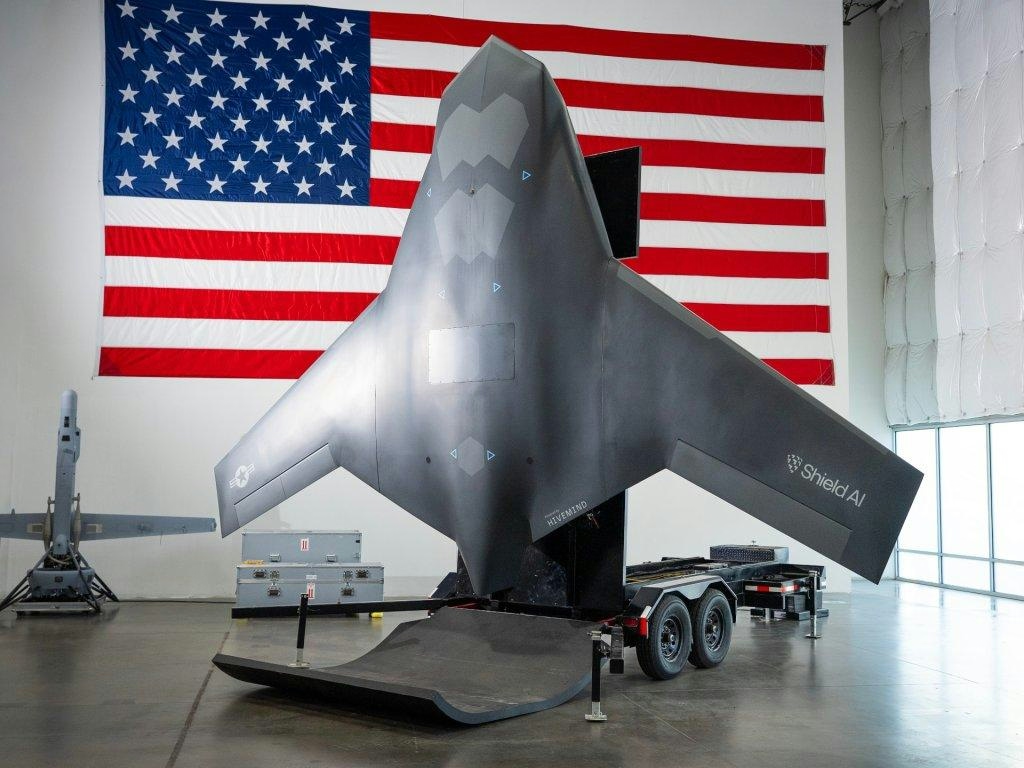
Navy Commits $50 Million to Shield AI’s X-BAT VTOL Drone as Air Force Abstains
The U.S. Navy has allocated approximately $50 million to Shield AI for the development of the X-BAT, an advanced AI-piloted fighter drone capable of vertical takeoff and landing (VTOL). This funding, confirmed in August 2026, originates from the Navy’s Rapid Capabilities Office and the Defense Innovation Unit (DIU) under the RIMES program. The Navy’s investment underscores its strategic interest in pioneering next-generation, ship-based uncrewed combat aircraft. In contrast, the U.S. Air Force has chosen not to participate in funding the X-BAT, instead maintaining its focus on its own Collaborative Combat Aircraft (CCA) program.
The X-BAT Concept and Capabilities
The X-BAT is a “tailsitter” drone designed to stand upright on its tail, ignite its afterburner, and lift off vertically before transitioning to horizontal flight. Developed by Shield AI, a San Diego-based company founded in 2015, the concept was unveiled in October 2025. The drone is powered by a single General Electric F110-class engine—the same engine family used in the F-16 fighter jet—integrated into a compact and lightweight airframe. This innovative design eliminates the need for traditional runways, catapults, or arresting wires, enabling flexible deployment from naval vessels or austere environments.
Shield AI projects that the X-BAT will achieve a range exceeding 2,000 nautical miles and operate at altitudes above 50,000 feet. The company estimates a target unit cost of approximately $27 million. The drone’s compact size is notable; Shield AI claims that three X-BAT units can occupy the deck space typically required for a single legacy fighter aircraft. The first flight is scheduled before the end of 2026, although such timelines in defense development programs are often subject to change.
Central to the X-BAT’s capabilities is Shield AI’s Hivemind autonomy software, which has demonstrated its effectiveness in previous tests, including flying the X-62A VISTA—a modified F-16—in a 2024 DARPA dogfight exercise against a human pilot. The X-BAT is intended to function either as a digital wingman supporting manned aircraft or as a fully autonomous strike platform capable of independent operation even in the event of lost communications.
Challenges and Industry Competition
Despite the Navy’s financial backing, Shield AI faces considerable challenges ahead. Securing further funding will be essential as the program progresses, given the substantial costs and technical complexities involved in developing a new class of uncrewed combat aircraft. The Navy’s interest in ship-based VTOL strike drones has attracted attention from major defense contractors, intensifying competition for future contracts in this emerging domain.
Industry analysts remain cautious about the X-BAT’s technological maturity and readiness for operational deployment. The Air Force’s decision to withhold funding, opting instead to prioritize its CCA Increment 1 program with platforms such as the Anduril YFQ-44A and General Atomics YFQ-42A, may provide an opening for rival companies to advance their own VTOL drone initiatives within the Navy’s evolving requirements.
As the X-BAT program advances, its ultimate success will depend not only on overcoming technical hurdles but also on Shield AI’s ability to navigate a competitive and rapidly changing defense market.

Etihad Airways Suspends Airbus A380 Flights on Key Route

Aditya Birla Group Seeks Approval for Aircraft Leasing in GIFT City

Qatar Airways Highlights Innovation and Connectivity at Arabian Travel Market 2026

Hong Kong's Five-Year Plan Includes Andrew Fan's Aircraft Parts Processing Hub Proposal

ACIA Aero Leasing Delivers ATR72-600 to Air Nostrum

RTX Appoints Jill Albertelli as Head of Pratt & Whitney

TAT Technologies Joins Beyond Aero Hydrogen Aircraft Program

AURAK Study Highlights Barriers to Air Taxi Adoption in Emerging Economies

Xiamen Air Selects Altitude for 787 Maintenance at Heathrow

Etihad and Swissport Extend Global Partnership
