
Zet AI‑inzichten om in gerichte actie

Trending
Categories
NTSB Finds UPS Cockpit Voice Recordings Were Fabricated Using AI
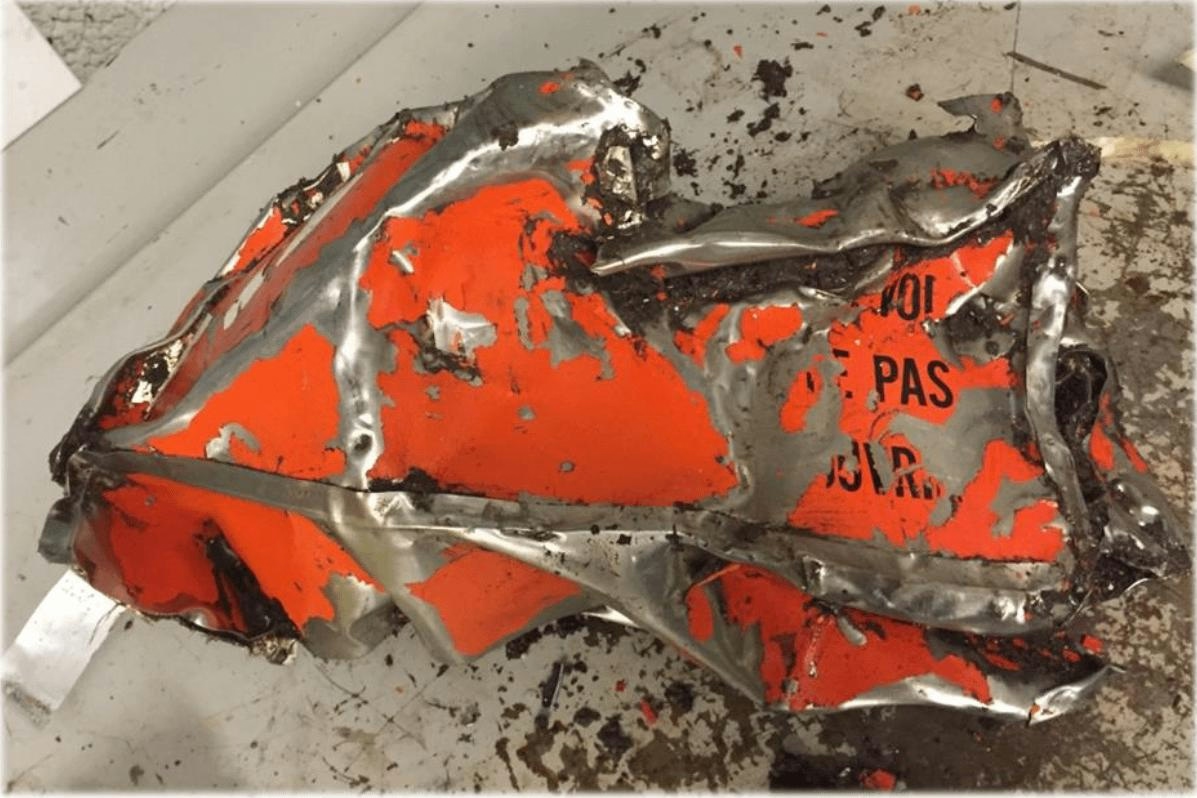
NTSB Reveals AI-Fabricated Cockpit Voice Recordings in UPS Crash Probe
The National Transportation Safety Board (NTSB) has uncovered that cockpit voice recordings related to the 2025 crash of UPS Flight 2976 in Louisville, Kentucky, were artificially fabricated using advanced AI technology. The agency disclosed on Thursday that certain individuals employed artificial intelligence to reconstruct approximations of cockpit audio from sound spectrum imagery that had been publicly released as part of the investigation’s documentation. This discovery has sparked serious concerns regarding privacy violations and the potential misuse of sensitive investigative data.
Privacy and Legal Protections Surrounding Cockpit Recordings
The NTSB traditionally releases only transcripts of cockpit voice recorder (CVR) conversations, refraining from making the actual audio publicly available due to the highly sensitive nature of cockpit communications. Federal law explicitly prohibits the public dissemination of cockpit audio recordings to protect the privacy of crew members and the integrity of investigations. In an official statement, the NTSB reaffirmed its commitment to these protections, emphasizing that it “does not release cockpit audio recordings” and takes privacy restrictions “seriously.”
In light of the AI-generated fabrications, the NTSB has taken the rare measure of temporarily suspending public access to its docket system. This pause allows the agency to assess the full extent of the issue and to develop appropriate safeguards before restoring access. The NTSB has expressed its intention to reinstate public availability as soon as it can ensure the integrity and security of its investigative materials.
Ongoing Investigation into the UPS Flight 2976 Crash
The incident under scrutiny involves the November 4 crash of a UPS MD-11 aircraft, which resulted in the deaths of all three crew members and 12 individuals on the ground. During a recent two-day hearing, the NTSB released video footage showing the left engine detaching from the wing during takeoff, triggering a catastrophic fire. The CVR transcript detailed the crew’s unsuccessful efforts to regain altitude before the aircraft crashed into an industrial area beyond the runway.
Testimony during the hearing included contributions from Boeing, the manufacturer of the MD-11, focusing on the spherical bearing and lugs that secure the engine mounts. The investigation revealed that both Boeing and UPS had been aware of cracks and bearing migration issues dating back to 2008 and 2011. Furthermore, the inquiry highlighted that prior reporting and analysis errors may have obscured the risk of engine failure, underscoring the necessity for more stringent safety evaluations.
The NTSB’s final report on the probable cause of the crash is anticipated in the coming months. Meanwhile, the agency’s response to the AI fabrication incident underscores growing apprehension about how emerging technologies such as artificial intelligence can be exploited to manipulate or counterfeit sensitive investigative materials, thereby challenging established privacy protections and the credibility of accident investigations.

Etihad Airways Suspends Airbus A380 Flights on Key Route

Aditya Birla Group Seeks Approval for Aircraft Leasing in GIFT City

Qatar Airways Highlights Innovation and Connectivity at Arabian Travel Market 2026

Hong Kong's Five-Year Plan Includes Andrew Fan's Aircraft Parts Processing Hub Proposal

ACIA Aero Leasing Delivers ATR72-600 to Air Nostrum

RTX Appoints Jill Albertelli as Head of Pratt & Whitney

TAT Technologies Joins Beyond Aero Hydrogen Aircraft Program

AURAK Study Highlights Barriers to Air Taxi Adoption in Emerging Economies

Xiamen Air Selects Altitude for 787 Maintenance at Heathrow

Etihad and Swissport Extend Global Partnership
